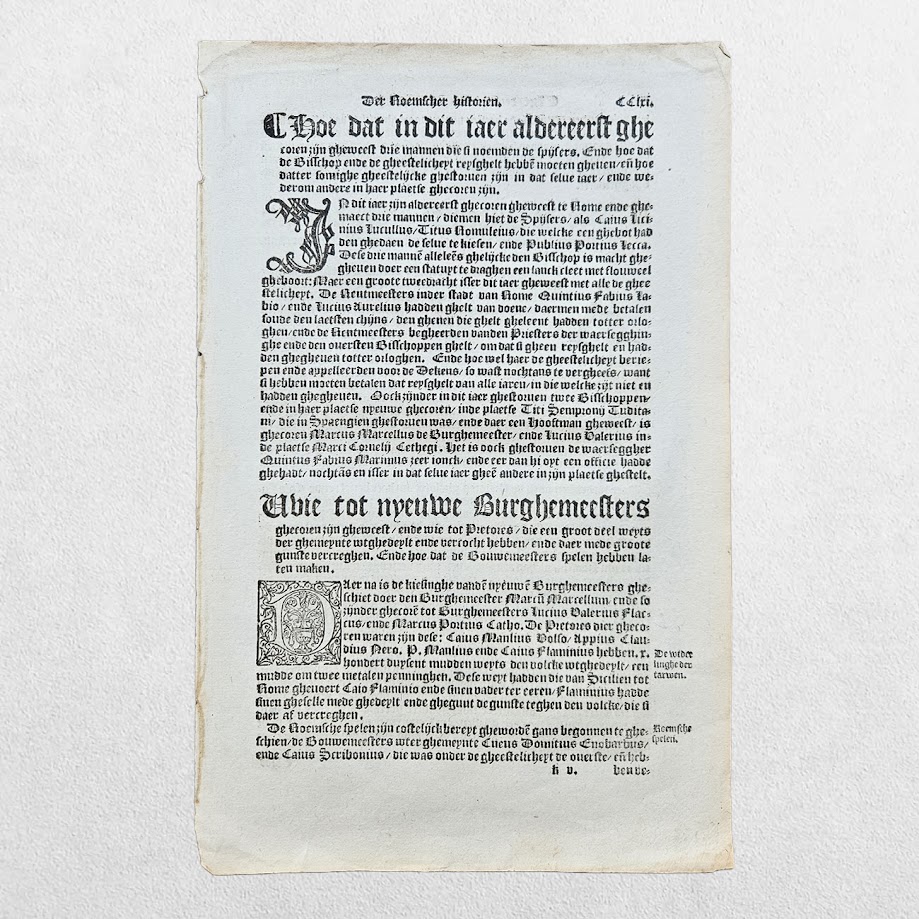
TITUS LIVY – FIRST DUTCH EDITION OF THE HISTORY OF ROME – ORIGINAL RENAISSANCE PRINTED LEAF – ANTWERP – JOANNES GRAPHEUS FOR JAN GYMNICK – 1541
An original Renaissance printed leaf from the first Dutch translation of Titus Livy’s great history of Rome, Titus Liuius, dat is, de Roemsche historie oft Gesten, printed at Antwerp in 1541 by Joannes Grapheus for the publisher Jan Gymnick. Modern scholarship identifies the edition precisely as Titus Liuius, Dat is, de Roemsche historie oft Gesten, Antwerp: Joannes Grapheus for Jan Gymnick, 1541, while the edition itself proclaimed that Livy was being printed “nu eerstmael in onser Nederlantscher spraken” — “now for the first time in our Netherlandish language”.
The present leaf comes from Book III of the Dutch Roemsche historie and is headed on one side “Het derde boeck Titi Livii”. The text concerns Roman political and military affairs and names a succession of important figures from the history of the Republic, including Lucius Valerius Flaccus, Marcus Porcius Cato, Gaius Flaminius, Appius Claudius, Publius Manlius and others, together with references to Spain, Macedonia, Sicily and the movements of Roman troops and magistrates. The opposite side is headed “Der Roemscher historien” and contains further sections concerning civic and military appointments, including the election or replacement of Roman magistrates and burgomasters in the vocabulary of the Dutch translation. The use of familiar Netherlandish civic terminology to render Roman Republican offices is itself an illuminating example of the way classical political history was made intelligible to a sixteenth-century vernacular readership.
The significance of the 1541 edition extends well beyond its status as a translation of one of antiquity’s greatest historians. Jan Gymnick deliberately presented the publication as an argument for the intellectual capacity of the Dutch language. In his prefatory remarks he objected to Dutch being regarded as poor, unadorned or inadequate and argued that, just as Latin had been brought to refinement through sustained cultivation, Dutch could likewise attain greater perfection through practice, translation and learned use. He specifically argued that valuable knowledge should not remain inaccessible to those unable to read Latin and expressed the hope that the knowledge of ancient histories would begin to flourish in the mother tongue and that Dutch itself would thereby become more widely practised and esteemed.
The book therefore occupies an important position in the history of vernacular humanism in the Low Countries. Scholarship on early-modern Dutch multilingualism identifies Gymnick’s Livy as a significant moment in the promotion of Dutch as a language capable of carrying serious historical, political and scholarly prose. Brill’s study of sixteenth-century printing houses similarly notes Gymnick’s publication of a Dutch translation of Livy in 1541 as part of the development of vernacular print culture.
The translation itself appears to have been anonymous, and scholarship indicates that it was mediated through or closely dependent upon contemporary German Livy editions rather than being an entirely independent translation directly from the Latin. A modern Leiden University study of the 1541 volume has demonstrated that the edition’s illustrations were closely copied from German Livy editions published by the Schöffer printing family at Mainz. The same research identifies 52 different woodcut designs, many repeatedly used throughout the book. Although the present leaf is typographical rather than illustrated, it belongs to this ambitious, extensively illustrated vernacular production.
The typography is characteristically early Netherlandish, printed in a dense Gothic type with substantial display headings and ornamental initials. Particularly attractive are the large initial A and the elaborate foliated initial on the opposite side, which lend considerable graphic presence despite the absence of a narrative woodcut on this particular leaf. The generous margins and strong dark impression preserve the physical character of a substantial Antwerp folio produced during one of the most fertile periods of Renaissance printing in the Low Countries.
An original surviving leaf from a bibliographically and culturally important publication: the first appearance of Livy’s Roman history in printed Dutch, and a work intimately connected with the sixteenth-century campaign to demonstrate that the vernacular language of the Low Countries could serve as a vehicle for classical learning, history and sophisticated prose.
Condition
Very good condition overall for an original leaf dating from 1541. The paper remains sound and the Gothic letterpress is strongly and clearly printed on both sides. There is expected light age-toning, occasional minor spotting and marking, gentle handling wear and some marginal creasing and edge irregularity, particularly at the corners and along the former binding edge. A few small marginal nicks and areas of light staining are present but do not materially affect the printed text. The generous margins survive well and the main text block is complete and notably clean. Please examine all photographs carefully, as they form an important part of the condition description.
Author: Titus Livius – Livy (59 BC–AD 17).
Title: Titus Liuius, dat is, de Roemsche historie oft Gesten.
Text: Book III, concerning Roman Republican political and military history.
Printer: Joannes Grapheus.
Publisher: Jan Gymnick.
Place: Antwerp.
Date: 1541
Edition: First Dutch edition / first printed Dutch translation of Livy’s history of Rome.
Format: Original single folio leaf.
Sheet Size: 19.9 × 31 cm.
Language: Early Dutch / Netherlandish vernacular.
Printing: Letterpress in Gothic type with ornamental and display initials.
Historical Importance
An original leaf from a landmark of sixteenth-century Dutch vernacular humanism. Jan Gymnick explicitly used this edition to argue that Dutch could and should become a language of serious learning, translation and historical writing, making the publication significant both in the reception of classical literature and in the development and cultural prestige of written Dutch.
Authentication
Handled, inspected and researched in-house. An original sixteenth-century printed leaf from the 1541 Antwerp edition, not a later reproduction.
Why buy from us?
At Hornseys, we are committed to offering items that meet the highest standards of quality and authenticity. Our book collection is meticulously curated to ensure that each edition is a valuable and authentic piece of bibliographical history. Here’s what sets us apart:
- Authenticity and Provenance: Every book is researched, collated, and verified for authenticity.
- Expert Curation: Each book is selected with a keen eye for significance, condition, and rarity, ensuring a collection that is both diverse and distinguished.
- Customer Satisfaction: We strive to provide an exceptional customer experience, from detailed descriptions and provenance to secure and prompt delivery of your purchase.
- Returns Policy: We offer an unconditional guarantee on every item. If you wish to make a return, books may be sent back to us within fourteen days of receipt for any reason. We request advance notification of returns, and books must be returned in the same condition as sent for a full refund.
Explore Our Collection:
Visit Hornseys to explore our fine collection of rare and signed books. Whether you are an avid collector or looking for a special gift, our selection offers something truly unique. Located in the picturesque Yorkshire Dales, our Ripon gallery has been a haven for book lovers, art enthusiasts, and collectors since 1976.