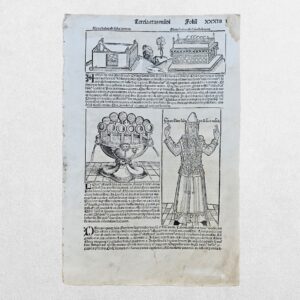
William Harrison – The Description of Britaine – Ports, Creeks and the Air & Soil of England – Original Leaf from Holinshed’s Chronicles – London, 1587
Description
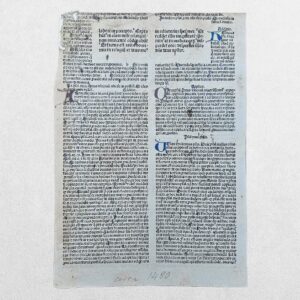
An original Elizabethan leaf from the second and definitive 1587 edition of Raphael Holinshed’s Chronicles of England, Scotland, and Ireland, comprising pages 107–108 from William Harrison’s The Description of Britaine. Printed in London by Henry Denham in 1587, the leaf measures approximately 23.2 x 35 cm and survives from the edition now particularly celebrated as the Holinshed used by William Shakespeare. The 1587 edition is bibliographically recorded as STC 13569.
The identification is exact. Both sides carry the running heading:
“The description of Britaine.”
Page 108 contains two particularly interesting chapters:
“Of such ports and creekes as our sea-faring men doe note for their benefit upon the coasts of England. Chap. 17.”
and:
“Of the aire, soile, and commodities of this Iland. Cap. 18.”
The chapter numbering and text correspond precisely to the revised 1587 version of Harrison’s Description. The 1587 edition lists these respectively as chapters 17 and 18, whereas the corresponding material occupied different positions in the first edition of 1577.
Ports and Creeks of Elizabethan England
The most striking feature of page 108 is Harrison’s remarkably detailed catalogue of English coastal ports, havens, creeks and landing places.
The list proceeds county by county around the coast, with marginal headings including:
Northumberland
Durham
Yorkshire
Lincolnshire
Norfolk
Suffolk
Essex
and numerous individual ports and coastal places set within the text.
This is essentially a late-sixteenth-century verbal coastal survey of England: a printed inventory of the places which contemporary mariners recognised as useful harbours, anchorages and creeks.
The Yorkshire section is particularly extensive, listing coastal places associated with the north-east coast. Harrison’s list has subsequently been used by historians studying vanished or altered coastal settlements; later antiquarian scholarship, for example, specifically quotes his list of ports and creeks when discussing places such as Hornsea Beck and the lost towns of the Yorkshire coast.
For a modern collector, the chapter is therefore much more than a geographical curiosity. It is primary-source evidence for the maritime landscape of Elizabethan England, recording coastal geography before centuries of harbour development, erosion, silting and urban change.
“Of the Aire, Soile, and Commodities of this Iland”
The second half of page 108 begins:
“Of the aire, soile, and commodities of this Iland. Cap. 18.”
Harrison opens by considering the reputation of the British climate. He acknowledges the common belief that Britain’s air is cloudier and less pleasant than that of continental Europe, but argues from experience that it is nevertheless pure, wholesome and temperate.
He invokes Julius Caesar and classical authority in discussing the comparative climate of Britain and Gaul, and even refers to Plutarch’s association of Britain with the Elysian Fields. The surviving modern transcription of Harrison’s text confirms this material and identifies it explicitly as Book I, chapter 18 in the 1587 edition.
The chapter is an excellent example of Harrison’s method: geography, personal observation, classical authority and national pride are combined to produce an extraordinarily detailed portrait of Elizabethan Britain.
Page 107
The reverse, page 107, completes the preceding geographical discussion before moving into the account of the coastline.
Among the most significant features are Harrison’s references to coastal divisions and individual places, together with marginal place-names such as Kent, Sussex, Hampshire and Dorset.
The text also demonstrates Harrison’s use of contemporary cartographic information. Modern scholarship has specifically noted that in the 1587 revision Harrison acknowledged the usefulness of Christopher Saxton’s maps, something not present in the same way in the 1577 version. A scholarly study of Harrison cites page 107 of the 1587 edition in discussing this dependence upon Saxton.
This is therefore a particularly good leaf for anyone interested in the relationship between Elizabethan chorography, printed maps and the emergence of a more systematic geographical description of England.
William Harrison and The Description of Britaine
Although generally encountered as part of “Holinshed’s Chronicles”, this particular section was principally the work of William Harrison (1534–1593).
Harrison’s Description of Britaine formed the geographical and social introduction to the Chronicles. It was first published in 1577 and extensively revised for the second edition of 1587.
His project was extraordinarily ambitious. He sought to describe not merely the physical outline of Britain but its rivers, roads, languages, inhabitants, climate, agriculture, settlements, resources and social life.
Modern scholarship emphasises that Harrison made extensive use of the manuscript remains of John Leland, while also drawing upon contemporary cartography and a wide range of correspondents and printed sources. The 1587 revision substantially expanded his material.
Holinshed and Shakespeare
The significance of the 1587 edition goes well beyond antiquarian history.
Christie’s describes it as the “true Shakespearean edition”, following the scholarship of W. G. Boswell-Stone and H. R. D. Anders, and records it as the edition on which Shakespeare drew for Richard II, Richard III, the Henry IV plays, Henry V, the Henry VI trilogy, Henry VIII, Macbeth and Cymbeline, with possible use for King Lear and King John.
The Royal Collection likewise states that the second edition of 1587 was used extensively by Shakespeare, including for Macbeth.
It is important not to overstate the connection of this specific leaf: these pages themselves are not among the narrative passages known to have been directly adapted into one of Shakespeare’s plays. Their significance lies in belonging to the exact edition of the monumental work Shakespeare used, and in representing the geographical framework within which the historical narratives were presented.
The 1587 Edition
The second edition was printed in London by Henry Denham, in Aldersgate Street at the sign of the Star, at the expense of John Harrison, George Bishop, Rafe Newbery, Henry Denham and Thomas Woodcocke. The National Library of Ireland records the publication as completed in January 1587, in the twenty-ninth year of Elizabeth I.
The edition is recorded as:
STC 13569.
It was a monumental production and became politically controversial almost immediately. Certain passages concerning contemporary Anglo-Scottish affairs, the Babington Plot and events in the Low Countries were ordered suppressed by the Privy Council. Surviving complete copies consequently vary according to which cancelled or replacement leaves they contain.
The present leaf, from Harrison’s geographical Description, is not one of the notorious censored sheets.
Condition
Good to very good condition overall for an original Elizabethan folio leaf of 1587.
The paper is generally clean and remarkably fresh for its age, with light overall toning, scattered minor spotting and occasional surface marks. There is some marginal wear and slight irregularity, particularly along the outer edge, together with a few very small marks and pinholes.
There is faint show-through from the opposing printed side, entirely normal for the paper.
The principal text remains complete, dark and highly legible, including the chapter headings, marginal county names and ornamental initials.
The leaf retains generous margins and displays particularly well.
Please study the photographs carefully as they form an integral part of the condition description.
Author of this Section
William Harrison (1534–1593)
General Compiler
Raphael Holinshed (d. c.1580)
Work: The First and Second Volumes of Chronicles — commonly Holinshed’s Chronicles
Section: The Description of Britaine
Edition: Second Edition — the Shakespearean edition
Pages: 107–108
Chapters Represented
Chapter 17: Of such ports and creekes as our sea-faring men doe note for their benefit upon the coasts of England
Chapter 18: Of the aire, soile, and commodities of this Iland
Printer: Henry Denham
Place: London
Date: 1587
Bibliographical Reference: STC 13569.
Size: Approximately 23.2 x 35 cm
Language: English.
Printing: Original Elizabethan letterpress in double columns, with ornamental woodcut initials and marginal geographical headings.
Subject
Elizabethan England; English ports; maritime history; Yorkshire coast; British geography; climate; agriculture; Christopher Saxton; William Harrison; Raphael Holinshed; Shakespeare; sixteenth-century printing.
Authentication & Research
This leaf has been handled, inspected and catalogued in-house at our Ripon gallery. Its pagination, running title, chapter headings and textual sequence have been compared against the 1587 text of Harrison’s Description of Britaine. Independent bibliographical records identify the second edition as London, Henry Denham, 1587, STC 13569, while scholarly sources confirm the chapter numbering and the importance of the 1587 revision.
Why buy from us?
At Hornseys, we are committed to offering items that meet the highest standards of quality and authenticity. Our book collection is meticulously curated to ensure that each edition is a valuable and authentic piece of bibliographical history. Here’s what sets us apart:
- Authenticity and Provenance: Every book is researched, collated, and verified for authenticity.
- Expert Curation: Each book is selected with a keen eye for significance, condition, and rarity, ensuring a collection that is both diverse and distinguished.
- Customer Satisfaction: We strive to provide an exceptional customer experience, from detailed descriptions and provenance to secure and prompt delivery of your purchase.
- Returns Policy: We offer an unconditional guarantee on every item. If you wish to make a return, books may be sent back to us within fourteen days of receipt for any reason. We request advance notification of returns, and books must be returned in the same condition as sent for a full refund.
Explore Our Collection:
Visit Hornseys to explore our fine collection of rare and signed books. Whether you are an avid collector or looking for a special gift, our selection offers something truly unique. Located in the picturesque Yorkshire Dales, our Ripon gallery has been a haven for book lovers, art enthusiasts, and collectors since 1976.