

Vilmorin-Andrieux & Cie
£55.00
Availability: In stock
Publisher: Siegfried Brumme
Date: 1986
Sheet Size: 48.8cm x 63.6cm with good margins
Format: Offset lithograph after the original 19th century print
Edition: First edition thus
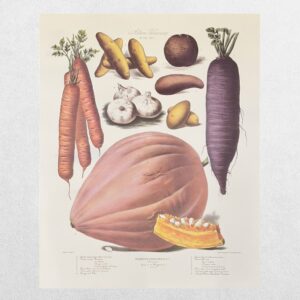
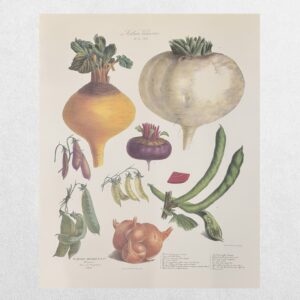
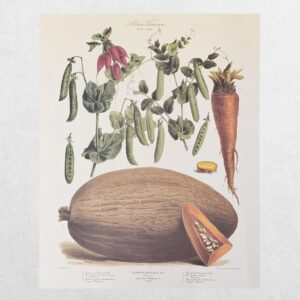
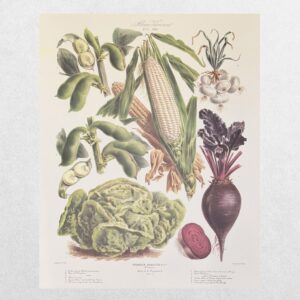
Sheet size: 48.8cm x 63.6cm with good margins. This fine print is one from a series of 35 after the original 19th century original lithographs.
Overview
Vilmorin-Andrieux & Cie occupies a singular position in the history of European agriculture and botany. Established in the eighteenth century and sustained across multiple generations of the same family, the firm evolved from a Parisian seed merchant into one of the world’s most influential seed and plant-breeding enterprises. Its history intertwines commercial innovation, scientific plant breeding, and public service to agriculture, making it a foundational actor in the modern seed industry.
Origins in Enlightenment France (1743–1770s)
The origins of the firm date to 1743, when Claude Geoffroy, an apothecary-botanist in Paris, began commercialising seeds selected for reliability and purity. At a time when seed quality was inconsistent and poorly standardised, Geoffroy’s emphasis on selection and botanical knowledge marked an early shift from simple seed trading to informed seed improvement.
The business passed through marriage to Philippe‑Victoire Lévêque de Vilmorin, who joined the enterprise in the mid‑eighteenth century. Under his stewardship, the firm adopted the Vilmorin name and began to systematise seed production, cataloguing varieties and emphasising traceability—an approach that prefigured modern seed certification.
Expansion and Scientific Orientation (late 18th–early 19th century)
By the end of the eighteenth century, Vilmorin had become one of the most respected seed houses in France. The firm supplied market gardeners, estates, and experimental farms, while maintaining close relationships with botanists and agricultural reformers.
A decisive development came with the establishment of experimental gardens, notably at Verrières‑le‑Buisson near Paris. These gardens were not merely commercial trial grounds but centres of observation, selection, and comparative experimentation. They allowed the firm to stabilise varieties and improve yield, uniformity, and resilience—core principles of plant breeding long before genetics was formally articulated.
The Andrieux Partnership and Nineteenth‑Century Consolidation
The addition of the Andrieux name reflects family alliances that strengthened both capital and expertise, giving rise to the formal style “Vilmorin‑Andrieux & Cie”. Throughout the nineteenth century, successive generations of the Vilmorin family combined commercial leadership with scientific engagement.
Louis de Vilmorin (1816–1860) was particularly influential. His articulation of the principle of selection based on individual plant performance—rather than population averages—represented a conceptual breakthrough in plant breeding. His work on sugar beet demonstrated that systematic selection could dramatically increase sugar content, directly influencing the viability of the European beet sugar industry.
This period established Vilmorin‑Andrieux & Cie as both a commercial house and an intellectual authority. Members of the family were active in learned societies, agricultural journals, and advisory bodies, reinforcing the firm’s credibility and influence.
Publishing and the Dissemination of Knowledge
A distinctive feature of the company was its commitment to publication. Vilmorin‑Andrieux catalogues were renowned not only as sales instruments but as botanical references, often richly illustrated and carefully described. These works circulated widely across Europe and beyond, shaping horticultural practice and varietal nomenclature.
The firm also contributed to agricultural education by sharing experimental results and varietal descriptions, reflecting a philosophy that commercial success was inseparable from the advancement of agricultural knowledge.
Industrialisation and Global Reach (late 19th–early 20th century)
As agriculture industrialised, Vilmorin‑Andrieux adapted by scaling seed production and expanding internationally. The company developed distribution networks across Europe, the Americas, and parts of Asia, supplying both subsistence crops and specialised horticultural varieties.
The firm increasingly focused on field crops—cereals, sugar beet, and oilseeds—while maintaining its historic strength in vegetable and ornamental seeds. Its breeding programmes emphasised yield stability, disease resistance, and adaptation to regional conditions, reinforcing its reputation among professional growers.
Twentieth‑Century Transformation
The twentieth century brought profound change. Advances in genetics, plant pathology, and agronomy transformed breeding from an empirical art into a data‑driven science. Vilmorin‑Andrieux invested heavily in research infrastructure, professional scientists, and experimental stations.
World wars disrupted operations but also underscored the strategic importance of reliable seed supply. In the post‑war period, the firm participated in national and international efforts to modernise agriculture, contributing to food security and productivity gains across Europe.
Corporate restructuring gradually separated publishing, retail seed activities, and industrial breeding. Vilmorin‑Andrieux became increasingly aligned with large‑scale agricultural seed production, setting the stage for later integration into multinational structures.
Integration into the Modern Vilmorin Group
In the later twentieth century, Vilmorin‑Andrieux & Cie evolved into what is now known as Vilmorin & Cie, a core entity within the Limagrain cooperative group. While the historic name is less prominent in contemporary branding, the intellectual and institutional legacy of Vilmorin‑Andrieux remains central to the organisation’s identity.
Today’s activities—focused on vegetable seeds and high‑value field crops—are direct descendants of the firm’s historic emphasis on scientific breeding, long‑term experimentation, and close engagement with growers.
Legacy and Significance
Vilmorin‑Andrieux & Cie’s enduring significance lies in its role as a bridge between Enlightenment botany and modern agricultural science. The firm helped establish:
Few agricultural enterprises can claim such continuity of purpose across nearly three centuries. Vilmorin‑Andrieux & Cie stands as a foundational institution in the history of plant breeding, whose influence persists in contemporary global agriculture.
Conclusion
From a Parisian seed shop to a cornerstone of international seed science, Vilmorin‑Andrieux & Cie exemplifies the long‑term interplay of commerce, science, and public agricultural service. Its history is not merely that of a company, but of the emergence of modern plant breeding as a disciplined, evidence‑based practice.
At Hornseys, we are committed to offering items that meet the highest standards of quality and authenticity. Our collection of fine prints is meticulously curated to ensure that each piece is both a valuable and authentic addition to your collection. Here’s what sets us apart:
Explore Our Collection:
Visit Hornseys to explore our exceptional collection of illustrations by Vilmorin-Andrieux & Cie. Located in the picturesque Yorkshire Dales, our Ripon gallery has been a haven for art lovers and collectors since 1976.




| Cookie | Duration | Description |
|---|---|---|
| cookielawinfo-checkbox-analytics | 11 months | This cookie is set by GDPR Cookie Consent plugin. The cookie is used to store the user consent for the cookies in the category "Analytics". |
| cookielawinfo-checkbox-functional | 11 months | The cookie is set by GDPR cookie consent to record the user consent for the cookies in the category "Functional". |
| cookielawinfo-checkbox-necessary | 11 months | This cookie is set by GDPR Cookie Consent plugin. The cookies is used to store the user consent for the cookies in the category "Necessary". |
| cookielawinfo-checkbox-others | 11 months | This cookie is set by GDPR Cookie Consent plugin. The cookie is used to store the user consent for the cookies in the category "Other. |
| cookielawinfo-checkbox-performance | 11 months | This cookie is set by GDPR Cookie Consent plugin. The cookie is used to store the user consent for the cookies in the category "Performance". |
| viewed_cookie_policy | 11 months | The cookie is set by the GDPR Cookie Consent plugin and is used to store whether or not user has consented to the use of cookies. It does not store any personal data. |