
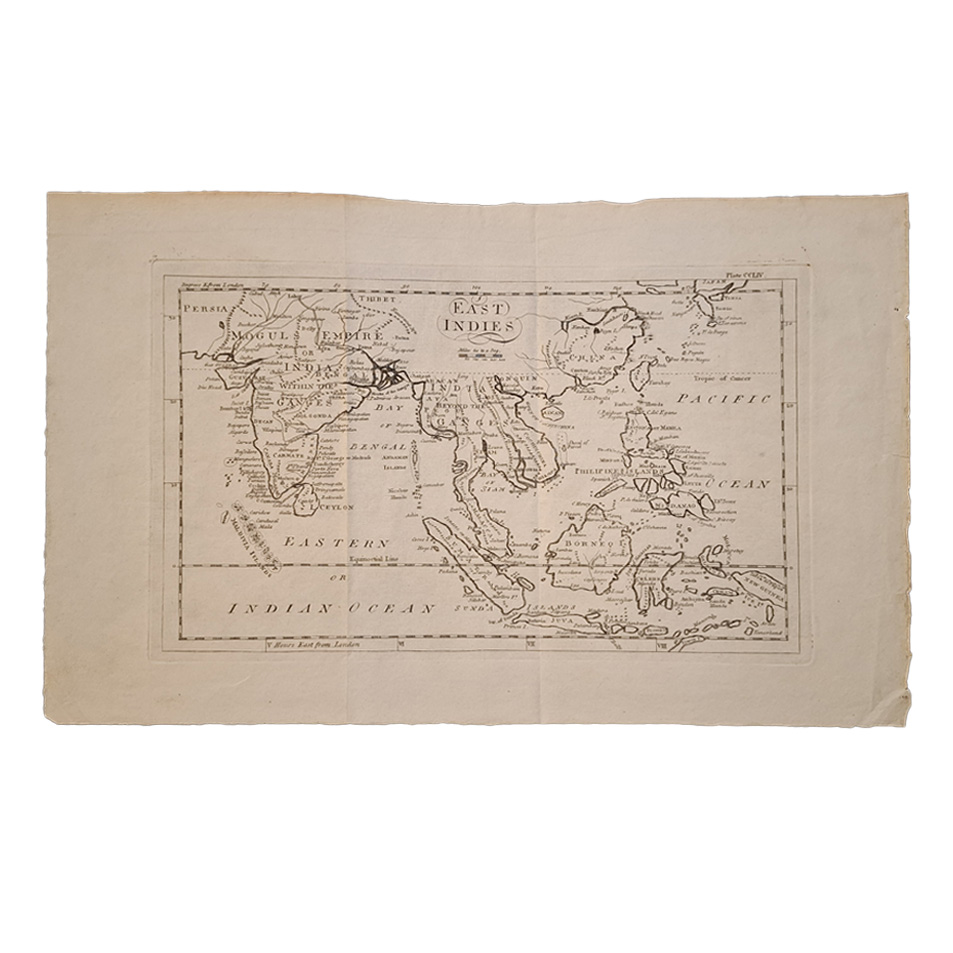
EAST INDIES – PLATE CCLIV
Not stated
£30.00
Availability: In stock
Product Description
EAST INDIES – PLATE CCLIV
Engraver: Not stated
Publisher: Not stated
Price: £30
Publication Date: c.1780
Edition: Not stated
Format: Original copper engraving
Condition: In very good condition, unframed
Sheet Size: 37.8cm x 23.7cm
Condition:
Not dated but c. 1780. Original fold lines. Very minor age toning. In very good condition overall.
Location: Map Drawer C: FS: Folder M2000 002553
The East Indies in 1780: A Short Historical Overview
The East Indies in 1780 was a region of immense geopolitical, economic, and cultural significance, encompassing the Indian subcontinent, Southeast Asia, and the islands of the Malay Archipelago. This period was marked by colonial competition, trade dominance, and significant local resistance.
Colonial Powers and Trade
- The British East India Company (EIC):
- The British were rapidly expanding their influence in India, having established key footholds in Bengal, Bombay (Mumbai), and Madras (Chennai).
- The EIC was a dominant trading and administrative entity, heavily involved in the lucrative spice trade, textiles, and opium production.
- By 1780, the EIC was consolidating its control after the Battle of Plassey (1757) and the Treaty of Allahabad (1765), which granted the company revenue collection rights in Bengal, Bihar, and Orissa.
- The Dutch East India Company (VOC):
- The VOC maintained control over much of the Indonesian archipelago, including Java, Sumatra, and the Moluccas (Spice Islands).
- The Dutch were focused on maintaining their monopoly over the spice trade, particularly nutmeg, cloves, and mace.
- Batavia (modern Jakarta) served as the VOC’s administrative centre.
- The French and Portuguese:
- The French East India Company had a presence in Pondicherry and other parts of India, competing with the British.
- The Portuguese, while no longer a dominant force, retained control over Goa, Macau, and East Timor.
- Local Kingdoms and Empires:
- Despite colonial encroachments, powerful local states like Mysore under Tipu Sultan, the Marathas, and the Mughal remnants in India, as well as the Sultanate of Johor and other kingdoms in Southeast Asia, remained influential.
- These states often resisted European colonisation and engaged in complex alliances and conflicts.
The Anglo-French Rivalry
- The Anglo-French rivalry was particularly intense in the East Indies during the late 18th century, as part of their global contest for dominance.
- The American Revolutionary War (1775–1783) had repercussions in the East Indies, as the French and British clashed in the region.
- In 1780, the Second Anglo-Mysore War began, with Tipu Sultan and his father Haider Ali allied with the French against the British.
Trade and Commerce
- The East Indies were a hub of the global spice trade, which had been central to European exploration and colonization since the 16th century.
- Other key commodities included textiles, tea, coffee, opium, and porcelain.
- The region’s role in triangular trade systems linked the East Indies to Europe, China, and the Americas.
Cultural and Social Context
- Cultural Exchange:
- The presence of multiple colonial powers and vibrant local cultures led to a rich exchange of ideas, technologies, and traditions.
- Missionary activities by Christians, particularly Jesuits, sought to convert local populations, often with limited success.
- Indigenous Resistance:
- Local leaders and populations resisted European dominance in various ways, from open warfare to subversive economic and cultural strategies.
- In Java and India, anti-colonial sentiments often blended with regional power struggles.
Significance
The East Indies in 1780 represented a critical juncture in the age of empire. While European powers expanded their footholds, indigenous polities and resistance movements demonstrated the complexities and challenges of colonial rule. The region’s strategic and economic importance would continue to shape global history for centuries to come.
SHOP WITH CONFIDENCE AT HORNSEYS
At Hornseys, we are dedicated to offering items that uphold the highest standards of quality and authenticity. Our collection of artwork is carefully curated to ensure that each item we offer is authentic, collated, and complete.
Here’s what sets us apart:
- Authenticity and Provenance: Each map is researched and verified for authenticity.
- Expert Curation: We wholly own all our artworks. We trust our taste and have invested heavily in it. We have confidence in all artwork that we offer for sale.
- Customer Satisfaction: We strive to provide an exceptional customer experience, from detailed descriptions and provenance to secure and prompt delivery of your purchase.
- Returns Policy: We offer an unconditional guarantee on every item. If, however, you wish to make a return, artworks may be sent back to us within fourteen days of receipt for whatever reason. We request that we are notified in advance if you wish to do so. They must be returned to us in the same condition as they were sent for a full refund.
OUR COMMITMENT TO QUALITY AND SERVICE
Understanding the value and rarity of these items, we ensure that every aspect of your purchase meets the highest standards of quality and service. This includes:
- Free Expedited, Tracked, and Insured Delivery within the UK: Ensuring that your artwork arrives safely and promptly.
- Fully-Insured Worldwide Delivery: Offering peace of mind for international collectors with reliable and secure shipping options.
EXPLORE OUR COLLECTION
Visit Hornseys today to explore our fine collection of maps and other artworks. Whether you are an avid collector or looking for a special gift, our selection offers something truly unique. Located since 1976 in Ripon in the picturesque Yorkshire Dales, we are recognised as a destination gallery for tastefully curated artwork, rare maps, design, and fine books.
Related products

(China And Korea) L’Empire De La Chine Pour Servir A L’Histoire Generale Des Voyages
£295.00Bellin, Jacques Nicolas


