
The Mysterious Affair At Styles – First Cheap Edition
Christie, Agatha
£345.00
Out of stock
Product Description
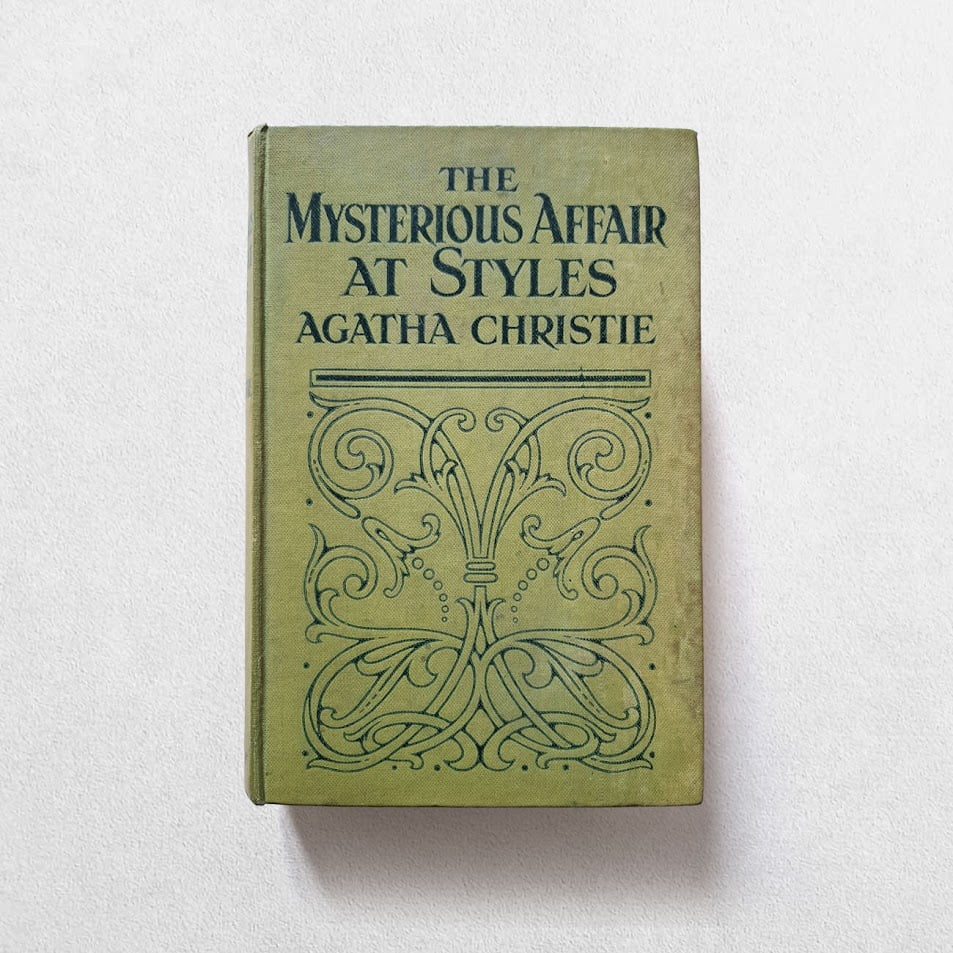
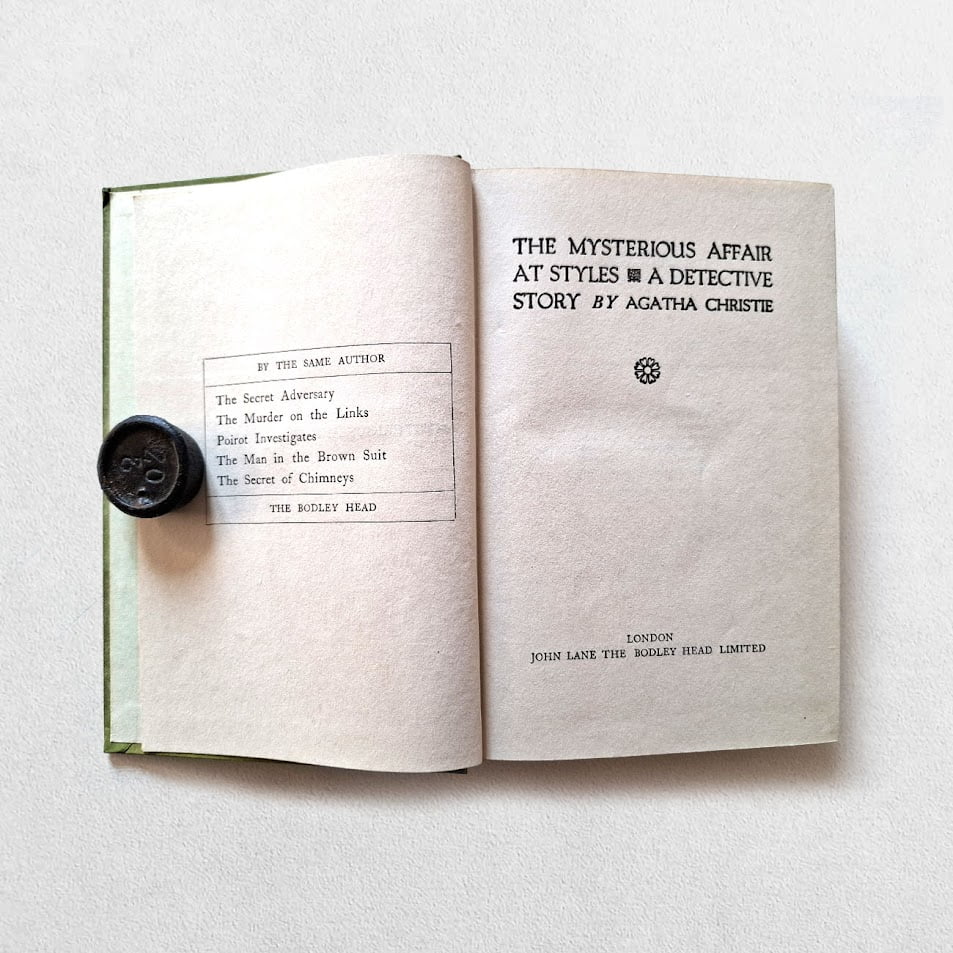
The Mysterious Affair At Styles – First Cheap Edition
Author: Agatha Christie
Price: £345
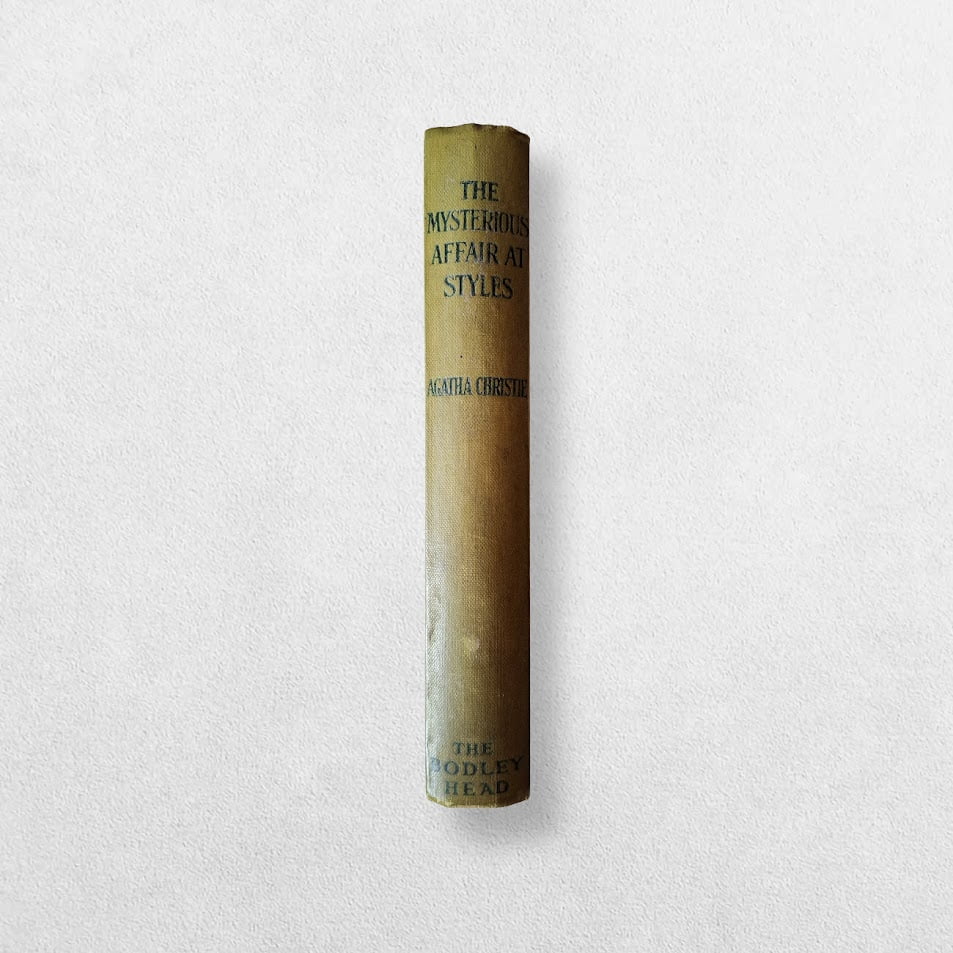
Publisher: The Bodley Head, UK
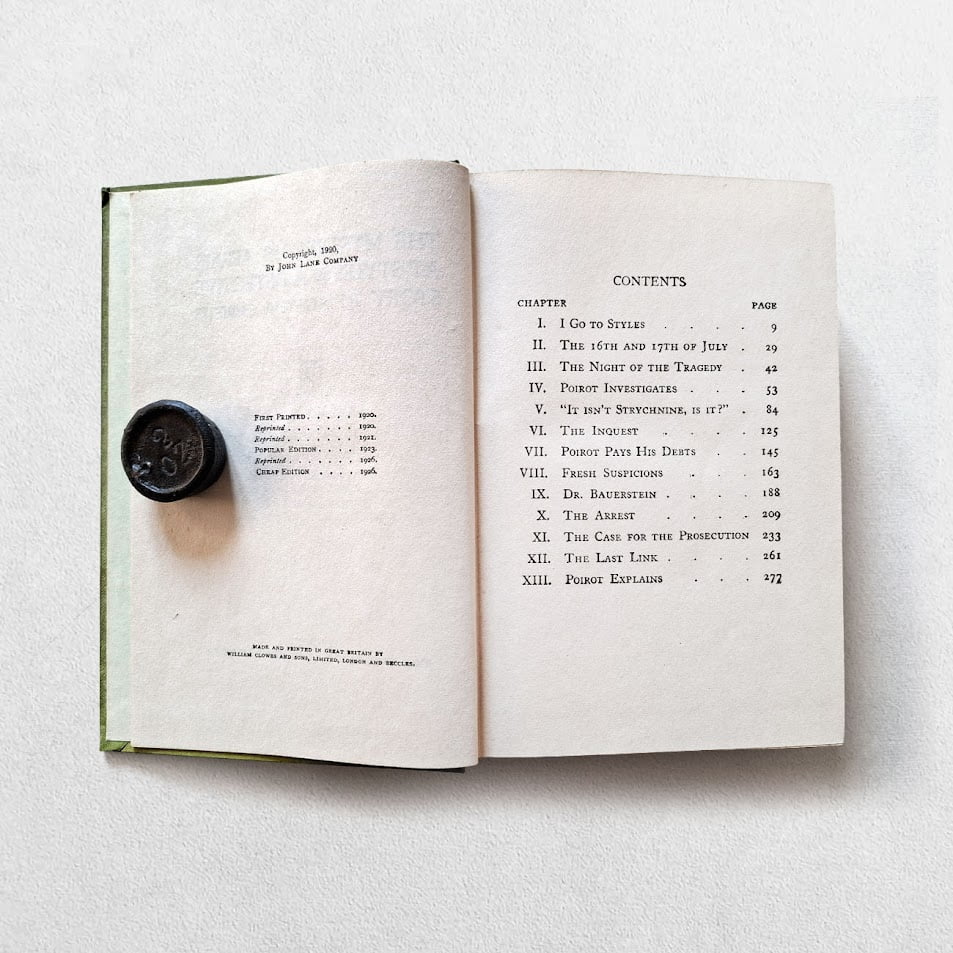
Edition: 1st cheap edition
Publication Date: 1926
Format: Original cloth
Condition: Very good
Pages: 296
Description:
Binding nice and tight with very slight rubbing to the edges. Light marks to the boards but generally nice and clean. Pages very nice and clean. A very good copy. Scarce.
The Plot
The Mysterious Affair at Styles (1920) is the debut novel of Agatha Christie, marking the first appearance of her famous detective, Hercule Poirot. The book is a classic example of a detective novel from the Golden Age of Mystery, introducing many of the conventions that would come to define Christie’s work.
Plot Summary:
The novel is set during World War I in the small village of Styles St. Mary, where the wealthy Emily Inglethorp is found poisoned in her bedroom at Styles Court, her country estate. Her death appears mysterious and the cause seems to be strychnine poisoning.
The story is narrated by Captain Arthur Hastings, a friend of Poirot who happens to be staying at Styles Court at the time of the murder. Hastings, an amiable and somewhat naive figure, seeks the help of his friend, Hercule Poirot, a brilliant Belgian detective and refugee living nearby. Poirot takes on the case, using his methodical approach and famous “little grey cells” to investigate the complex relationships and hidden motives of those in the household.
Key Characters:
- Hercule Poirot: The brilliant Belgian detective making his first appearance. His use of logical deduction and attention to detail become trademarks of his character.
- Captain Arthur Hastings: The novel’s narrator, who acts as Poirot’s companion and serves a similar role to Dr. Watson in the Sherlock Holmes stories.
- Emily Inglethorp: The wealthy victim, who had recently remarried a much younger man, Alfred Inglethorp.
- Alfred Inglethorp: Emily’s husband and a prime suspect in the murder due to his suspicious behaviour and financial interest in her death.
- John Cavendish: Emily’s stepson, who also has motives related to the inheritance of Styles Court.
- Mary Cavendish: John’s wife, who is caught up in the drama of the household.
Themes:
- The Locked Room Mystery: One of the key elements of the novel is the mystery of how Emily Inglethorp was poisoned in a locked room, a classic trope in detective fiction.
- Misdirection and Red Herrings: Christie masterfully weaves false clues and misdirection throughout the plot, keeping readers guessing until the end.
- Psychology and Motives: The novel explores the hidden motives and emotions of the characters, providing insights into human nature, jealousy, and greed.
Importance in Christie’s Work:
- Hercule Poirot’s Debut: Poirot would go on to become one of Christie’s most beloved and famous detectives, starring in 33 novels and numerous short stories.
- Golden Age of Mystery: This novel helped define the style of the “Golden Age” of detective fiction, characterised by fair-play puzzles, intricate plots, and the eventual revelation of the solution by a master detective.
- Poirot’s Methods: The book introduces readers to Poirot’s meticulous and logical method of solving cases, emphasizing observation, interviews, and attention to detail.
Reception:
Upon its release, The Mysterious Affair at Styles received positive reviews for its intricate plotting and its clever and unexpected solution. It established Christie as a rising star in the mystery genre and laid the foundation for her illustrious career. The novel remains a classic of detective fiction and is a must-read for fans of Hercule Poirot and Agatha Christie.
Hercule Poirot: A Short Biography
Hercule Poirot is one of the most iconic fictional detectives, created by British author Agatha Christie. He first appeared in her debut novel, The Mysterious Affair at Styles (1920), and went on to feature in 33 novels, over 50 short stories, and one play. Poirot is known for his distinctive personality, meticulous methods, and sharp intellect, making him one of the most beloved and enduring characters in crime fiction.
Key Characteristics:
- Belgian Detective:
- Poirot is a retired Belgian police officer who later works as a private detective. His Belgian nationality is emphasised throughout the series, as he often finds himself an outsider in English society, which adds to his charm and uniqueness.
- Physical Appearance:
- Poirot is described as a small man with a round, egg-shaped head, a meticulously groomed moustache, and a fastidious nature regarding his appearance. He often wears elegant suits and prides himself on his personal neatness.
- Personality:
- Poirot is confident in his abilities, sometimes to the point of arrogance, but he is also deeply principled and compassionate. He values justice and strives to ensure that the truth is revealed, even if it means going against societal norms.
- He is also known for his eccentricities, such as his dislike of disorder, his obsession with symmetry, and his love of gourmet food. He frequently refers to the use of his “little grey cells”—his term for his powers of logic and deduction.
- Methodology:
- Poirot’s approach to solving mysteries is based on his belief in “order and method.” He uses his keen observational skills and psychological insight to solve cases, often relying on seemingly small details to unravel the truth.
- Unlike some other famous detectives (such as Sherlock Holmes, who frequently employs physical investigation), Poirot focuses more on understanding human behaviour, motives, and relationships.
- Companions:
- Captain Arthur Hastings: Poirot’s loyal friend and occasional sidekick, who serves as the narrator in many of the early stories. Hastings is often the “Watson” to Poirot’s “Holmes”—he is brave but sometimes misses key clues, allowing Poirot to shine.
- Inspector Japp: A Scotland Yard inspector who works with Poirot on several cases, serving as a professional counterpart to Poirot’s private investigations.
- Miss Felicity Lemon: Poirot’s efficient and unflappable secretary, who helps him in various investigations.
Notable Novels and Stories:
- The Mysterious Affair at Styles (1920):
- Poirot’s debut novel, in which he investigates the poisoning of a wealthy woman at an English country estate.
- Murder on the Orient Express (1934):
- One of Poirot’s most famous cases, where he solves the murder of a wealthy man aboard the luxurious Orient Express train, uncovering a complex web of motives.
- The Murder of Roger Ackroyd (1926):
- Famous for its shocking and innovative twist, this novel is considered one of the greatest detective stories ever written.
- Death on the Nile (1937):
- Set on a steamboat cruise on the Nile River, Poirot investigates the murder of a wealthy heiress. The novel is known for its exotic setting and intricate plot.
- Curtain: Poirot’s Last Case (1975):
- The final Poirot novel, in which an elderly Poirot solves his last mystery and meets his own fate at Styles Court, the same location where he first appeared.
Poirot’s Legacy:
- Poirot is one of the most popular fictional detectives of all time, and his cases have been adapted for television, film, and radio countless times. David Suchet’s portrayal of Poirot in the long-running British TV series (1989–2013) is particularly well-known and widely regarded as definitive.
- Poirot is unique in that he ages throughout the series. By the time of his final appearance in Curtain, he is an elderly man in declining health, making him one of the few fictional detectives to have a fully developed life cycle.
- In 1975, Poirot became the only fictional character to receive an obituary in The New York Times, following the publication of Curtain, underscoring his cultural impact.
Poirot’s methodical approach, brilliant mind, and distinctive personality have ensured that he remains a lasting figure in detective fiction, continuing to capture the imaginations of readers and audiences around the world.
Agatha Christie: A Short Biography
Agatha Christie (1890–1976) is one of the most famous and influential writers in the history of crime fiction. Often referred to as the “Queen of Mystery,” she is best known for her numerous detective novels, short stories, and plays. Christie’s works have sold over two billion copies, making her the best-selling novelist of all time, and her influence on the mystery and detective genre is profound.
Key Contributions and Works:
- Hercule Poirot:
- Christie’s most famous creation is Hercule Poirot, a Belgian detective known for his meticulous method of solving crimes using “order and method.” He appeared in 33 novels, including:
- The Mysterious Affair at Styles (1920) — Poirot’s debut.
- Murder on the Orient Express (1934) — One of the most famous mystery novels of all time, involving a murder aboard a luxurious train.
- The Murder of Roger Ackroyd (1926) — Known for its surprising twist and innovative narrative style.
- Death on the Nile (1937) — A mystery set on a cruise along the Nile River.
- Christie’s most famous creation is Hercule Poirot, a Belgian detective known for his meticulous method of solving crimes using “order and method.” He appeared in 33 novels, including:
- Miss Marple:
- Another iconic character is Miss Jane Marple, an elderly woman with a keen sense of human nature who solves crimes in her quiet English village of St. Mary Mead. Some key works featuring her include:
- The Murder at the Vicarage (1930) — Miss Marple’s first appearance.
- The Body in the Library (1942)
- A Murder is Announced (1950)
- Another iconic character is Miss Jane Marple, an elderly woman with a keen sense of human nature who solves crimes in her quiet English village of St. Mary Mead. Some key works featuring her include:
- And Then There Were None (1939):
- One of Christie’s most famous and chilling standalone novels. Ten strangers are invited to a remote island, and one by one, they are killed off in accordance with a nursery rhyme. It is widely regarded as one of the greatest mystery novels ever written.
- The Mousetrap:
- Christie’s play The Mousetrap is the longest-running play in the history of theatre, having opened in London’s West End in 1952 and continuing its run to this day.
Writing Style and Innovations:
- Ingenious Plotting: Christie was renowned for her intricate and clever plots, often leading readers through red herrings and misdirection before delivering a stunning twist at the end.
- Closed-Circle Mysteries: Many of her works, such as Murder on the Orient Express and And Then There Were None, feature a “closed circle” of suspects, often isolated in some way, adding to the tension and intrigue.
- Psychological Insight: Christie’s characters are often ordinary people, yet her keen understanding of human psychology allowed her to craft compelling motives and personal stories behind the crimes.
Legacy:
- Agatha Christie’s work has been adapted countless times for film, television, radio, and stage. Hercule Poirot and Miss Marple have become iconic characters, with actors such as David Suchet (Poirot) and Joan Hickson (Miss Marple) being closely associated with their portrayals.
- She received numerous accolades during her lifetime, including being made a Dame Commander of the Order of the British Empire (DBE) in 1971 for her contribution to literature.
Agatha Christie’s enduring popularity and the timeless appeal of her stories continue to make her a central figure in the world of detective fiction and beyond.
Why buy from us?
At Hornseys, we are committed to offering items that meet the highest standards of quality and authenticity. Our book collection is meticulously curated to ensure that each edition is a valuable and authentic piece of bibliographical history. Here’s what sets us apart:
- Authenticity and Provenance: Every book is researched, collated, and verified for authenticity.
- Expert Curation: Each book is selected with a keen eye for significance, condition, and rarity, ensuring a collection that is both diverse and distinguished.
- Customer Satisfaction: We strive to provide an exceptional customer experience, from detailed descriptions and provenance to secure and prompt delivery of your purchase.
- Returns Policy: We offer an unconditional guarantee on every item. If you wish to make a return, books may be sent back to us within fourteen days of receipt for any reason. We request advance notification of returns, and books must be returned in the same condition as sent for a full refund.
Explore Our Collection:
Visit Hornseys to explore our fine collection of rare and signed books. Whether you are an avid collector or looking for a special gift, our selection offers something truly unique. Located in the picturesque Yorkshire Dales, our Ripon gallery has been a haven for book lovers, art enthusiasts, and collectors since 1976.


