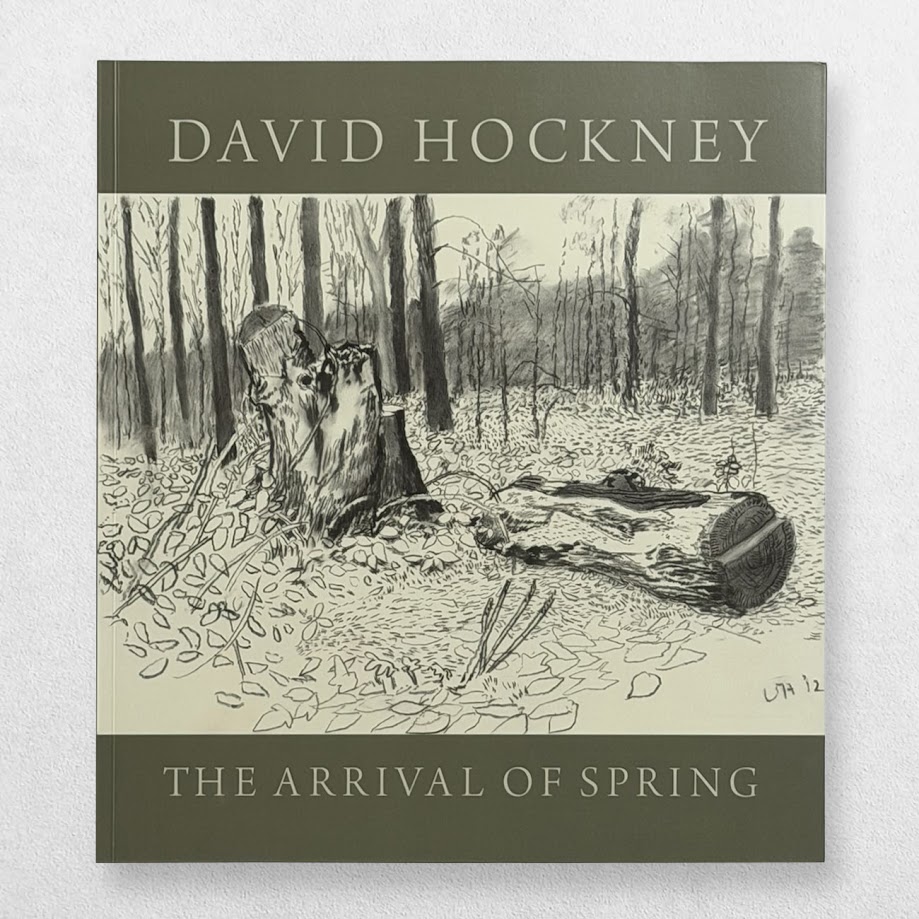
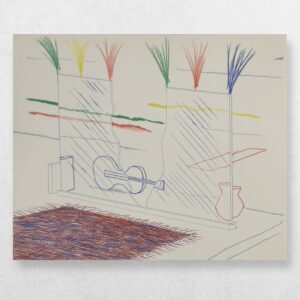
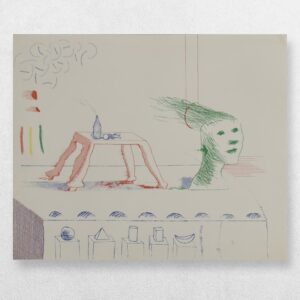
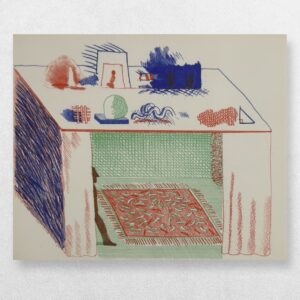
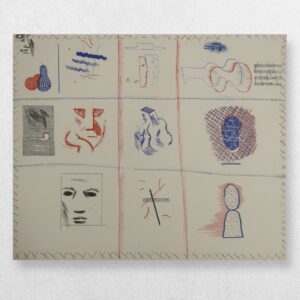
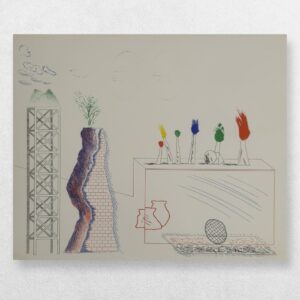
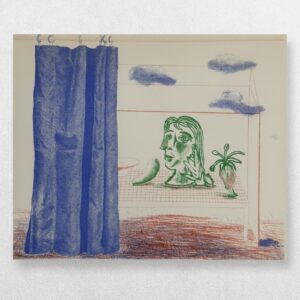
David Hockney – The Arrival of Spring – Annely Juda Fine Art – London 8 May – 12 July 2014
Artist: Hockney, David
Publisher: Annely Juda
Price: £45 including postage in the UK
Publication Date: 2014
Edition: First edition
Size: Quarto
Condition: Fine
Condition:
The softcover catalogue of the exhibition held at Annely Juda Gallery. Illustrated throughout. A fine copy.
David Hockney – The Arrival Of Spring: A Brief Overview
Annely Juda Fine Art, London, 8 May – 12 July 2014
Context and Curatorial Framework
The 2014 exhibition The Arrival of Spring at Annely Juda Fine Art presented a focused and conceptually rigorous examination of seasonal transformation, centred on David Hockney’s sustained engagement with the landscape of Woldgate in East Yorkshire.
Although related to works previously shown in A Bigger Picture (Royal Academy, 2012), this exhibition recontextualised the material within a commercial gallery setting, emphasising editioned prints, seriality, and process. The curatorial emphasis was not simply on landscape representation, but on perception over time—how a single motif can be re-seen through changing light, weather, and medium.
Structure of the Exhibition
- iPad Drawings (2011): Serial Observation in Colour
The principal body of work consisted of a series of iPad drawings documenting the transition from late winter into spring in 2011. These works were printed as large-scale inkjet editions.
Key characteristics include:
- Sequential development: The same stretch of road and woodland is depicted repeatedly, showing gradual changes in foliage, colour, and atmosphere.
- Digital immediacy: The iPad enabled rapid, on-site drawing, allowing Hockney to respond directly to fleeting visual conditions.
- High chromatic intensity: Colours are deliberately saturated and luminous, influenced by the backlit digital screen.
- Flattened pictorial space: Compared with traditional painting, these works often compress depth, producing a more graphic, surface-oriented effect.
Art historically, these images sit between landscape tradition (recalling Constable or Van Gogh) and contemporary digital practice. They foreground the mediation of vision through technology, raising questions about authenticity, mark-making, and reproduction.
Critical responses were divided: while many acknowledged the vitality and accessibility of the works, others noted a perceived lack of depth or complexity compared with Hockney’s earlier painterly output.
- Charcoal Drawings (2013): Return to Materiality
Displayed separately, the charcoal drawings from 2013 provided a striking counterpoint to the digital prints.
Their defining qualities include:
- Monochrome exploration: Hockney investigated the idea that black and white can convey a full range of visual experience, including implied colour.
- Textural richness: Dense, layered marks evoke the tactile qualities of bark, branches, and undergrowth.
- Serial structure: As with the iPad works, repeated views of the same location emphasise temporal progression and sustained observation.
- Heightened draughtsmanship: These works demonstrate a renewed focus on line, pressure, and compositional balance.
Produced following a minor stroke in 2012, the drawings are often interpreted as part of a late-career intensification. They reconnect Hockney with traditions of observational drawing while maintaining his longstanding interest in perception and duration.
- Film Installation: Woldgate Woods, November 26th 2010
The exhibition also included a multi-screen film installation composed of nine synchronised views of a journey through a snow-covered woodland.
This work extends Hockney’s exploration of:
- Expanded vision: Multiple screens approximate the breadth of human peripheral perception.
- Temporal duration: The landscape unfolds in real time, emphasising experience rather than snapshot representation.
- Embodied viewing: The viewer becomes immersed in the act of moving through space.
The film bridges still and moving image, reinforcing the exhibition’s broader investigation into how landscape is perceived.
Thematic and Conceptual Analysis
Seasonal Time and Seriality
The exhibition is structured around temporal progression, presenting landscape as a process rather than a fixed image. Each work gains meaning in relation to others in the sequence.
Technology versus Tradition
A central dialogue emerges between:
- Digital immediacy (iPad drawings)
- Manual materiality (charcoal works)
Rather than opposing these modes, Hockney uses them to explore how different tools shape perception.
Perception and Embodied Vision
Across all media, the exhibition advances a consistent proposition: vision is experiential and unfolds over time. The serial drawings and multi-screen film both resist the single-point perspective of conventional representation.
Late Style and Resilience
The works reflect a period of renewed concentration following a health setback. The charcoal drawings, in particular, suggest a deepened engagement with observation and mark-making.
Critical Reception and Market Context
Critically, the exhibition prompted mixed responses:
- Praised for its energy, innovation, and clarity of concept
- Questioned for the formal limitations of some digital works
Commercially, it was highly successful, with strong demand for the editioned prints. This reflects the broader acceptance of digital works within the contemporary art market, as well as Hockney’s established reputation.
Significance within Hockney’s Oeuvre
The Arrival of Spring represents a significant moment in Hockney’s later career:
- It consolidates his exploration of digital drawing technologies
- It deepens his engagement with the Yorkshire landscape
- It integrates multiple media into a coherent conceptual framework
Most importantly, it continues his lifelong investigation into how we see—an enquiry that remains central to his practice.
Why buy from us?
At Hornseys, we are committed to offering items that meet the highest standards of quality and authenticity. Our book collection is meticulously curated to ensure that each edition is a valuable and authentic piece of bibliographical history. Here’s what sets us apart:
- Authenticity and Provenance: Every book is researched, collated, and verified for authenticity.
- Expert Curation: Each book is selected with a keen eye for significance, condition, and rarity, ensuring a collection that is both diverse and distinguished.
- Customer Satisfaction: We strive to provide an exceptional customer experience, from detailed descriptions and provenance to secure and prompt delivery of your purchase.
- Returns Policy: We offer an unconditional guarantee on every item. If you wish to make a return, books may be sent back to us within fourteen days of receipt for any reason. We request advance notification of returns, and books must be returned in the same condition as sent for a full refund.
Explore Our Collection:
Established in 1976, Hornseys’ is a family business based in Ripon. We buy and sell rare and signed books, artwork, maps, furnishings, bruins, ‘The Adventures of Tintin’ and many other carefully curated items. We exhibit regularly at London book-fairs. We sell to leading dealers and clients throughout the world. Authenticity is guaranteed on all our products. Postage is free in the UK and we also offer fully-insured and tracked worldwide shipping.