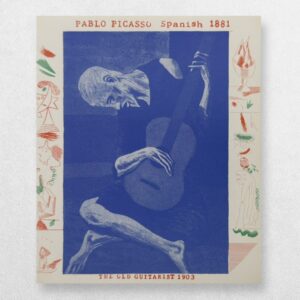
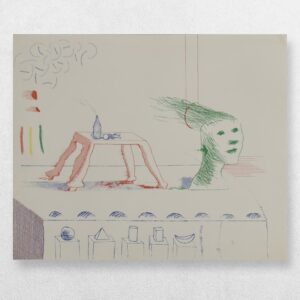
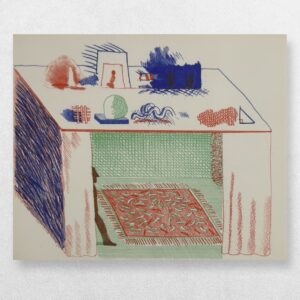
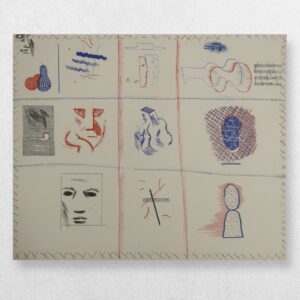
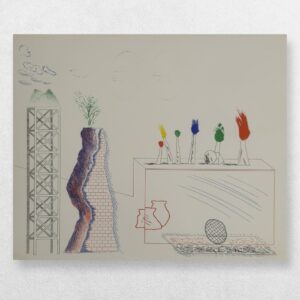
David Hockney (born 9 July 1937) is one of the most significant British artists of the twentieth and twenty-first centuries. A painter, draughtsman, printmaker, stage designer, and digital innovator, he is closely associated with Pop Art, though his work consistently transcends stylistic categorisation. His career is marked by a sustained exploration of space, perception, colour, and the act of looking, combined with an unusual openness to new technologies.
Early Life and Education
Hockney was born in Bradford, West Yorkshire, into a modest, intellectually curious family. His father was a conscientious objector and advocate of progressive ideas, influences that encouraged independent thinking.
He studied at:
- Bradford School of Art (1953–1957)
- Royal College of Art, London (1959–1962)
At the Royal College, Hockney emerged as a leading figure among a generation that included Peter Blake and R. B. Kitaj. His early work combined:
- Expressionist figuration
- Text and graphic elements
- Personal subject matter, including coded references to his homosexuality at a time when it was still criminalised in Britain
Early Career and Pop Art
London and the early 1960s
Hockney’s early paintings, such as We Two Boys Together Clinging (1961), show:
- Rough, energetic surfaces
- Graffiti-like inscriptions
- A fusion of literary reference (notably Walt Whitman) and personal narrative
Although often grouped with British Pop Art, Hockney’s work differs in its intimacy and autobiographical focus, rather than engagement with mass media imagery.
California and the Swimming Pools
Move to Los Angeles
In 1964, Hockney travelled to California, a move that transformed his work. He was captivated by:
- Light and clarity of atmosphere
- Modernist architecture
- The culture of leisure and openness
The pool paintings
His California paintings are among his most celebrated works, including:
- A Bigger Splash (1967)
- Portrait of an Artist (Pool with Two Figures) (1972)
These works are characterised by:
- Flat, luminous colour
- Precise composition
- Exploration of water as both surface and abstraction
The swimming pool became a central motif, allowing Hockney to investigate representation of transparency, reflection, and movement.
Portraiture
Portraiture has remained central throughout Hockney’s career. His portraits are notable for:
- Psychological clarity
- Use of flat space combined with careful observation
- Depiction of friends, lovers, and cultural figures
Double portraits, such as Mr and Mrs Clark and Percy (1970–71), explore relationships through spatial arrangement and gesture rather than overt narrative.
Photography and the “Joiners”
Photographic experiments
In the 1980s, Hockney turned to photography, producing composite images known as “joiners”. These works:
- Combine multiple photographs taken from slightly different viewpoints
- Challenge the single-point perspective of traditional photography
- Suggest a more temporal and experiential vision of seeing
This phase reflects his growing interest in how vision operates over time rather than as a fixed instant.
Theoretical Work and Art History
Hockney has also engaged deeply with art history and perception. His book Secret Knowledge (2001) argues that:
- Old Master painters used optical devices (mirrors, lenses)
- Western art history must be reconsidered in light of technological mediation
Though controversial, this work demonstrates his analytical engagement with how images are constructed.
Return to Landscape: Yorkshire
Late 1990s onwards
From the late 1990s, Hockney increasingly focused on the landscape of Yorkshire, particularly around Bridlington and Woldgate. These works are marked by:
- Bold colour
- Large scale
- Serial depiction of the same locations across seasons
Paintings such as The Bigger Trees Near Warter (2007) demonstrate a renewed engagement with observation and place.
Digital Innovation
iPad and iPhone drawings
Hockney has been a pioneer in using digital tools for fine art. From the 2000s onwards, he created:
- Drawings on iPhones and iPads
- Large-scale digital prints
These works maintain his core concerns—colour, light, and perception—while embracing new media. He has treated digital technology not as novelty but as a continuation of draughtsmanship.
Stage Design and Other Work
Hockney has also worked extensively in:
- Opera stage design (notably for Glyndebourne, the Metropolitan Opera, and others)
- Printmaking, including etching and lithography
- Set and costume design
These projects extend his exploration of space into theatrical environments.
Themes and Artistic Concerns
Across his career, several themes recur:
- Seeing and perception: rejecting fixed perspective in favour of multiple viewpoints
- Space and composition: flattening and restructuring pictorial space
- Colour: bold, often non-naturalistic but structurally precise
- Time: representing duration rather than single moments
Personal Life and Identity
Hockney has been openly gay throughout his career, and his work often reflects:
- Personal relationships
- Intimacy and domestic life
- A quiet but persistent challenge to social norms
His openness was significant in the context of mid-twentieth-century Britain.
Honours and Recognition
Hockney has received numerous honours, including:
- Appointment to the Order of Merit (OM)
- Major retrospectives at institutions such as the Tate, Royal Academy, and Metropolitan Museum of Art
He is widely regarded as one of the most influential living British artists.
Concluding Assessment
David Hockney’s career spans more than six decades and encompasses painting, photography, printmaking, and digital media. His work is unified not by style but by a sustained investigation into how we see and represent the world. From the swimming pools of California to the hedgerows of Yorkshire, he has continually reinvented both subject and method while remaining rooted in observation.
His enduring significance lies in combining technical innovation with clarity of vision, demonstrating that tradition and experimentation are not opposites but complementary forces in modern art.
WHY CHOOSE HORNSEYS?
At Hornseys, we are dedicated to offering items that uphold the highest standards of quality and authenticity. Our collection is carefully curated to ensure that each item is a valuable and authentic piece of history.
Here’s what sets us apart:
• Authenticity and Provenance: Every item is meticulously verified for authenticity, condition and edition.
• Expert Curation: We select each item with a keen eye for literary significance, condition, and rarity, ensuring a collection that is both diverse and distinguished.
• Customer Satisfaction: We strive to provide an exceptional customer experience, from detailed descriptions and provenance to secure and prompt delivery of your purchase.
OUR COMMITMENT TO QUALITY AND SERVICE
Understanding the value and rarity of these unique collectables, we ensure that every aspect of your purchase meets the highest standards of quality and service. This includes:
• Free Expedited, Tracked, and Insured Delivery within the UK: Ensuring that your signed book arrives safely and promptly.
• Fully-Insured Worldwide Delivery: Offering peace of mind for international collectors with reliable and secure shipping options.
EXPLORE OUR COLLECTION
Established in 1976, Hornseys’ is a family business based in Ripon. We buy and sell rare and signed books, artwork, maps, furnishings, bruins, ‘The Adventures of Tintin’ and many other carefully curated items. We exhibit regularly at London book-fairs. We sell to leading dealers and clients throughout the world. Authenticity is guaranteed on all our products. Postage is free in the UK and we also offer fully-insured and tracked worldwide shipping.