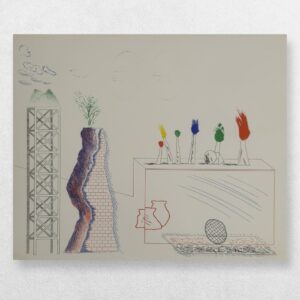
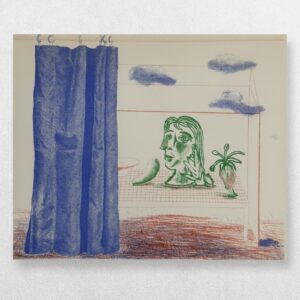
‘It Picks Its Way’ – From ‘The Blue Guitar’ Published By The Petersburg Press – Publisher’s Promotional Card – 1977
Hockney, David
£45.00
Availability: In stock
Product Description
‘It Picks Its Way’ – From ‘The Blue Guitar’ Published By The Petersburg Press – Publisher’s Promotional Card – 1977
Author: Hockney, David
Publisher: The Petersburg Press
Price: £45 including postage in the UK
Publication Date: c.1977
Edition: First edition
Size: 18.4cm x 14.7cm
Condition: Very good
Condition:
Published by The Petersburg Press, London, UK in c.1977. 1st edition thus. Printed on stiff card with print details verso. Suitable for framing. An unusual production which was possibly produced as a publisher’s promotional item. Size: 18.4cm x 14.7cm. Slightly creased. A very good copy. A very scarce item of David Hockney ephemera.
David Hockney And ‘The Blue Guitar’: A Brief Overview
The Blue Guitar is a major series of etchings by David Hockney, produced between 1976 and 1977 and published as a portfolio accompanied by text. It represents one of Hockney’s most intellectually ambitious print projects, combining poetry, art history, and formal experimentation.
The series is directly inspired by the poem The Man with the Blue Guitar by Wallace Stevens, itself loosely derived from the imagery of Pablo Picasso’s Blue Period and Cubist explorations. Hockney’s work thus forms a layered dialogue across literature and modern art.
Conceptual Framework
Art about art
At its core, The Blue Guitar is concerned with:
- The nature of representation
- The transformation of reality through art
- The relationship between artist, object, and viewer
Stevens’ poem explores how art reshapes the world; Hockney translates this philosophical inquiry into visual form.
Intertextual dialogue
The series operates on three levels:
- Poetic — responding to Stevens’ text
- Art historical — engaging with Picasso and Cubism
- Personal — reflecting Hockney’s own concerns with perception
Rather than illustrating the poem literally, the prints interpret and extend its ideas.
Technique and Printmaking
Etching process
The works are executed primarily as etchings, often combined with aquatint. Hockney uses:
- Fine linear drawing
- Tonal variation through aquatint
- Controlled mark-making
The medium allows both precision and spontaneity, echoing the tension between structure and improvisation found in the subject.
Serial structure
The portfolio consists of a sequence of images, each functioning as:
- An independent composition
- Part of a conceptual progression
The cumulative effect is narrative without conventional storytelling — an unfolding of visual thought.
Visual Language
Cubist influence
Many plates reference Cubist strategies:
- Fragmented objects
- Multiple viewpoints
- Flattened pictorial space
Guitars, figures, and interiors are reconfigured into shifting geometric arrangements.
Line and gesture
Hockney’s line is:
- Economical
- Expressive
- Structurally decisive
He uses line not only to describe form but to suggest movement and transformation.
Recurring motifs
The series includes:
- The guitar as central symbol
- Studio interiors
- Human figures (often stylised or fragmented)
- References to Picasso’s imagery
These motifs are repeatedly altered, reinforcing the theme of reinterpretation.
Themes
Reality and transformation
Echoing Stevens, Hockney explores how:
- Art does not copy reality
- It reorders and reimagines it
The “blue guitar” becomes a metaphor for artistic mediation.
Perception and multiplicity
The rejection of single-point perspective reflects Hockney’s broader interest in:
- Multiple viewpoints
- Temporal experience
- The instability of visual truth
Dialogue with Picasso
Hockney does not imitate Picasso but:
- Engages critically with Cubism
- Revisits its methods in a contemporary context
- Questions its assumptions about space and representation
Relationship to Hockney’s Wider Work
The Blue Guitar sits within a broader phase of experimentation in the 1970s, when Hockney was:
- Expanding his printmaking practice
- Investigating photographic and spatial perception
- Moving beyond the Californian paintings of the 1960s
It anticipates later work, including:
- Photographic “joiners”
- Multi-perspective landscapes
Publication and Format
The series was issued as a portfolio with accompanying text, reinforcing its intellectual ambition. It is not merely a set of prints but a coherent artistic statement, combining visual and literary elements.
For collectors, it is regarded as one of Hockney’s most important graphic works of the period.
Critical Reception
The series has been widely recognised for:
- Its intellectual depth
- Its technical mastery of etching
- Its successful engagement with both poetry and art history
It is often cited as one of the most sophisticated artist–poet dialogues in late twentieth-century printmaking.
Concluding Assessment
The Blue Guitar (1976–77) is a pivotal work in David Hockney’s career, marking a shift toward more conceptual and formally experimental approaches. By engaging with Wallace Stevens and Pablo Picasso, Hockney situates himself within a lineage of modernist inquiry while asserting his own distinct vision.
The series demonstrates that printmaking, often considered secondary to painting, can serve as a primary medium for philosophical and visual exploration, addressing fundamental questions about how art transforms reality.
Why buy from us?
At Hornseys, we are committed to offering items that meet the highest standards of quality and authenticity. Our book collection is meticulously curated to ensure that each edition is a valuable and authentic piece of bibliographical history. Here’s what sets us apart:
- Authenticity and Provenance: Every book is researched, collated, and verified for authenticity.
- Expert Curation: Each book is selected with a keen eye for significance, condition, and rarity, ensuring a collection that is both diverse and distinguished.
- Customer Satisfaction: We strive to provide an exceptional customer experience, from detailed descriptions and provenance to secure and prompt delivery of your purchase.
- Returns Policy: We offer an unconditional guarantee on every item. If you wish to make a return, books may be sent back to us within fourteen days of receipt for any reason. We request advance notification of returns, and books must be returned in the same condition as sent for a full refund.
Explore Our Collection:
Established in 1976, Hornseys’ is a family business based in Ripon. We buy and sell rare and signed books, artwork, maps, furnishings, bruins, ‘The Adventures of Tintin’ and many other carefully curated items. We exhibit regularly at London book-fairs. We sell to leading dealers and clients throughout the world. Authenticity is guaranteed on all our products. Postage is free in the UK and we also offer fully-insured and tracked worldwide shipping.
Related products

The Nonsense Verse Of Edward Lear: Signed By The Illustrator
£95.00Lear, Edward Illustrated By Lord, John Vernon



You may also like…
Pop Art: Peter Blake, An Alphabet: Presentation Copy To Mel Gooding: Signed By Peter Blake, Gavin Turk And Paul Stolper
£495.00Blake, Peter, Turk, Gavin & Gooding, Mel
David Hockney – My Yorkshire – Conversations With Marco Livingstone
£225.00Hockney, David & Livingstone, Marco