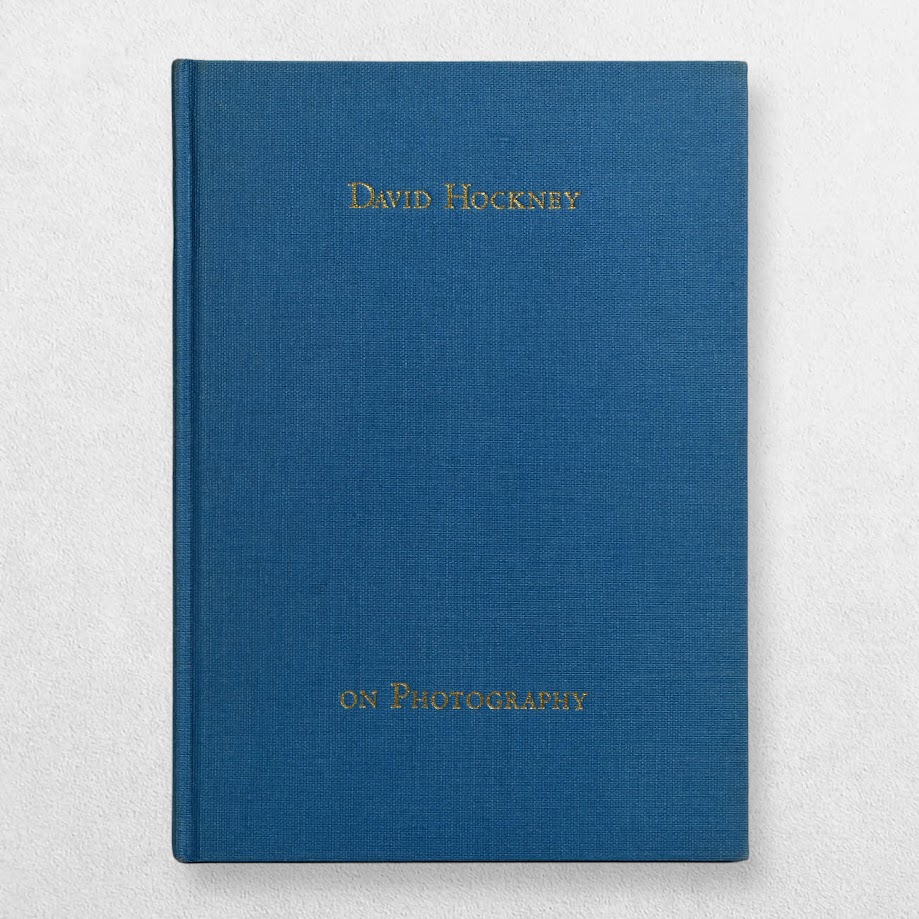
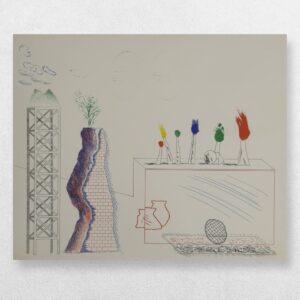
David Hockney On Photography – A Lecture At The Victoria & Albert Museum – November 1983
Artist: Hockney, David
Publisher: Andre Emmerich Gallery Inc
Price: £125 including postage in the UK
Publication Date: Not stated
Edition: First edition
Size: Octavo
Condition: A fine copy.
Condition:
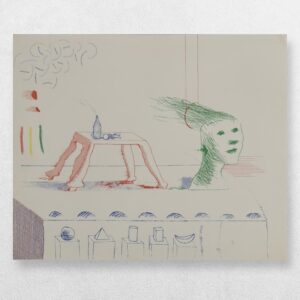
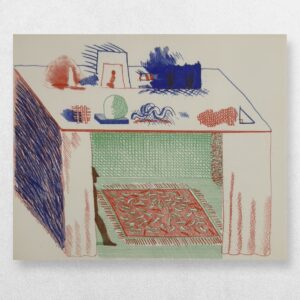
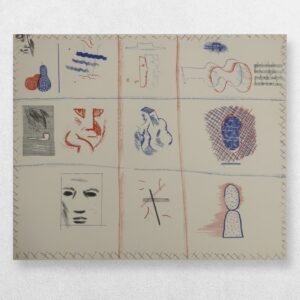
Original blue cloth gilt. Printed on fine paper. Illustrated. The very scarce hardcover edition. A fine copy.
David Hockney On Photography – A Lecture At The Victoria & Albert Museum: A Brief Overview
Context and Intellectual Background
David Hockney’s 1983 lecture On Photography, delivered at the Victoria and Albert Museum, occupies a critical position within his broader theoretical enquiry into image-making during the late 1970s and early 1980s.
At this time, Hockney had already begun producing his influential “joiners” — composite photographic works constructed from multiple snapshots — which challenged the conventions of single-point perspective and mechanical vision. The lecture should therefore be understood not as an isolated talk, but as part of an ongoing investigation into how images represent reality, and how photography conditions seeing.
Importantly, this lecture predates and anticipates arguments later formalised in Secret Knowledge: Rediscovering the Lost Techniques of the Old Masters, particularly concerning optics, perspective, and the historical use of image-making devices.
Core Thesis
Hockney’s central argument is that photography, despite its apparent objectivity, imposes a highly specific and limited way of seeing. He challenges the widespread assumption that photographs provide neutral or truthful representations of the world.
Instead, he proposes:
- Photography is a mechanical system with built-in constraints
- It enforces a fixed viewpoint
- It captures a single moment in time, detached from lived experience
By contrast, human vision is dynamic, temporal, and spatially complex.
Key Arguments and Concepts
- The Problem of Single-Point Perspective
Hockney critiques the dominance of Renaissance perspective, which photography inherits and reinforces.
- A photograph is organised around a single, fixed viewpoint
- This viewpoint is artificial and rarely corresponds to lived visual experience
- Human perception involves constant movement of the eye and body
He argues that photography perpetuates a convention rather than reflecting reality.
- Time Versus the “Instant”
A central distinction in the lecture is between:
- Photographic time: a fraction of a second
- Perceptual time: extended, cumulative, and experiential
Hockney insists that we do not see the world as a series of frozen instants. Instead, perception unfolds:
- Over seconds, minutes, or longer
- Through memory and anticipation
- Via multiple glances and shifting attention
Photography, therefore, abstracts time, producing an image that may appear precise but is experientially impoverished.
- The “Joiners” as a Counter-Model
Hockney uses his own photographic collages—often called “joiners”—as practical demonstrations of an alternative visual logic.
These works:
- Combine multiple photographs taken from slightly different positions
- Extend the image across time rather than compressing it
- Reintroduce movement, duration, and multiplicity
Rather than presenting a seamless illusion, joiners expose their construction, emphasising that seeing is an active process.
- The Illusion of Photographic Truth
Hockney directly challenges the cultural authority of photography:
- Photographs are often perceived as objective evidence
- In reality, they are shaped by framing, lens choice, and timing
- They exclude as much as they include
He argues that painting and drawing may, paradoxically, offer truer accounts of experience, precisely because they acknowledge interpretation.
- Optics and the History of Representation
Although not yet fully developed into the thesis of Secret Knowledge, Hockney’s lecture touches on:
- The historical use of optical devices (mirrors, lenses)
- The relationship between technology and representation
- The possibility that earlier artists engaged with similar visual problems
This situates photography within a longer continuum of image-making technologies, rather than as a radical break.
Methodology and Rhetorical Approach
Hockney’s lecture is notable for its clarity and accessibility, but also for its practice-led reasoning:
- He draws on his own studio experiments
- He references art history selectively, focusing on visual evidence
- He uses comparative examples (painting vs photography)
Rather than presenting a formal academic argument, Hockney adopts an artist’s analytical perspective, grounded in making and looking.
Thematic Implications
Vision as Active and Constructed
Hockney reframes vision as:
- Mobile rather than fixed
- Temporal rather than instantaneous
- Interpretative rather than neutral
Critique of Technological Authority
The lecture questions the privileged status of photography in modern culture, exposing its limitations as a representational system.
Reassertion of Painting and Drawing
By highlighting what photography cannot do, Hockney implicitly revalidates traditional media as capable of conveying richer perceptual experiences.
Reception and Influence
Although not a widely published text at the time, the ideas articulated in the 1983 lecture proved highly influential:
- They informed Hockney’s subsequent artistic production
- They contributed to broader debates about photography and representation
- They anticipated later theoretical developments in visual studies
The lecture is now often cited as an early articulation of concerns that would become central to Hockney’s later work and writing.
Position within Hockney’s Oeuvre
On Photography represents a crucial conceptual moment:
- It consolidates his experiments with photographic collage
- It marks a shift towards more explicit theoretical reflection
- It establishes key ideas that underpin later projects across multiple media
It demonstrates that Hockney’s practice is not only visually innovative but also intellectually engaged with fundamental questions about perception.
Why buy from us?
At Hornseys, we are committed to offering items that meet the highest standards of quality and authenticity. Our book collection is meticulously curated to ensure that each edition is a valuable and authentic piece of bibliographical history. Here’s what sets us apart:
- Authenticity and Provenance: Every book is researched, collated, and verified for authenticity.
- Expert Curation: Each book is selected with a keen eye for significance, condition, and rarity, ensuring a collection that is both diverse and distinguished.
- Customer Satisfaction: We strive to provide an exceptional customer experience, from detailed descriptions and provenance to secure and prompt delivery of your purchase.
- Returns Policy: We offer an unconditional guarantee on every item. If you wish to make a return, books may be sent back to us within fourteen days of receipt for any reason. We request advance notification of returns, and books must be returned in the same condition as sent for a full refund.
Explore Our Collection:
Established in 1976, Hornseys’ is a family business based in Ripon. We buy and sell rare and signed books, artwork, maps, furnishings, bruins, ‘The Adventures of Tintin’ and many other carefully curated items. We exhibit regularly at London book-fairs. We sell to leading dealers and clients throughout the world. Authenticity is guaranteed on all our products. Postage is free in the UK and we also offer fully-insured and tracked worldwide shipping.