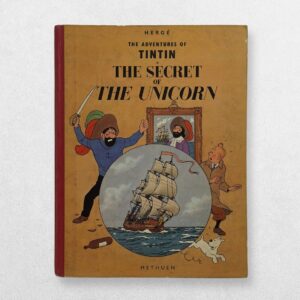
Les Aventures De Tintin – Le Temple Du Soleil – The Adventures Of Tintin – Prisoners Of The Sun – First Edition – 1949
Hergé
£275.00
Availability: In stock
Product Description
Les Aventures De Tintin – Le Temple Du Soleil – The Adventures Of Tintin – Prisoners Of The Sun – First Edition – 1949
Author: Hergé
Price: £275.00
Publisher: Casterman
Publication date: 1949
Format: Original cloth-backed boards with pictorial endpapers
Condition: Very good
Pages: 62
Illustrations: Illustrated throughout in colour by the author
Description:
Casterman Tournai Paris, 1949. Printed in Belgium. First edition. Original cloth-backed boards. Pictorial endpapers. Pp. 62. Illustrated throughout in colour by the author. Binding nice and tight with minor rubbing and creasing to the spine and edges of the boards. Minor ink marks to the rear board alongside five titles. Slight age toning to the pages as usual. A very good, tight, copy. Scarce.
Le Temple Du Soleil: A Brief Summary
Le Temple du Soleil begins immediately after the events of Les 7 Boules de Cristal. Tintin and Captain Haddock travel to Peru, determined to rescue Professor Cuthbert Calculus, who has been abducted by descendants of the Inca civilisation. Their journey takes them from the coastal cities into the mountainous interior, following fragmentary clues and rumours.
They are joined by General Alcazar, a volatile but resourceful ally, whose presence underscores the political instability of the region and adds urgency to their quest.
Capture and imprisonment
Despite their determination, Tintin and Haddock are quickly outmatched. They are captured by the Inca descendants and brought before a hidden, highly organised community that has preserved its traditions, hierarchy, and authority in isolation from the modern world.
The captives are condemned to death for their role—direct or indirect—in the desecration of Rascar Capac’s tomb. Unlike conventional villains, their captors act not out of greed, but from a strict moral code rooted in cultural survival and historical grievance.
Tintin and Haddock are imprisoned, awaiting execution alongside other condemned prisoners.
Calculus revealed
It is revealed that Professor Calculus is alive. His scientific knowledge has made him valuable to the Incas, who have spared him so that he may assist them. Calculus, characteristically oblivious to danger and misunderstanding much of what is happening, believes he is being treated as an honoured guest.
This contrast between Calculus’s innocence and the grim reality of the situation heightens both tension and dark humour.
The eclipse and the turning of fate
Tintin realises that the execution is scheduled to coincide with a solar eclipse—a moment of immense symbolic importance. Drawing on his scientific knowledge, Tintin plans a desperate gamble.
At the moment of execution, Tintin announces that the sun will disappear if they are put to death. When the eclipse occurs exactly as he predicts, panic and awe spread among the Inca community. The apparent fulfilment of Tintin’s prophecy halts the execution.
The eclipse is interpreted as a sign of divine displeasure, forcing the leaders to reconsider the fate of the prisoners.
Reversal and escape
The Incas acknowledge Tintin’s apparent power over the sun and spare the captives. Calculus is released, and the surviving members of the original expedition are cured of their comas, reversing the effects of the earlier attacks.
Tintin, Haddock, and Calculus are escorted safely out of the hidden city. The Incas choose to withdraw once more into secrecy, preserving their way of life and ensuring that their sacred sites will not be violated again.
Resolution and return
The story concludes with the heroes returning to Europe. The mystery of the crystal balls is fully resolved, and the moral balance restored—not through conquest, but through understanding and restraint.
Unlike many earlier Tintin adventures, there is no sense of triumph. The Incas are not defeated; they simply reclaim control over their history and future. Tintin’s success lies in preventing injustice, not exploiting power.
Narrative significance
Le Temple du Soleil completes one of the most ambitious story arcs in the Tintin series. It stands out for:
- Sustained moral tension rather than simple antagonism
- A serious engagement with themes of colonialism and cultural violation
- The rare depiction of a non-European society as disciplined, intelligent, and ethically coherent
The eclipse sequence is one of the most famous moments in the series, emblematic of Tintin’s reliance on intelligence and courage rather than force.
Thematic summary
Central themes include:
- Respect for cultural sovereignty
- Knowledge as power, responsibly used
- Justice versus revenge
- Survival through secrecy rather than domination
The story suggests that some worlds are not meant to be absorbed into modernity, and that ethical action sometimes requires withdrawal rather than intervention.
Concluding assessment
Le Temple du Soleil is a sober, humane conclusion to the Inca diptych. It replaces the adventure’s earlier atmosphere of fear with reflection and resolution, offering one of the most ethically nuanced endings in the Tintin canon. It confirms Tintin not as a conqueror or hero of empire, but as a mediator—someone who recognises limits, respects difference, and leaves the world fundamentally unchanged, but safer.
Why Buy from Us?
At Hornseys, we are committed to offering items that meet the highest standards of quality and authenticity. Our collection of rare books is carefully curated to ensure each edition is a valuable piece of bibliographical history. Here’s what sets us apart:
- Authenticity and Provenance: Each book is meticulously researched and verified for authenticity and collation.
- Expert Curation: Our selection process focuses on significance, condition, and rarity, resulting in a collection that is both diverse and distinguished.
- Customer Satisfaction: We aim to provide an exceptional customer experience, from detailed descriptions to secure and prompt delivery of your purchase.
- Returns Policy: We offer an unconditional guarantee on every item. If you wish to return a book, it may be sent back to us within fourteen days of receipt. Please notify us in advance if you wish to do so. The book must be returned in the same condition as it was sent for a full refund.
Cataloguer: Daniel Hornsey
Daniel Hornsey has specialised in fine and rare books, ephemera, and collectors’ editions for over thirty years. As a long-standing member of the antiquarian book trade, he has advised private collectors, curated catalogues, and sourced works for leading dealers, libraries and institutions across the world.
Hornseys’ exhibit regularly at book and map fairs in London and throughout the UK and are members of the Provincial Booksellers Fairs Association, the PBFA.
His fascination with Hergé’s work — especially ‘The Adventures of Tintin’ — began in childhood. Daniel recalls reading Tintin in original European editions and quickly recognising that these were not merely children’s books, but finely illustrated narratives crafted with artistic depth and wit.
As noted by the Musée Hergé in Louvain-la-Neuve, Hergé’s ‘ligne claire’ style has influenced generations of European comic artists and his original drawings and paintings command very high prices with his painting of ‘The Blue Lotus’ jar fetching £2.8m at auction in 2021.
By presenting these works through Hornseys’, he hopes to contribute to the continued appreciation of one of the 20th century’s most influential illustrators, helping new generations discover the artistry and legacy of Hergé.
Related products

Newt Scamander: Fantastic Beasts And Where To Find Them: Signed By The Illustrator: Includes Promotional Poster
£175.00Rowling, J K & Gill, Olivia Lomenech