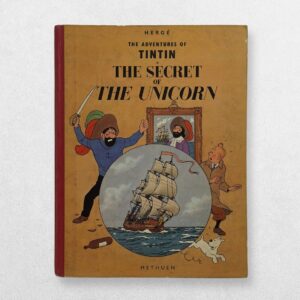
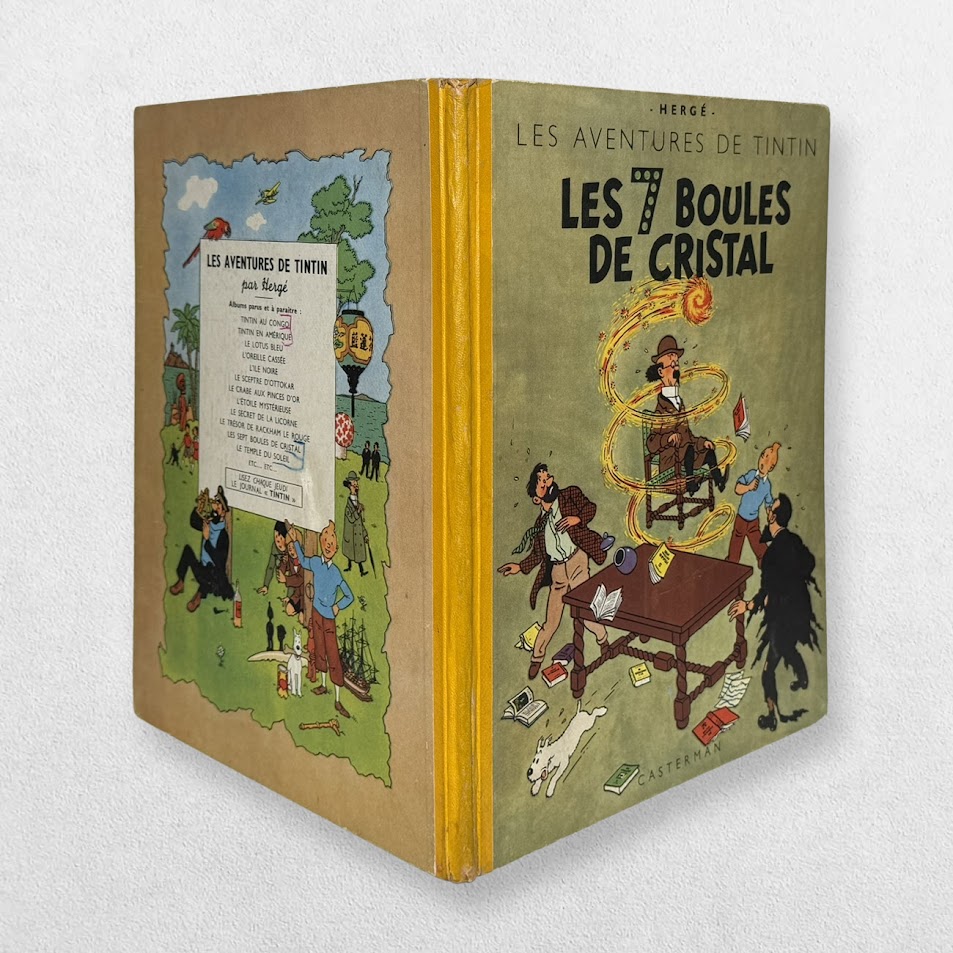
Les Aventures De Tintin – Les 7 Boules De Cristal – The Adventures Of Tintin – The Seven Crystal Balls – Very Early Edition – 1949
Hergé
£275.00
Availability: In stock
Product Description
Les Aventures De Tintin – Les 7 Boules De Cristal – The Adventures Of Tintin – The Seven Crystal Balls – Very Early Edition – 1949
Author: Hergé
Price: £275.00
Publisher: Casterman
Publication date: 1949
Format: Original cloth-backed boards with pictorial endpapers
Condition: Very good
Pages: 62
Illustrations: Illustrated throughout in colour by the author
Description:
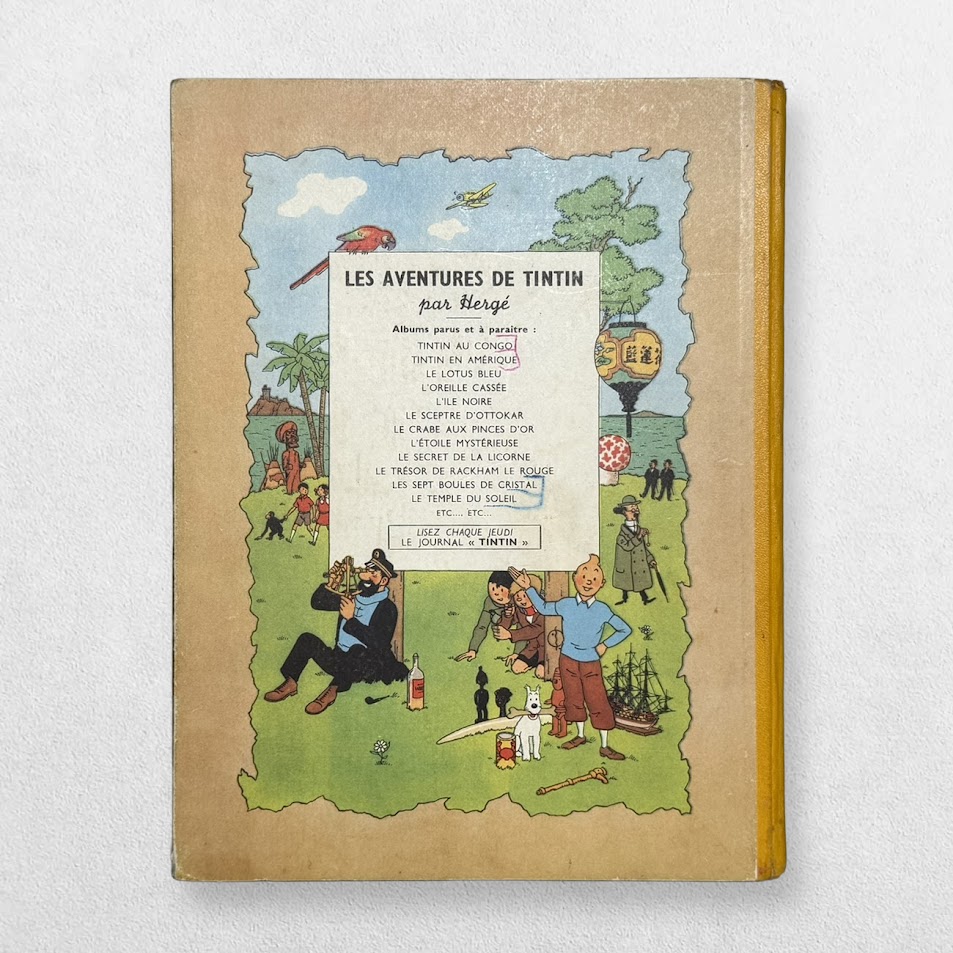
Casterman Tournai Paris, 1949. Printed in Belgium. Very early edition. Original cloth-backed boards. Pictorial endpapers. Pp. 62. Illustrated throughout in colour by the author. Binding nice and tight with minor rubbing and creasing to the spine and edges of the boards. Minor ink marks to the rear board alongside four titles. Slight age toning to the pages as usual. A very good, tight, copy. Scarce.
Les 7 Boules De Cristal: A Brief Summary
The story opens in Belgium, where members of an archaeological expedition have returned from South America after disturbing the tomb of the Inca ruler Rascar Capac. The expedition is celebrated publicly, but an atmosphere of unease quickly develops. During an exhibition, the mummy of Rascar Capac is displayed, and its presence is accompanied by ominous hints of an ancient curse.
Soon afterwards, a series of unexplained attacks begins. One by one, the expedition members fall into a deep, inexplicable coma. Each victim is found with shattered glass nearby, suggesting the mysterious “crystal balls” of the title, though no conventional explanation emerges.
Tintin investigates: fear, silence, and pattern
Tintin takes a close interest in the case, recognising that the attacks follow a pattern and are not random accidents. As he visits victims and their families, he discovers that the comas are identical: the victims are alive but utterly unresponsive, as if struck by a paralysing force.
Despite the police investigation, the authorities remain baffled. The attacks defy rational explanation, creating an atmosphere of growing dread. Hergé deliberately slows the narrative pace, allowing tension to build through repetition and uncertainty rather than action.
Professor Calculus enters the story
The situation becomes personal when Professor Cuthbert Calculus reveals that he has taken home the mummy of Rascar Capac, believing it to be of scientific interest. His casual disregard for danger adds both humour and menace to the story.
That same night, Calculus is attacked. Tintin and Captain Haddock witness terrifying phenomena: lightning, thunder, and the sudden appearance of a glowing apparition. Calculus disappears, apparently abducted by supernatural forces.
This moment marks a shift in the story, transforming an abstract mystery into an urgent personal quest.
The trail to Peru
Tintin and Haddock learn that Calculus’s disappearance is connected to the fate of the expedition members and that the events are not supernatural, but carefully orchestrated acts of vengeance.
They discover that the expedition violated sacred burial customs and that survivors of the Inca civilisation are exacting revenge. The supposed curse is a psychological weapon, designed to inspire fear and confusion.
Tintin uncovers evidence pointing towards Peru, where the roots of the conspiracy lie. The mystery broadens from a European crime story into an international pursuit.
The conspiracy revealed
It emerges that the attackers are members of a secret Inca network led by High Priest-like figures, operating with meticulous planning and discipline. Their goal is not indiscriminate punishment, but targeted retribution against those responsible for sacrilege.
Professor Calculus is revealed to have been taken alive and transported secretly, his knowledge and value making him a bargaining tool.
The seven crystal balls are not magical objects but instruments of psychological terror, used to induce fear and paralysis.
Cliffhanger ending
The story ends with Tintin and Haddock departing for South America, determined to rescue Calculus and stop the conspiracy. The fate of the comatose scientists remains unresolved, and the power of the Inca organisation is still largely unknown.
The narrative closes on a note of suspended danger, leading directly into the sequel, Le Temple du Soleil (Prisoners of the Sun), where the story reaches its conclusion.
Narrative significance
Les 7 Boules de Cristal is one of the darkest and most atmospheric Tintin stories. It marks a mature phase in Hergé’s work, characterised by:
- Psychological suspense rather than constant action
- A sustained tone of menace
- Moral complexity, particularly concerning colonial exploitation and cultural violation
The story is notable for its careful balance between rational explanation and apparent supernatural threat, keeping readers in a state of uncertainty for much of the narrative.
Thematic summary
Key themes include:
- Cultural disrespect and its consequences
- Fear as a weapon
- Science confronted by belief
- Guilt inherited through collective action
Unlike earlier adventures, victory is postponed rather than achieved, reinforcing the sense that some injustices cannot be easily undone.
Why Buy from Us?
At Hornseys, we are committed to offering items that meet the highest standards of quality and authenticity. Our collection of rare books is carefully curated to ensure each edition is a valuable piece of bibliographical history. Here’s what sets us apart:
- Authenticity and Provenance: Each book is meticulously researched and verified for authenticity and collation.
- Expert Curation: Our selection process focuses on significance, condition, and rarity, resulting in a collection that is both diverse and distinguished.
- Customer Satisfaction: We aim to provide an exceptional customer experience, from detailed descriptions to secure and prompt delivery of your purchase.
- Returns Policy: We offer an unconditional guarantee on every item. If you wish to return a book, it may be sent back to us within fourteen days of receipt. Please notify us in advance if you wish to do so. The book must be returned in the same condition as it was sent for a full refund.
Cataloguer: Daniel Hornsey
Daniel Hornsey has specialised in fine and rare books, ephemera, and collectors’ editions for over thirty years. As a long-standing member of the antiquarian book trade, he has advised private collectors, curated catalogues, and sourced works for leading dealers, libraries and institutions across the world.
Hornseys’ exhibit regularly at book and map fairs in London and throughout the UK and are members of the Provincial Booksellers Fairs Association, the PBFA.
His fascination with Hergé’s work — especially ‘The Adventures of Tintin’ — began in childhood. Daniel recalls reading Tintin in original European editions and quickly recognising that these were not merely children’s books, but finely illustrated narratives crafted with artistic depth and wit.
As noted by the Musée Hergé in Louvain-la-Neuve, Hergé’s ‘ligne claire’ style has influenced generations of European comic artists and his original drawings and paintings command very high prices with his painting of ‘The Blue Lotus’ jar fetching £2.8m at auction in 2021.
By presenting these works through Hornseys’, he hopes to contribute to the continued appreciation of one of the 20th century’s most influential illustrators, helping new generations discover the artistry and legacy of Hergé.
Related products
-

-

The House At Pooh Corner Signed By Christopher Robin Milne.
£695.00Milne, A. A. With Decorations By Shepard, E. H
-

Paul Blake Or The Story Of A Boy’s Perils In The Islands Of Corsica And Monte Cristo
£145.00Elwes, Alfred (Leighton Binding)
-