
MARK HEARLD FOLK ART PLATTER FOR TATE BRITAIN – 6
Hearld, Mark & Tate Britain
£145.00
Availability: In stock
Product Description
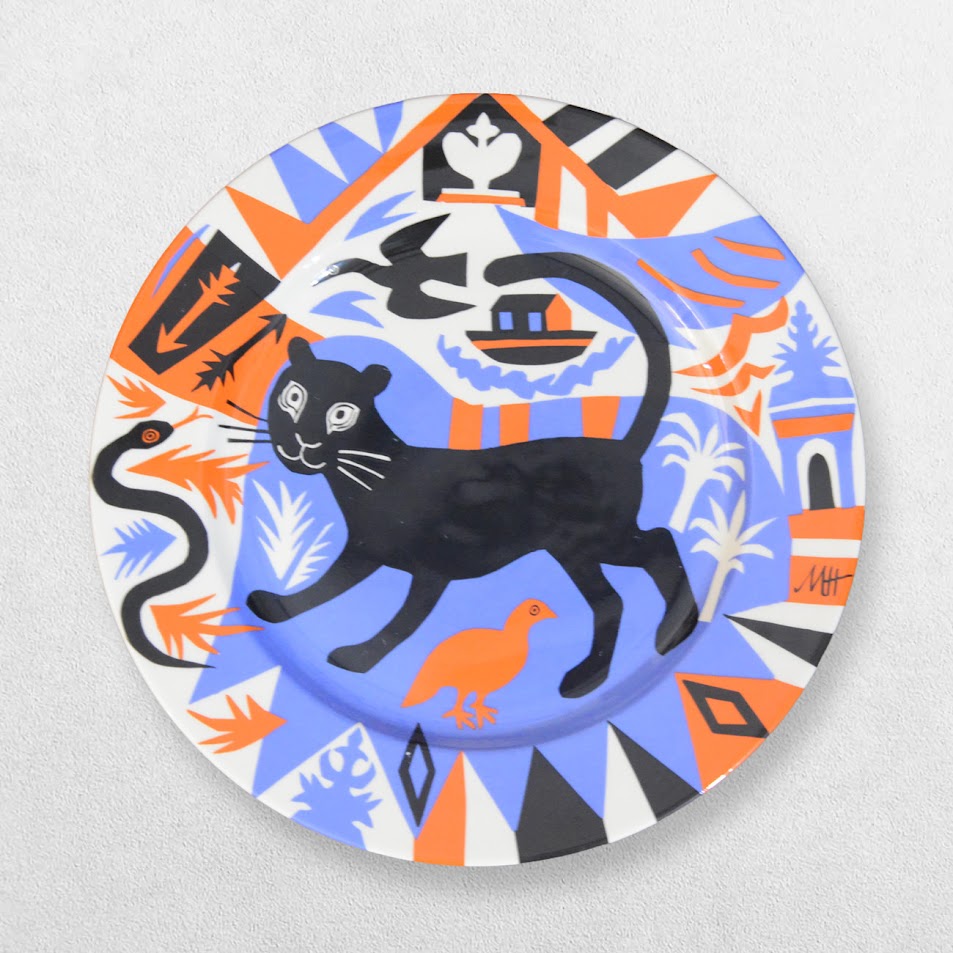
MARK HEARLD FOLK ART PLATTER FOR TATE BRITAIN – 6
Artist: Mark Hearld
Price: £145.00
Publisher: The Big Tomato Company, UK
Publication date: 2015
Format: Transfer Printed Ceramic Plate
Condition: Very minor production flaws including minor rubbing to the glaze. No chips or damage. In very good condition indeed.
Size: 32cm diameter
DESCRIPTION:
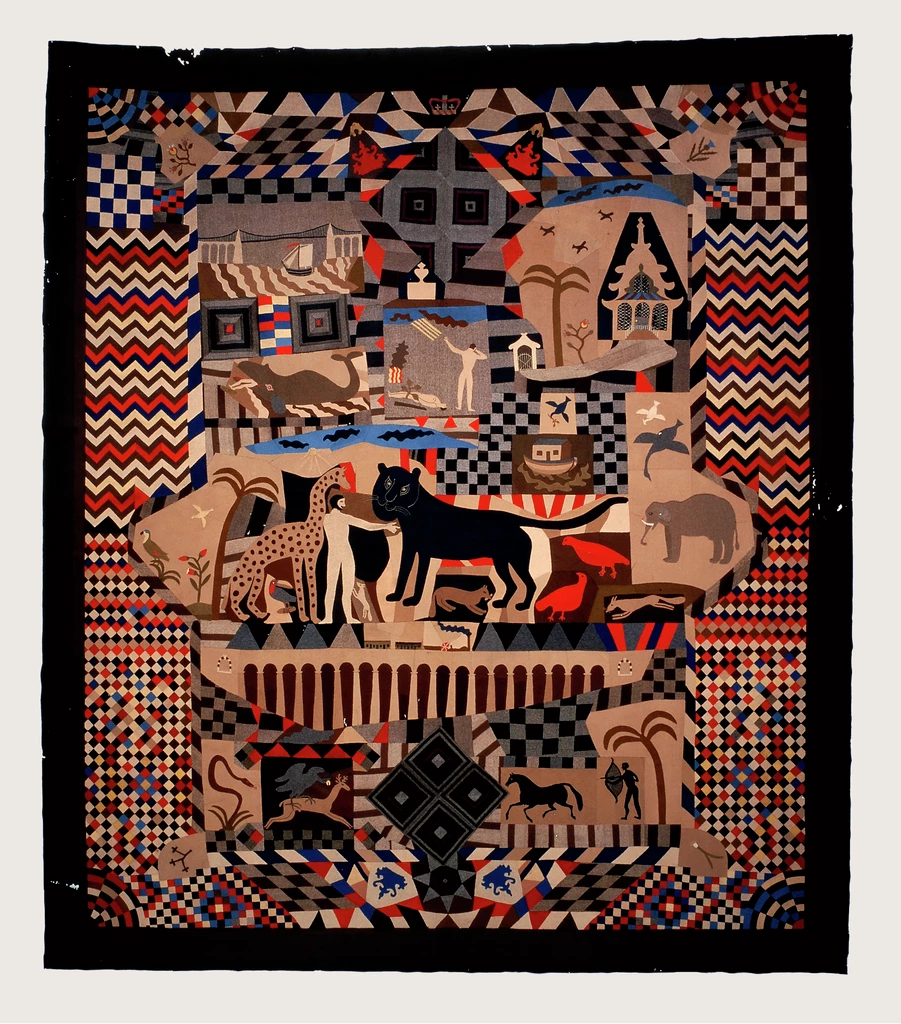
This creamware platter, designed by Mark Hearld to celebrate the major exhibition of British Folk Art at Tate Britain, is a stunning example of his artistic talent. The transfer-printed ceramic plate was made in Stoke-On-Trent by the Big Tomato Company. Hearld’s design for the Tate Shop was inspired by James Williams of Wrexham’s Patchwork Quilt. (see image) The platter is in very good condition indeed, and is referred to by the maker as a very slight ‘second’ aside from the edition of 250 produced for Tate Britain.
THE WREXHAM TAILOR’S QUILT: A BRIEF ACCOUNT
Introduction
The Wrexham Tailor’s Quilt is one of the most remarkable surviving examples of nineteenth-century Welsh textile craft, distinguished by its sophistication, narrative richness and technical ambition. Made in the 1840s by James Williams, a tailor from the Wrexham area, it stands apart from the predominantly domestic quilting tradition in Wales. Rather than following the familiar pattern-based or whole-cloth quilting styles associated with Welsh homes, this work demonstrates a professional maker’s eye for design, draughtsmanship and precision.
Now recognised as a significant piece of Welsh material heritage, the quilt represents an exceptional fusion of storytelling, patriotic imagery and skilled needlework.
Maker and Craft Context
James Williams was a trained tailor, accustomed to fine hand-stitching, precise cutting and pattern drafting. These professional skills are evident throughout the quilt. Unlike quilts created primarily for warmth and household use, this piece reveals the ambition of a maker versed in garment construction and decorative needlework, working at a scale more typical of framed artworks than bedding.
In mid-nineteenth-century Wales, quilting was predominantly a women’s craft, rooted in domestic life and intergenerational teaching. Williams’s work is therefore notable as a rare surviving example of a male-made narrative quilt, merging tailoring practice with a visual storytelling tradition.
Design and Imagery
The quilt’s visual programme is striking in its narrative complexity. Rather than relying solely on repeating geometric blocks or floral motifs, it incorporates detailed appliqué scenes, including:
- Biblical figures and allegories
- Architectural forms resembling classical or religious buildings
- Crown and royal imagery
- Heraldic and symbolic motifs drawn from British iconography
The scenes are surrounded by carefully worked borders and framed in a composition that suggests deliberate design planning rather than improvisational patchwork. Williams appears to have used dress fabrics, felt and tailored cloth remnants, drawing from the materials of his trade.
The quilt’s style evokes the illustrative impulse of chapbook woodcuts and religious prints, filtered through a needleworker’s technical vocabulary.
Technique
The technical execution demonstrates:
- Fine hand-stitching, consistent with professional tailoring skill
- Appliqué panels, requiring precision cutting and layering
- Embellishment using embroidery, adding texture and clarity
- Careful placement of contrasting cloth, enhancing visual definition
The maker’s ability to manipulate small fabric pieces into recognisable figures and architectural shapes speaks to an experienced hand accustomed to shaping cloth into meaningful forms.
Cultural Significance
The Wrexham Tailor’s Quilt carries several layers of cultural meaning:
Welsh Material Heritage
It stands as a celebrated example of textile craft from north Wales, illuminating regional practice beyond the better-documented South-Wales whole-cloth quilting style.
Male Craft in a Domestic Medium
Its creation challenges assumptions about gender roles within historic craft traditions, showing how professional tailoring intersected with broader needle-based creativity.
Narrative Quilting Tradition
The work aligns with the long European tradition of textiles as storytelling media, where cloth functions not only as material but as bearer of belief, identity and aspiration.
Patriotism and Morality
Its imagery suggests a blend of moral instruction, religious reference and loyalty to crown and nation — themes widely resonant in Victorian Britain.
Legacy and Preservation
The quilt has achieved recognition as a key work of Welsh textile history and has been preserved in museum care. It has drawn attention from curators, textile historians and craft scholars, who regard it as both an artistic achievement and a rare document of male participation in nineteenth-century needle arts.
Increasing public appreciation of textile heritage, combined with renewed interest in folk art and vernacular craft, has further elevated the quilt’s status as a cultural landmark.
Conclusion
The Wrexham Tailor’s Quilt is exceptional in both conception and execution: a large-scale textile narrative crafted by a skilled tailor with clear artistic ambition. Preserved into the modern era, it offers insight into the creativity, symbolism and technical excellence embedded in Welsh craft traditions. More than a functional object, it serves as a visual testament to personal devotion, skilled labour and the enduring cultural value of textile art.
Mark Hearld: A Short Biography
Mark Hearld (born 1974, York, England) is a contemporary British artist, illustrator, printmaker, and designer celebrated for his richly textured depictions of the natural world. His multidisciplinary practice encompasses collage, printmaking, ceramics, textiles, and book illustration, uniting fine art and craft through a distinctively British sensibility rooted in observation, imagination, and the joy of making.
Early Life and Education
Mark Hearld was born and raised in Yorkshire, where his fascination with the countryside began early. His childhood was spent exploring rural landscapes, observing wildlife, and drawing animals — habits that would form the foundation of his artistic voice.
He studied Illustration at the Glasgow School of Art, graduating in 1997, before completing a Master’s degree in Natural History Illustration at the Royal College of Art, London. There, he refined his observational skills and developed an interest in how the natural world could be reinterpreted through design and pattern.
Artistic Development and Influences
Hearld’s art draws inspiration from British flora and fauna, folk traditions, and mid-twentieth-century British artists such as Eric Ravilious, Edward Bawden, and John Piper. He also acknowledges the influence of Picasso’s collages and ceramics, particularly in the spontaneity and rhythm of his compositions.
His work embodies a reverence for the natural world filtered through the language of design. He transforms familiar subjects — birds, foxes, hares, hedgerows, and farmyards — into dynamic arrangements of colour and form. Each piece reveals a balance between careful observation and creative improvisation, combining accuracy with expressive freedom.
Media and Methods
Hearld works across a wide range of materials and processes. His collages, often made from hand-painted or found papers, form the heart of his practice. They are layered, textured, and full of movement, evoking the spontaneity of the natural world.
He also produces linocuts, lithographs, and screenprints, each reflecting his command of pattern and rhythm. His work extends naturally into ceramic decoration, wallpapers, and fabrics, where his motifs translate beautifully into domestic and interior settings.
His textile and wallpaper designs, such as the well-known Harvest Hare pattern, have become modern classics of British design. These works bridge the divide between fine art and applied art, reaffirming the unity of craft and creativity in everyday life.
Exhibitions and Collaborations
Since the early 2000s, Hearld’s work has been exhibited widely across the United Kingdom. His debut solo exhibition was presented in York in 2001, marking the beginning of a prolific career. Subsequent shows at institutions such as the Yorkshire Sculpture Park, The Scottish Gallery, and Godfrey & Watt have established his reputation as one of Britain’s leading contemporary artists inspired by nature.
Hearld has collaborated with numerous publishers, designers, and makers. His illustrations for Outside Your Window: A First Book of Nature introduced his work to a younger audience, while his Work Book (2012) and Raucous Invention: The Joy of Making (2022) document his creative process in depth.
He has also designed stage sets and contributed to film projects, including art direction for Nanny McPhee and the Big Bang (2010). His curatorial work includes the re-display of the Folk Art Collection at Compton Verney in 2018, demonstrating his deep engagement with British cultural heritage.
Style and Philosophy
Hearld’s art celebrates abundance, vitality, and the hand-made. He approaches his subjects with a collector’s eye and a maker’s hand, often surrounding himself with found objects, antique books, and folk art, all of which feed into his visual language.
His practice rejects the sterile precision of purely digital design in favour of tactile experimentation. He values the marks of process — the texture of paper, the irregularity of a cut, the overlap of colour — as integral to the final composition.
Central to Hearld’s philosophy is the joy of making: a belief that creativity flourishes through direct engagement with materials. His work encourages a renewed appreciation of the natural world, not through grand gestures but through attentive observation and playful interpretation.
Legacy and Continuing Work
Mark Hearld continues to live and work in York, where his home and studio reflect the eclectic and exuberant spirit of his art. His work is represented by leading galleries, and his designs feature in homes and collections across the country.
He is widely regarded as one of the most distinctive voices in contemporary British art — a figure who bridges fine art, craft, and design with authenticity and imagination. His contribution lies not only in his visual output but also in his reaffirmation of the handmade as a vital form of cultural expression.
SHOP WITH CONFIDENCE AT HORNSEYS
At Hornseys, we are dedicated to offering items that uphold the highest standards of quality and authenticity. Our collection of artwork is carefully curated to ensure that each item we offer is authentic, collated, and complete.
Here’s what sets us apart:
- Authenticity and Provenance: Each piece is researched and verified for authenticity, guaranteeing that you receive a genuine product.
- Expert Curation: We wholly own all our artworks. We trust our taste and have invested heavily in it. We have confidence in all artwork that we offer for sale.
- Customer Satisfaction: We strive to provide an exceptional customer experience, from detailed descriptions and provenance to secure and prompt delivery of your purchase.
- Returns Policy: We offer an unconditional guarantee on every item. If, however, you wish to make a return, items may be sent back to us within fourteen days of receipt for whatever reason. We request that we are notified in advance if you wish to do so. They must be returned to us in the same condition as they were sent for a full refund.
OUR COMMITMENT TO QUALITY AND SERVICE
Understanding the value and rarity of these items, we ensure that every aspect of your purchase meets the highest standards of quality and service. This includes:
- Free Expedited, Tracked, and Insured Delivery within the UK: Ensuring that your artwork arrives safely and promptly.
- Fully-Insured Worldwide Delivery: Offering peace of mind for international collectors with reliable and secure shipping options.
EXPLORE OUR COLLECTION
Visit Hornseys today to explore our fine collection of Mark Hearld’s works and other artworks. Whether you are an avid collector or looking for a special gift, our selection offers something truly unique. Located since 1976 in Ripon in the picturesque Yorkshire Dales, we are recognized as a destination gallery for tastefully curated artwork, design, and fine books.
Related products


You may also like…

BRAMBLE AND APPLE ALLOTMENT – ORIGINAL LITHOGRAPH EDITIONED AT THE CURWEN STUDIO
£1,195.00Hearld, Mark
THE CURWEN STUDIO 50TH ANNIVERSARY PORTFOLIO – EDITIONED AT THE CURWEN STUDIO
£3,500.00The Curwen Studio


