
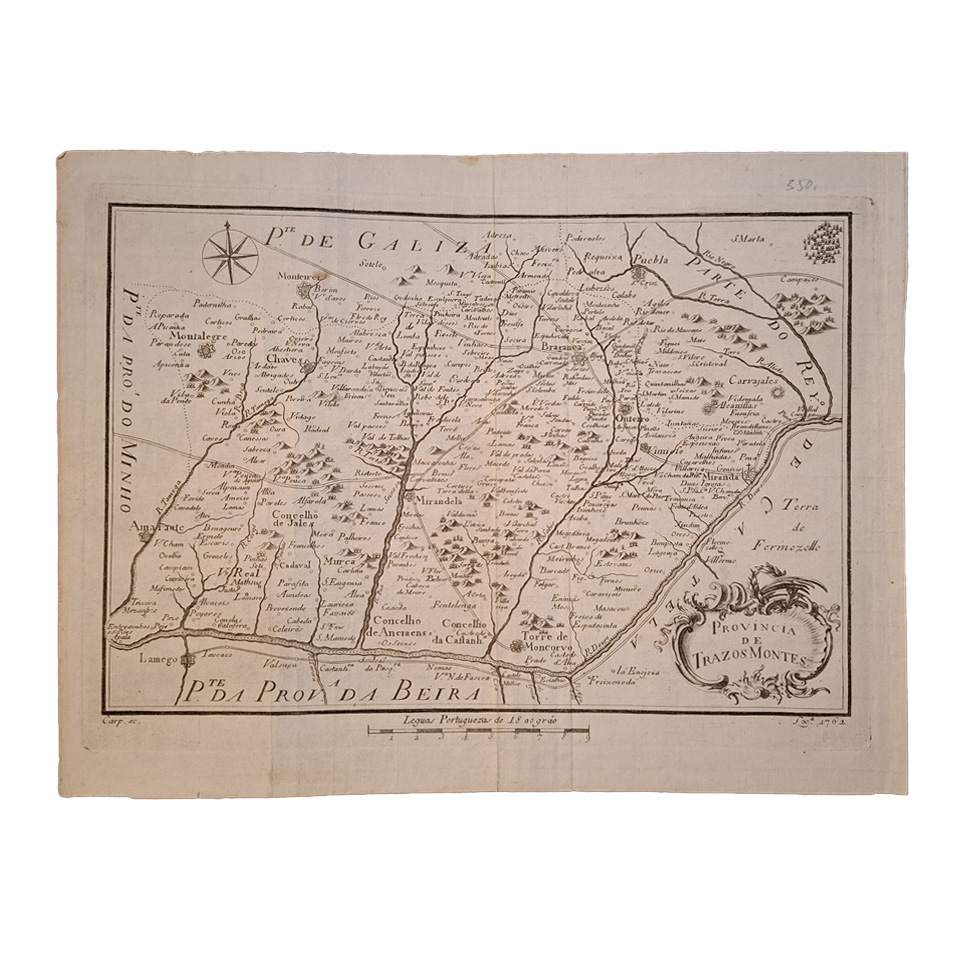
PROVINCIA DE TRAZOS MONTES – 1762
Baptista de Castro, J
£30.00
Availability: In stock
Product Description
PROVINCIA DE TRAZOS MONTES – 1762
Cartographer: J Baptista de Castro
Publisher: Not stated
Price: £30 (post-free in the UK)
Publication Date: 1762
Edition: 1st edition
Format: Copper engraving
Condition: In very good condition, unframed
Sheet Size: 20.8cm x 27.2cm
Condition:
Map of the Portuguese province of Trás-os-Montes. Original fold lines. Minor age toning and offsetting. In very good condition overall.
Location: Map Drawer C: FS: Folder M2000 002568
The Portuguese Province Of Trás-os-Montes In The 18th Century: A Brief Description
Trás-os-Montes, located in the north-eastern corner of Portugal, was one of the country’s historical provinces, known for its rugged terrain, remote location, and distinctive cultural identity. In the 18th century, this region remained relatively isolated but played a vital role in Portugal’s economic, military, and cultural landscape.
Geography and Landscape
The name Trás-os-Montes, meaning “Beyond the Mountains,” aptly describes the province’s location and topography. It was bounded by the Douro River to the south, the Minho province to the west, Galicia (Spain) to the north, and León (Spain) to the east.
- Terrain: The region was characterised by its mountainous landscape, dominated by the Marão, Alvão, and Montemuro ranges.
- Climate: The province experienced harsh winters and hot, dry summers, contributing to its agricultural challenges and shaping its traditional lifestyle.
- Rivers: The Douro River and its tributaries, including the Tâmega and Sabor, played a crucial role in irrigation and transportation.
Economy and Society
Trás-os-Montes in the 18th century had a predominantly agrarian economy, with local industries and crafts supplementing the livelihoods of its inhabitants.
Agriculture and Livestock
- The rocky terrain and poor soils made large-scale agriculture difficult. However, the province was known for subsistence farming, with crops such as wheat, barley, rye, maize, and olives.
- Viticulture: Vineyards thrived along the Douro River, contributing to the production of Port wine, which was gaining international recognition during this period.
- Livestock, particularly sheep and goats, were essential for providing meat, milk, and wool.
Local Industries
- Weaving and Textile Production: The province had a long-standing tradition of producing woollen goods and handmade textiles.
- Mining: Rich in mineral resources, Trás-os-Montes had small-scale mining of iron and other metals, which contributed to local industry.
Trade
- The region’s remoteness limited its involvement in national and international trade. However, its proximity to Spain facilitated cross-border commerce.
- Trade caravans transported goods, especially wine and agricultural products, to the southern provinces and the port of Porto.
Cultural Identity and Traditions
Trás-os-Montes was culturally distinct from other Portuguese provinces due to its geographical isolation and its mix of Celtic, Roman, and Moorish influences.
- Language and Dialect: The inhabitants spoke a distinct dialect of Portuguese, reflecting their cultural uniqueness.
- Festivals and Folk Traditions: Traditional festivals, music, and dances were integral to the social fabric. Celebrations often featured masks and costumes, especially during Carnival and religious feasts.
- Cuisine: The cuisine was hearty, relying on local ingredients such as lamb, chestnuts, and olives. Alheiras (a type of sausage) and smoked meats were staples.
Political and Military Importance
Trás-os-Montes had strategic importance due to its location on the Spanish border.
- Defence: The province served as a buffer zone against Spanish incursions, and its towns and villages often housed military garrisons.
- Fortifications: Towns such as Bragança and Chaves were fortified, with castles and walls that played crucial roles in defending Portuguese sovereignty during conflicts with Spain.
Key Towns and Settlements
- Bragança:
- The capital of Trás-os-Montes, known for its well-preserved medieval castle and city walls.
- A centre of administration and military activity.
- Chaves:
- Famous for its Roman heritage, including the Trajan Bridge, and its thermal baths.
- A strategic border town with strong fortifications.
- Miranda do Douro:
- Located on the border with Spain, it was a key site for trade and cultural exchange.
- Home to the Mirandese language, a recognised regional language.
Challenges and Decline
In the 18th century, Trás-os-Montes faced several challenges:
- Isolation: Poor infrastructure and limited transportation networks hindered development and integration with the rest of Portugal.
- Agricultural Struggles: The harsh climate and difficult terrain limited productivity, contributing to poverty.
- Depopulation: Many residents emigrated to other parts of Portugal or abroad, seeking better opportunities.
Legacy
Despite its challenges, Trás-os-Montes retained its cultural identity and contributed to Portugal’s history and economy. The region’s traditions, fortifications, and role in the production of Port wine ensured its lasting significance in the broader narrative of Portuguese history. Its rugged beauty and historical landmarks continue to attract interest, preserving the memory of its 18th-century character.
João Baptista de Castro (1700–1775): A Short Biography
João Baptista de Castro was a distinguished Portuguese priest, historian, and geographer in the 18th century. His scholarly contributions, particularly in cartography and historical studies, have left a lasting impact on Portuguese literature and geography.
Early Life and Education
Born in 1700, Castro pursued ecclesiastical studies, culminating in his ordination as a priest. His academic inclinations led him to explore various disciplines, including history, geography, and theology.
Major Works and Contributions
Castro’s intellectual pursuits resulted in several significant publications:
- “Mappa de Portugal Antigo e Moderno” (1762): This comprehensive work provided detailed maps and descriptions of Portugal’s regions, serving as a crucial reference for understanding the country’s geography during that era.
- “Roteiro Terrestre de Portugal” (1814): In this guide, Castro outlined the principal routes and distances between major Portuguese towns, offering insights into the nation’s infrastructure and travel practices in the 18th century.
- “Vida do Glorioso Patriarca S. José” (1761): This theological treatise delved into the life of Saint Joseph, reflecting Castro’s deep religious devotion and scholarly approach to theological subjects.
Legacy
João Baptista de Castro’s meticulous research and publications have been instrumental in preserving Portugal’s historical and geographical knowledge. His works continue to be valuable resources for historians and geographers studying Portugal’s past.
Note on Name Variations
It’s important to distinguish João Baptista de Castro from other individuals with similar names, such as Pedro Baptista de Castro, a contemporary researcher in materials science. João Baptista de Castro’s contributions are firmly rooted in the historical and geographical scholarship of 18th-century Portugal.
SHOP WITH CONFIDENCE AT HORNSEYS
At Hornseys, we are dedicated to offering items that uphold the highest standards of quality and authenticity. Our collection of artwork is carefully curated to ensure that each item we offer is authentic, collated, and complete.
Here’s what sets us apart:
- Authenticity and Provenance: Each map is researched and verified for authenticity.
- Expert Curation: We entirely own all our artworks. We trust our taste and have invested heavily in it. We have confidence in all artwork that we offer for sale.
- Customer Satisfaction: We strive to provide an exceptional customer experience, from detailed descriptions and provenance to secure and prompt delivery of your purchase.
- Returns Policy: We offer an unconditional guarantee on every item. If, however, you wish to make a return, artworks may be sent back to us within fourteen days of receipt for whatever reason. We request that we are notified in advance if you wish to do so. They must be returned to us in the same condition as they were sent for a full refund.
OUR COMMITMENT TO QUALITY AND SERVICE
Understanding the value and rarity of these items, we ensure that every aspect of your purchase meets the highest standards of quality and service. This includes:
- Free Expedited, Tracked, and Insured Delivery within the UK: Ensuring that your artwork arrives safely and promptly.
- Fully-Insured Worldwide Delivery: Offering peace of mind for international collectors with reliable and secure shipping options.
EXPLORE OUR COLLECTION
Visit Hornseys today to explore our fine collection of maps and other artworks. Whether you are an avid collector or looking for a special gift, our selection offers something truly unique. Located since 1976 in Ripon in the picturesque Yorkshire Dales, we are recognized as a destination gallery for tastefully curated artwork, rare maps, design, and fine books.
Related products

(Arctic, Nova Zembla) Partie De La Mer Glaciale Contenant La Nouvelle Zemble Et Le Pays Des Samoiedes
£85.00Bellin, Jacques Nicolas


You may also like…
ANTIQUORUM AFRICAE EPISCOPA TUUM GEOGRAPHIA DESCRIPTIO – 1640 – NORTHERN AFRICA
£95.00Tavernier, Melchior


