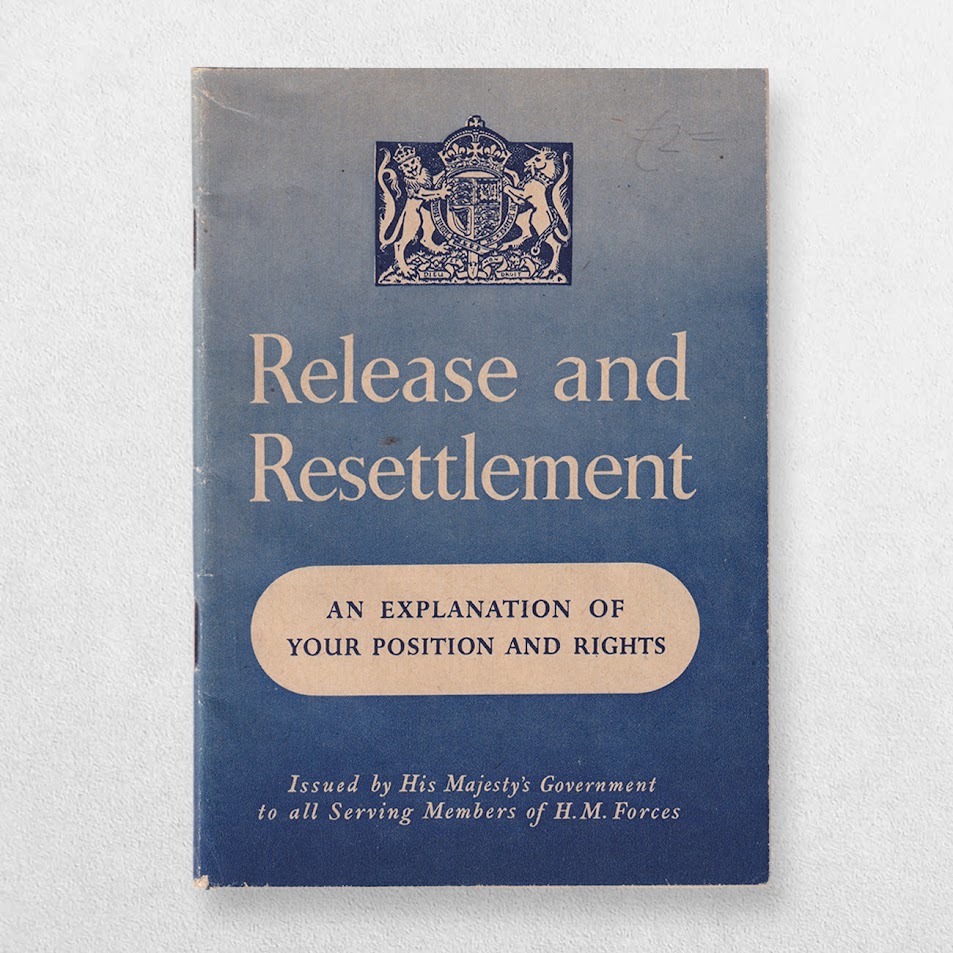
Release And Resettlement – An Explanation Of Your Position And Rights Issued By His Majesty’s Government To All Serving Members Of H. M. Forces
Author: H. M. Government
Price: £30
Publisher: HMSO
Editions: 1st edition
Publication Date: c.1945
Format: Original wrappers
Condition: Very good plus
Size: 12mo
Description:
Not dated but c.1944-1945. Original wrappers. 12mo. pp48. A guide to the interim relases for men and women from the Forces up to the cease fire. A near fine, bright, clean copy of a scarce item. From the collection of Steve Forbes, chairman of Forbes Magazine, who formed arguably the finest ever collection of Churchilliana.
Resettlement of British Forces After WWII: A Brief Account
The resettlement of British forces after the Second World War was a vast, multifaceted undertaking involving the demobilisation, reintegration, and reallocation of millions of servicemen and servicewomen. It was one of the largest post-war operations ever attempted by the British government and was critical not only to economic and social stability, but also to the moral responsibility of a nation emerging from six years of global conflict.
Context and Scale of Demobilisation
By 1945, over five million Britons were serving across the armed forces—Army, Royal Navy, Royal Air Force, and auxiliary units. As victory in Europe was declared in May 1945, and the war in the Pacific concluded in August, the British government was tasked with scaling down a vast military apparatus while maintaining a degree of global presence during a time of geopolitical uncertainty, particularly in occupied Germany, the Middle East, and parts of Asia.
The demobilisation programme had to strike a careful balance between military necessity and the desire—deeply felt across the country—for a return to civilian life. Many had been away from home for years, and social pressure mounted to bring them back swiftly and equitably.
The Demobilisation Scheme
The official demobilisation plan, devised before the war ended, was based on a points system called the “age-and-service scheme”. It prioritised release based on a combination of a serviceman’s age and length of military service. Those with the highest scores were demobilised first.
Special cases were made for individuals with urgent domestic responsibilities—such as widowed parents, dependants, or key roles in reconstruction industries.
The process was highly structured:
- Servicemen received a “demob suit”—a tailored civilian outfit designed to ease their transition from uniform to civilian life.
- Small financial grants and clothing coupons were provided.
- Orientation programmes helped returning personnel understand their employment rights, educational opportunities, and welfare options.
Despite efforts at fairness, the scheme was not without frustration. Some soldiers, especially those serving in far-flung theatres like Burma or Egypt, experienced long delays. Public impatience and troop unrest occasionally flared, prompting political responses and reviews.
Reintegration into Civilian Life
The British state took a proactive approach to post-service reintegration, informed by the failings experienced after the First World War. The government worked to avoid mass unemployment and social dislocation by investing in resettlement programmes, housing development, education, and job training.
Key aspects included:
- Retraining courses: Former military personnel could attend short courses tailored to specific trades—carpentry, mechanics, engineering, teaching and more.
- Further education: Universities and technical colleges expanded capacity to admit ex-servicemen, often under special government schemes.
- Priority housing: Local authorities were directed to give ex-service families special consideration amidst the severe post-war housing shortage.
- Employment placement: Job centres and regional labour boards worked to match ex-servicemen with work, often in government-backed infrastructure projects.
The Ministry of Labour played a central role in this transition, and employers were encouraged to reinstate returning personnel to their former jobs where practicable.
Continued Military Service and Overseas Presence
While large numbers returned to civilian life, others remained in service under new strategic roles:
- The British Army of the Rhine (BAOR) was stationed in Germany as part of the Allied occupation.
- Forces were deployed in Palestine, India, Malaya, and Greece, reflecting both colonial obligations and Cold War tensions.
- A professionalised standing military emerged from the reshaped post-war forces, with conscription—National Service—continuing until 1960 to maintain capacity.
Psychological and Social Adjustment
The psychological adjustment of ex-servicemen and women was a crucial though often overlooked aspect of post-war resettlement. Many carried trauma, both physical and emotional, into peacetime life. Family structures had changed during the war, and reintegration into domestic routines was not always smooth.
- Marriage strain, alienation from children, and difficulty adapting to civilian authority were common.
- Mental health support was rudimentary, though charities and informal networks offered some relief.
- The sense of shared purpose and camaraderie forged in service sometimes led to disillusionment with the mundane or fragmented nature of civilian society.
National Reconstruction and the Role of Veterans
Ex-servicemen were instrumental in rebuilding post-war Britain. They formed the backbone of labour in nationalised industries, housing construction, transportation, and public works. Many took advantage of the post-war welfare state, including the NHS (established in 1948), social security, and expanded education.
Their presence also shaped British politics and society:
- Many veterans entered public service, including Parliament and local government.
- Veteran associations influenced social policy and preserved the memory of wartime sacrifice.
- The war generation helped instil values of resilience, civic responsibility, and national service.
Legacy
The resettlement of British forces after the Second World War was a pivotal moment in the nation’s transition from wartime mobilisation to peacetime reconstruction. It required a careful blend of planning, compassion, and pragmatism. Despite inevitable imperfections, the effort was largely successful in reintegrating millions into a nation seeking to redefine itself in a new world order.
Today, the scale and scope of that resettlement remain a testament to Britain’s capacity to balance strategic demands with human needs—laying much of the groundwork for the modern welfare state and democratic society.
Why buy from us?
At Hornseys, we are committed to offering items that meet the highest standards of quality and authenticity. Our book collection is meticulously curated to ensure that each edition is a valuable and authentic piece of bibliographical history. Here’s what sets us apart:
- Authenticity and Provenance: Every book is researched, collated, and verified for authenticity.
- Expert Curation: Each book is selected with a keen eye for significance, condition, and rarity, ensuring a collection that is both diverse and distinguished.
- Customer Satisfaction: We strive to provide an exceptional customer experience, from detailed descriptions and provenance to secure and prompt delivery of your purchase.
- Returns Policy: We offer an unconditional guarantee on every item. If you wish to make a return, books may be sent back to us within fourteen days of receipt for any reason. We request advance notification of returns, and books must be returned in the same condition as sent for a full refund.
Explore Our Collection:
Visit Hornseys to explore our fine collection of rare and signed books. Whether you are an avid collector or looking for a special gift, our selection offers something truly unique. Located in the picturesque Yorkshire Dales, our Ripon gallery has been a haven for book lovers, art enthusiasts, and collectors since 1976.