
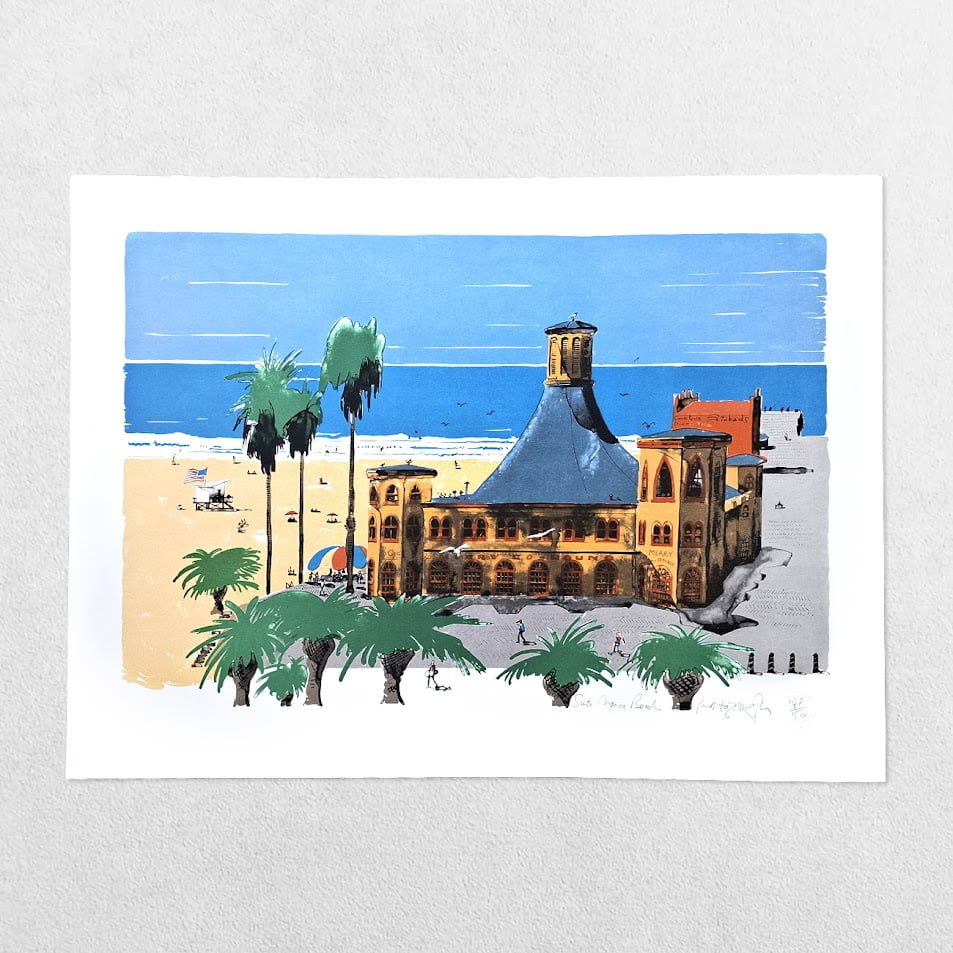
Santa Monica Beach: Original Lithograph
Hogarth, Paul OBE RA
£195.00
Availability: In stock
Product Description
Santa Monica Beach: Original Lithograph
Artist: Paul Hogarth
Price: £195.00
Publisher: The Artist & The Curwen Studio, UK
Publication date: c.1995
Format: Original lithograph
Condition: Very near fine to fine condition, unframed
Sheet Size: 54cm x 74cm
Edition: 143/150, signed by the artist
Description
This original lithograph by Paul Hogarth is one from a number that he produced at the Curwen Studio. The print, measuring 54cm x 74cm, is number 143 from the edition of 150 and is signed and numbered by the artist. The overall condition is very near fine to fine. It has never been framed.
Paul Hogarth: A Short Biography
Paul Hogarth (1917–2001) was a distinguished British artist and illustrator, widely recognised for his work in the fields of drawing and illustration, particularly his depiction of architectural and urban landscapes. Hogarth’s work is celebrated for its detailed and evocative portrayals of the human experience within the built environment.
Early Life and Education
Paul Hogarth was born on October 4, 1917, in Kendal, Cumbria, England. He grew up in a working-class family, which later influenced his political views and the themes in his work. Hogarth’s formal art education began at the Manchester School of Art in 1934, where he developed his skills in drawing and painting. He later continued his studies at St. Martin’s School of Art in London.
Career and Artistic Development
During the 1930s, Hogarth became involved with leftist political movements, including the Communist Party of Great Britain. This political engagement deeply influenced his early work, which often depicted the struggles of the working class and the impact of industrialization. In 1936, he joined the Mass Observation project, a social research organization that documented everyday life in Britain. Hogarth’s artistic career was interrupted by World War II, during which he served in the British Army. After the war, he travelled extensively, and his experiences abroad became a significant influence on his work. Hogarth’s travels took him across Europe, Africa, and Asia, where he documented his surroundings through detailed sketches and watercolours.
Collaboration with Writers
One of Hogarth’s most significant contributions to the arts was his collaboration with renowned writers, including Graham Greene and Lawrence Durrell. His illustrations for Greene’s novels, such as “Our Man in Havana” and “Travels with My Aunt”, brought him widespread acclaim. Hogarth’s ability to capture the essence of a story through his drawings made these collaborations particularly successful.
Later Life and Legacy
In the later years of his career, Paul Hogarth continued to travel and create, with his work becoming more focused on urban landscapes and the interaction between people and their environments. He was elected a Royal Academician in 1974, a testament to his impact on the British art scene. Hogarth’s work is held in numerous public and private collections, and he is remembered as one of the most significant British illustrators of the 20th century. His legacy lives on through his detailed and evocative illustrations that continue to inspire and captivate audiences.
Paul Hogarth passed away on December 27, 2001, leaving behind a rich legacy of artwork that documented the world with a unique blend of realism and social commentary.
Santa Monica Beach: A Historical Overview
Early History and Indigenous Inhabitants
Long before it became the world-famous tourist destination it is today, the area that is now Santa Monica Beach was inhabited by the Tongva people, a Native American tribe who lived in the Los Angeles Basin and Southern Channel Islands. The Tongva thrived in this region for thousands of years, relying on the rich coastal resources for their sustenance and cultural practices. The area was known for its natural springs, which were highly valued by the Tongva. The first European contact came in the 16th century, but significant changes began with the establishment of Spanish missions in the late 18th century, which disrupted the indigenous way of life.
Spanish and Mexican Era
Santa Monica’s modern history began with Spanish colonization. The land that includes present-day Santa Monica was part of Rancho San Vicente y Santa Monica, a large land grant given to Francisco Sepúlveda by the Spanish government in 1839. After Mexico gained independence from Spain in 1821, the rancho system continued under Mexican rule. During this time, the area was primarily used for cattle ranching. The coastline remained relatively undeveloped, with the beach and nearby bluffs serving as natural features of the landscape.
American Settlement and Development
In the mid-19th century, following the Mexican-American War and California’s subsequent statehood in 1850, the land was subdivided and sold off to American settlers. The town of Santa Monica was officially founded in 1875 by John P. Jones, a U.S. Senator from Nevada, and Colonel Robert S. Baker. They envisioned Santa Monica as a seaside resort and real estate venture, with the beach as its central attraction. Santa Monica’s popularity grew with the construction of the Los Angeles and Independence Railroad, which connected the city to Los Angeles and facilitated the transport of visitors. By the late 19th century, the beach began to attract tourists and settlers, leading to the construction of hotels, bathhouses, and other recreational facilities.
The Early 20th Century: A Resort Town
The early 20th century was a period of rapid growth and development for Santa Monica Beach. The construction of the Santa Monica Pier in 1909 became a major draw for tourists, offering an amusement park, fishing spots, and other entertainment. The pier remains one of the city’s most famous landmarks. The 1920s and 1930s saw Santa Monica Beach solidify its reputation as a glamourous destination for Hollywood stars and wealthy Angelenos. Luxury hotels, such as the Miramar and the Casa del Mar, catered to the elite, while the beach itself was a hub for recreation, with activities ranging from sunbathing to surfing. During this time, the beach also became a centre for physical fitness, largely due to the influence of Muscle Beach, an iconic outdoor gym located just south of the Santa Monica Pier. Muscle Beach attracted bodybuilders, gymnasts, and acrobats, contributing to the beach’s vibrant and eclectic culture.
Post-War Era and Modern Development
After World War II, Santa Monica Beach continued to evolve, with increased development along the coastline. The 1950s and 1960s saw the construction of more residential and commercial buildings, and the beach became even more accessible due to the expansion of the Pacific Coast Highway. During the 1960s and 1970s, the area also became known for its countercultural movements, with the beach serving as a gathering place for artists, musicians, and activists. Despite this, the beach maintained its appeal as a family-friendly destination, and efforts were made to preserve its natural beauty and accessibility. In the late 20th century, Santa Monica Beach underwent several environmental and infrastructural improvements. Efforts were made to combat erosion, improve water quality, and enhance public amenities. The creation of the Santa Monica State Beach, a 3.5-mile-long state park, ensured that much of the beachfront would remain open to the public.
Santa Monica Beach Today
Today, Santa Monica Beach is one of the most famous beaches in the world, attracting millions of visitors each year. It is known for its wide sandy shores, vibrant pier, and stunning views of the Pacific Ocean. The beach is a hub for a variety of activities, including surfing, volleyball, biking, and simply relaxing by the sea. The area around the beach has also become a bustling urban centre, with shopping, dining, and entertainment options that cater to both locals and tourists. Despite the development, efforts continue to maintain the beach’s natural beauty and ensure it remains a welcoming place for everyone.
Santa Monica Beach remains a quintessential Southern California destination, blending the charm of its historical past with the vibrancy of modern life. Its long history, from indigenous roots to its current status as a global icon, reflects the dynamic and ever-evolving nature of this beloved coastal community.
SHOP WITH CONFIDENCE AT HORNSEYS
At Hornseys, we are dedicated to offering items that uphold the highest standards of quality and authenticity. Our collection of artwork is carefully curated to ensure that each edition is a valuable and authentic piece. Here’s what sets us apart:
Authenticity and Provenance: Each print is researched and verified for authenticity, guaranteeing that you receive a genuine signature from the artist.
Expert Curation: We wholly own all our artworks. We trust our taste and have invested heavily in it. We have confidence in all artwork that we offer for sale.
Customer Satisfaction: We strive to provide an exceptional customer experience, from detailed descriptions and provenance to secure and prompt delivery of your purchase.
Returns Policy: We offer an unconditional guarantee on every item. If, however, you wish to make a return, artworks may be sent back to us within fourteen days of receipt for whatever reason. We request that we are notified in advance if you wish to do so. They must be returned to us in the same condition as they were sent for a full refund.
OUR COMMITMENT TO QUALITY AND SERVICE
Understanding the value and rarity of these items, we ensure that every aspect of your purchase meets the highest standards of quality and service. This includes:
Free Expedited, Tracked, and Insured Delivery within the UK: Ensuring that your artwork arrives safely and promptly.
Fully-Insured Worldwide Delivery: Offering peace of mind for international collectors with reliable and secure shipping options.
EXPLORE OUR COLLECTION
Visit Hornseys today to explore our fine collection of Paul Hogarth’s artworks and books. Whether you are an avid collector or looking for a special gift, our selection offers something truly unique. Located since 1976 in Ripon in the picturesque Yorkshire Dales, we are recognised as a destination gallery for tastefully curated artwork, design, and fine books.
Related products


You may also like…

The Mediterranean Shore: Travels In Lawrence Durrell Country: Signed By The Artist
£125.00Hogarth, Paul with introduction and commentary by Durrell, Lawrence
Graham Greene Country Visited By Paul Hogarth: Presentation Copy From The Artist To Elisabeth Frink
£225.00Hogarth, Paul with foreword and commentary by Greene, Graham


