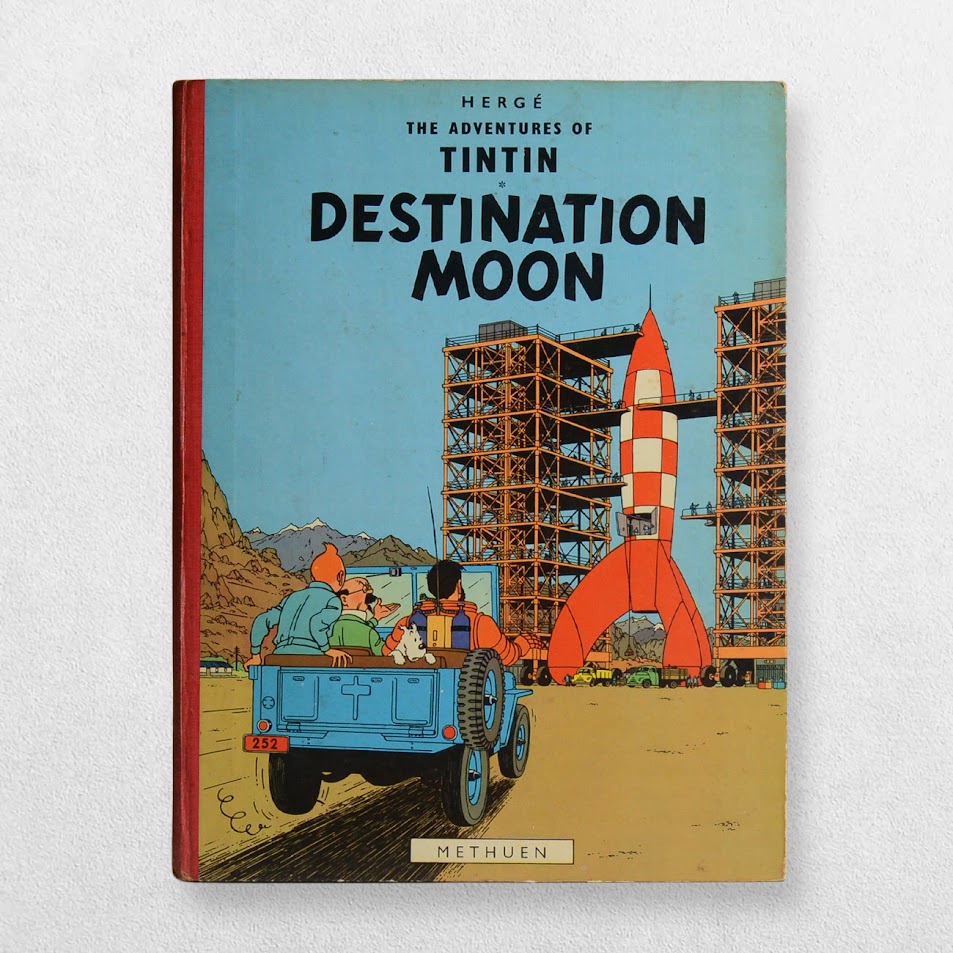
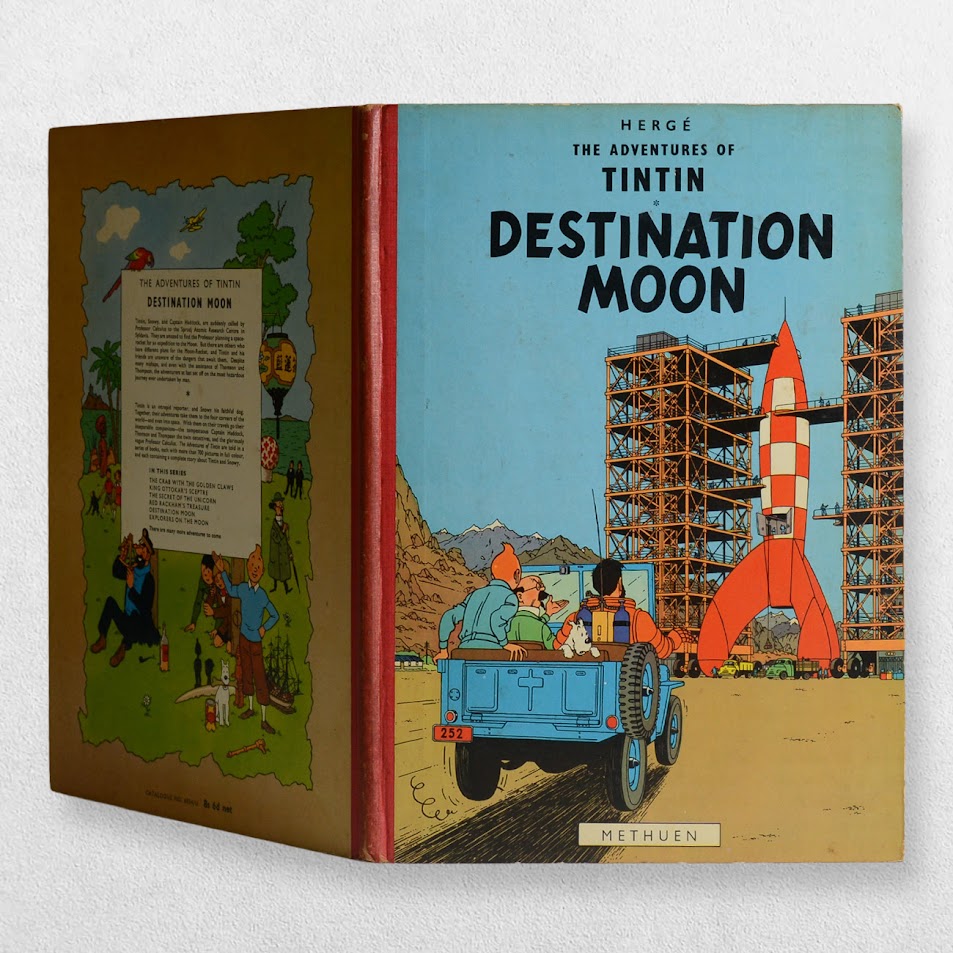
The Adventures Of Tintin – Destination Moon – First Edition – 1959
Hergé
£425.00
Availability: In stock
Product Description
The Adventures Of Tintin – Destination Moon – First Edition – 1959
Author: Hergé
Price: £425.00
Publisher: Methuen, London, UK
Publication Date: 1959
Format: Original cloth-backed boards with pictorial endpapers
Condition: Very good
Size: 23.2cm x 30.7cm
Pages: 62
Illustrations: Illustrated throughout in colour by the author
Description:
Published by Methuen, London, UK, 1959. 1st UK edition. Original cloth-backed boards. Pictorial endpapers. Size: 23.2cm x 30.7cm. Pp. 62. Illustrated throughout in colour by the author. Very slight rubbing and fading to the spine. Minor rubbing to the edges. Pages very slightly toned as usual. Binding very nice and tight. A very good, tight, clean copy.
Destination Moon: A Brief Summary
Destination Moon (Objectif Lune, 1953) is the sixteenth volume in The Adventures of Tintin series by Hergé (Georges Remi). It marks a decisive turning point in the saga — the moment when Tintin, Captain Haddock, and Professor Calculus leave behind the political and colonial themes of earlier adventures to embark on one of the most visionary feats in twentieth-century comic art: the conquest of space.
Published four years before the launch of Sputnik and sixteen years before the Apollo 11 mission, Destination Moon demonstrates Hergé’s extraordinary foresight and commitment to scientific realism. The story lays the groundwork for its sequel, Explorers on the Moon (On a marché sur la Lune, 1954), forming a two-part narrative that remains one of the most influential portrayals of space travel in fiction.
Publication Background
Hergé began work on Destination Moon in 1950, during a period of recovery after personal and creative turmoil following the Second World War. With Belgium rebuilding and science emerging as a symbol of optimism, Hergé turned away from political satire toward technological adventure.
He consulted physicists, engineers, and astronomers, including Alexis Lecoin and Bernard Heuvelmans, to ensure the accuracy of rocket design, propulsion, and spaceflight mechanics. His commitment to authenticity gave the story a rare sense of credibility — a meticulous blend of scientific precision and imaginative wonder.
Plot Summary
The story opens with Tintin, Captain Haddock, and Snowy receiving an invitation from Professor Calculus (Cuthbert Calculus) to visit him in the fictional European kingdom of Syldavia, where he has established a top-secret research centre.
Arrival in Syldavia
At the Sprodj Atomic Research Centre, Tintin and Haddock discover that Calculus is leading an ambitious project to build a nuclear-powered rocket capable of reaching the Moon. The base, located in a remote mountainous region, is guarded by armed soldiers and shrouded in secrecy.
Calculus reveals the colossal rocket — a sleek red-and-white craft based on the German V2 model — and invites Tintin and Haddock to assist with its preparation.
Espionage and Sabotage
As work progresses, mysterious incidents begin to occur. Documents go missing, equipment malfunctions, and sabotage attempts suggest that foreign agents are attempting to steal the project’s secrets. Tintin investigates, uncovering a network of espionage led by the treacherous Colonel Boris Jorgen and aided by an insider — the conflicted scientist Frank Wolff.
Testing and Launch
Despite the tension, Calculus and his team complete the rocket. A prototype unmanned rocket is launched successfully, paving the way for a manned mission.
The story concludes with Tintin, Captain Haddock, Calculus, Wolff, and Snowy preparing to board the spacecraft. As the countdown begins, Tintin realises with astonishment that the rocket is not heading to space for testing — it is the actual mission to the Moon.
The final page delivers one of the most dramatic cliff-hangers in the Tintin canon: the thunderous blast-off that propels the heroes into space, setting the stage for Explorers on the Moon.
Major Characters
Tintin
Calm, capable, and methodical, Tintin serves as the moral and intellectual anchor of the expedition. His role shifts from journalist to participant in humanity’s most daring scientific undertaking, embodying reason and courage.
Captain Haddock
Haddock provides humour and emotional depth. His gruff scepticism, fear of the unknown, and reluctant acceptance of adventure contrast beautifully with Tintin’s composure. His comic frustration during astronaut training adds warmth to the otherwise technical narrative.
Professor Calculus
The heart of the story, Calculus is portrayed as a visionary scientist — eccentric yet brilliant. His dream of reaching the Moon is both scientific and poetic, representing humankind’s yearning for progress and discovery.
Frank Wolff
Introduced as Calculus’s assistant, Wolff becomes one of the series’ most tragic figures. His quiet guilt and eventual self-sacrifice in the sequel (Explorers on the Moon) add emotional gravity to both works.
Colonel Boris Jorgen
A returning antagonist from King Ottokar’s Sceptre, Jorgen symbolises espionage, treachery, and Cold War paranoia. His infiltration of the project reflects the era’s anxieties about secrecy and technological theft.
Scientific and Technical Realism
Hergé’s depiction of space travel was remarkably prescient. Every aspect — from the design of the rocket to the preparation of the crew — was based on cutting-edge knowledge of the early 1950s.
- Rocket Design: Inspired by German V2 missiles but enlarged and stylised in Hergé’s signature red-and-white checkerboard pattern.
- Atomic Power: The rocket’s propulsion system is nuclear, reflecting post-war fascination with atomic energy as both threat and promise.
- Training: The depiction of astronaut preparation, including centrifuge testing and pressure simulation, anticipates real-life space programmes.
- Mission Structure: Hergé accurately portrayed countdown procedures, launch dynamics, and zero-gravity conditions — long before these became familiar to the public.
This scientific accuracy lent the story immense credibility and helped establish the Tintin series as serious, intelligent literature rather than simple adventure comic.
Themes and Analysis
- The Spirit of Scientific Discovery
Destination Moon celebrates human curiosity and ingenuity. Professor Calculus’s project embodies optimism in progress — the belief that knowledge can elevate humanity beyond its limitations.
Hergé’s tone is reverent but balanced: science is portrayed as noble, yet fragile — constantly threatened by greed, espionage, and moral compromise.
- The Cold War and the Politics of Secrecy
The story reflects the geopolitical anxieties of its time. The Sprodj base evokes both the clandestine atmosphere of nuclear research and the paranoia of espionage during the early Cold War.
Syldavia’s national pride and the ever-present threat of foreign spies echo the real-world rivalry between East and West.
- The Triumph of Human Cooperation
Despite political tension and personal conflict, the central message is one of collaboration. Scientists, engineers, and explorers of different backgrounds unite to achieve a common goal.
Tintin’s integrity, Haddock’s courage, and Calculus’s intellect form a microcosm of the ideal scientific community — one guided by truth rather than power.
Artistic Excellence
Visually, Destination Moon is among Hergé’s most accomplished works. The clean lines, architectural precision, and cinematic framing give the album a documentary quality.
The Sprodj Base — with its observation towers, hangars, and laboratories — stands as one of Hergé’s great feats of design. Its geometric layout and technical realism influenced later depictions of space centres in film and television, including 2001: A Space Odyssey.
The story’s pacing — alternating between calm technical exposition and bursts of tension — creates an atmosphere of anticipation rare in comics of the era.
Moral and Philosophical Dimension
At its heart, Destination Moon is a meditation on the human condition. It contrasts scientific aspiration with moral responsibility.
Professor Calculus’s vision represents faith in reason and human progress; the espionage subplot represents the ever-present danger of corruption and moral weakness. The story thus becomes a moral allegory: knowledge without conscience can be destructive.
Tintin’s role as moral witness ensures that the pursuit of knowledge remains grounded in decency and humility.
Psychological Reading
Hergé’s work on Destination Moon coincided with a period of introspection and emotional recovery. The story’s emphasis on teamwork, discipline, and forward motion may reflect the artist’s personal search for order after years of inner conflict.
The Moon project symbolises renewal — a way of looking outward after years of isolation and controversy. For Hergé, as for Calculus, the journey to the Moon was as much psychological as scientific: an act of faith in humanity’s better nature.
Legacy and Impact
Destination Moon and its sequel, Explorers on the Moon, remain masterpieces of speculative fiction. Their influence can be traced across popular culture — from Franco-Belgian comics to global space-themed literature and film.
When humanity finally set foot on the Moon in 1969, readers around the world marvelled at how accurately Hergé had anticipated the event. His blend of imagination, research, and moral vision gave the stories a prophetic quality.
Today, Destination Moon stands as a landmark in the history of graphic storytelling — a testament to the power of art to inspire both intellect and wonder.
Summary
- Title: Destination Moon (Objectif Lune)
- First Published: 1953
- Creator: Hergé (Georges Remi)
- Main Characters: Tintin, Captain Haddock, Professor Calculus, Frank Wolff, Colonel Jorgen
- Setting: Sprodj Atomic Research Centre, Syldavia
- Themes: Scientific progress, moral responsibility, Cold War espionage, cooperation, curiosity
- Significance: Prefigured real-world space exploration with scientific and moral authenticity
Conclusion
Destination Moon represents Hergé at the height of his artistic and intellectual powers. Combining rigorous research with visionary storytelling, it captures the optimism and anxiety of an age poised on the edge of the Space Race.
For readers, it remains more than an adventure — it is a reflection on what it means to dream, to strive, and to believe in human ingenuity.
In the red-and-white rocket that carries Tintin and his companions skyward, Hergé distilled a universal truth: that progress, when guided by conscience and curiosity, can turn imagination into reality.
Why buy from us?
At Hornseys, we are dedicated to offering items that uphold the highest standards of quality and authenticity. Our book collection is carefully curated to ensure that each edition is a valuable and authentic piece of bibliographical history. Here’s what sets us apart:
- Authenticity and Provenance: Every book is researched, collated and verified for authenticity.
- Expert Curation: Each book is selected using our keen eye for significance, condition, and rarity, ensuring a collection that is both diverse and distinguished.
- Customer Satisfaction: We strive to provide an exceptional customer experience, from detailed descriptions and provenance to secure and prompt delivery of your purchase.
- Returns Policy: We offer an unconditional guarantee on every item. If, however, you wish to make a return, books may be sent back to us within fourteen days of receipt for whatever reason. We request that we are notified in advance if you wish to do so. They must be returned to us in the same condition as they were sent for a full refund.
Cataloguer: Daniel Hornsey
Daniel Hornsey has specialised in fine and rare books, ephemera, and collectors’ editions for over thirty years. As a long-standing member of the antiquarian book trade, he has advised private collectors, curated catalogues, and sourced works for leading dealers, libraries and institutions across the world.
Hornseys’ exhibit regularly at book and map fairs in London and throughout the UK and are members of the Provincial Booksellers Fairs Association, the PBFA.
His fascination with Hergé’s work — especially ‘The Adventures of Tintin’ — began in childhood. Daniel recalls reading Tintin in original European editions and quickly recognising that these were not merely children’s books, but finely illustrated narratives crafted with artistic depth and wit.
As noted by the Musée Hergé in Louvain-la-Neuve, Hergé’s ‘ligne claire’ style has influenced generations of European comic artists and his original drawings and paintings command very high prices with his painting of ‘The Blue Lotus’ jar fetching £2.8m at auction in 2021.
By presenting these works through Hornseys’, he hopes to contribute to the continued appreciation of one of the 20th century’s most influential illustrators, helping new generations discover the artistry and legacy of Hergé.
Related products

The Gruffalo & The Gruffalo’s Child: First Deluxe Miniature Editions Both Signed By Julia Donaldson & Axel Scheffler
£495.00Donaldson, Julia & Scheffler, Axel
When We Were Very Young – Winnie The Pooh – Now We Are Six – The House At Pooh Corner – The Collectors’ Facsimile Edition – Four Volumes In Slipcase
£85.00Milne, A. A. & Shepard, Ernest H