
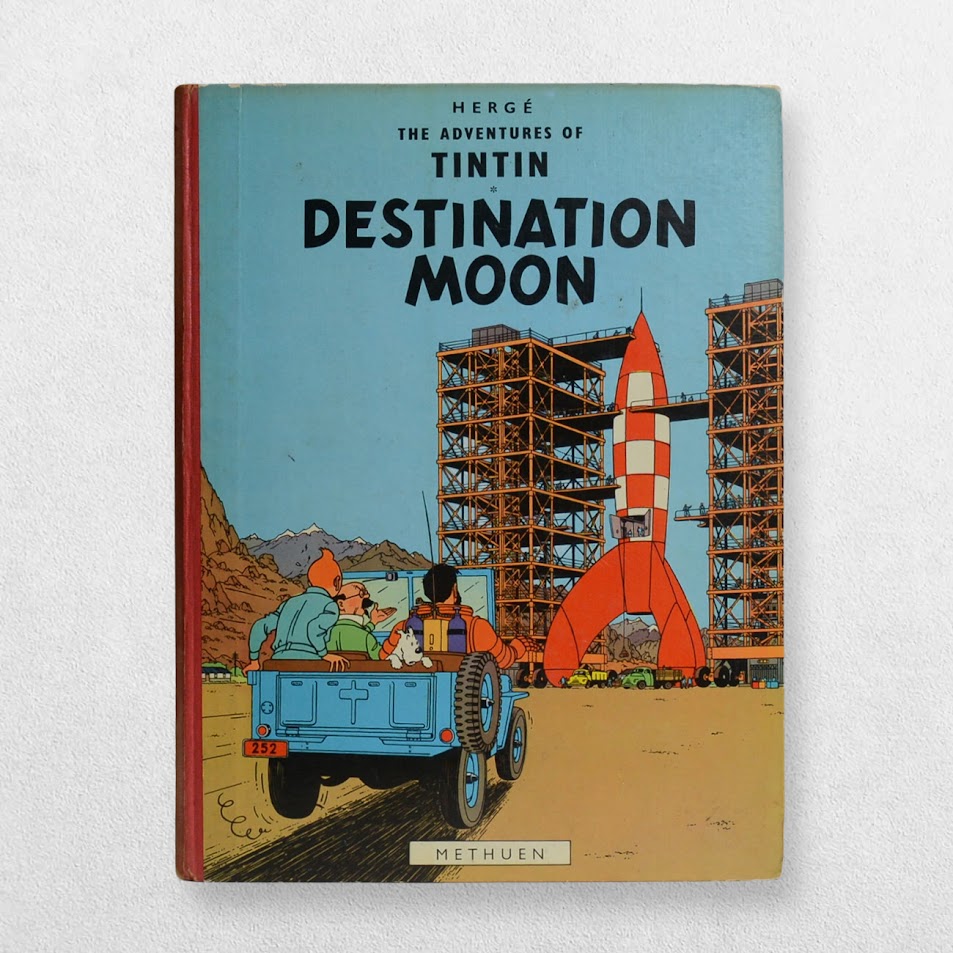
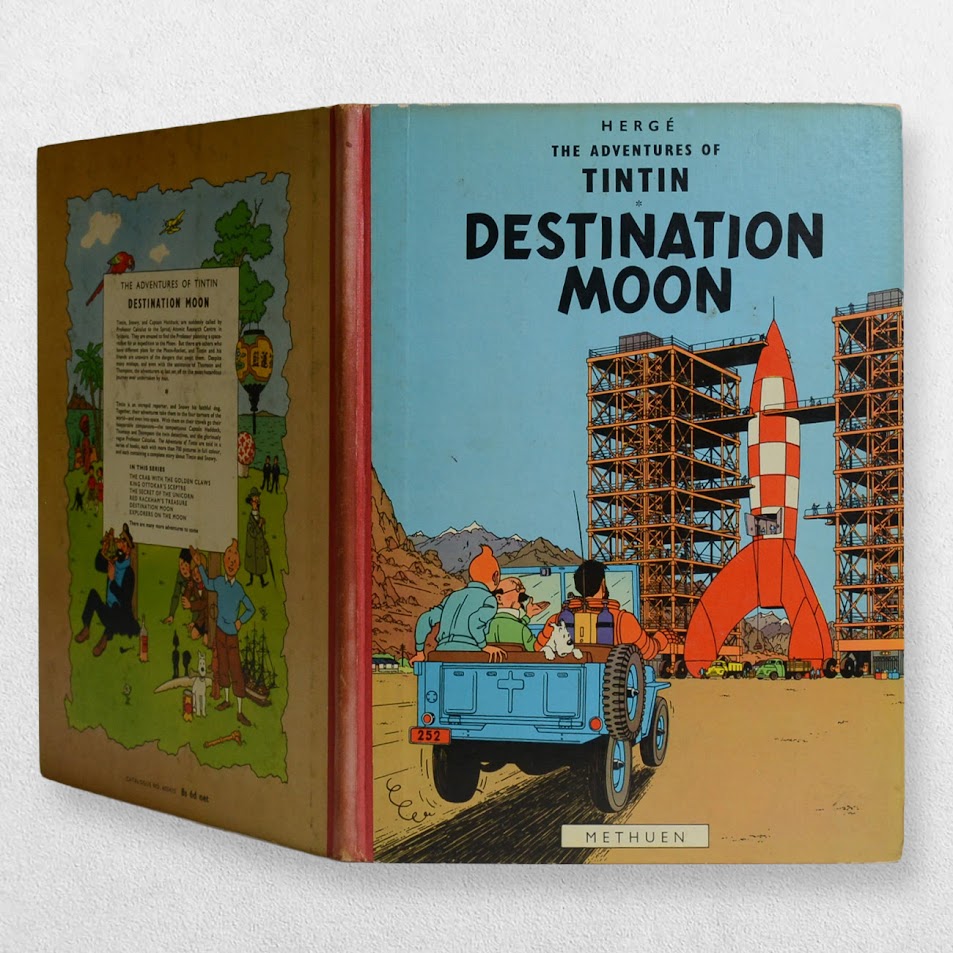
The Adventures Of Tintin – Destination Moon – First Edition – 1959
Hergé
£375.00
Out of stock
Product Description
The Adventures of Tintin: Destination Moon – First Edition
Author: Hergé
Price: £375.00
Publisher: Methuen, London, UK
Publication Date: 1959
Format: Original cloth-backed boards with pictorial endpapers
Condition: Very good
Size: 23.2cm x 30.7cm
Pages: 62
Illustrations: Illustrated throughout in colour by the author
Description:
Published by Methuen, London, UK, 1959. 1st UK edition. Original cloth-backed boards. Pictorial endpapers. Size: 23.2cm x 30.7cm. Pp. 62. Illustrated throughout in colour by the author. Binding nice and tight. Slight rubbing and fading to the spine with a couple of minor marks. Minor rubbing to the edges. Pages very slightly toned as usual. Binding very nice and tight. A very good, tight, clean copy.
Destination Moon: A Brief Summary
Destination Moon, first published in 1953 in French, is the sixteenth volume in Hergé’s The Adventures of Tintin. It marks the beginning of a two-part narrative completed in Explorers on the Moon. The story is a landmark in the series, notable for its meticulous research, scientific detail, and ambitious scope. It places Tintin, Captain Haddock, and Professor Calculus at the forefront of space exploration, years before the real-world Moon landings.
Arrival in Syldavia
The story begins with Tintin, Haddock, and Snowy travelling to the fictional Balkan kingdom of Syldavia at the invitation of Professor Cuthbert Calculus. The professor has been working in secrecy on an ambitious project: the construction of a nuclear-powered rocket capable of reaching the Moon. Tintin and Haddock are astonished by the scale and ambition of the enterprise, which is being carried out at a heavily guarded research facility.
The Rocket Project
Calculus reveals his plans for space travel and introduces the experimental rocket design. His enthusiasm and eccentricity, tempered by his brilliance, drive the project forward. Hergé provides detailed illustrations of laboratories, workshops, and rocket models, reflecting his thorough research and the influence of contemporary science.
Despite its scientific grounding, the project is plagued by challenges. Sabotage and espionage threaten its success, as rival powers attempt to steal Calculus’s secrets. Tintin and Haddock uncover plots by enemy agents, culminating in dramatic confrontations that highlight the ever-present danger of Cold War tensions.
Espionage and Suspense
The narrative balances scientific detail with suspenseful action. Tintin demonstrates his keen intellect and bravery in foiling sabotage attempts, while Haddock’s fiery temperament and comic mishaps provide humour. The detectives Thomson and Thompson also arrive, though their incompetence creates more problems than solutions.
As the rocket nears completion, tension builds. A key antagonist, Colonel Jorgen (previously seen in King Ottokar’s Sceptre), infiltrates the project, determined to disrupt the mission. His presence underscores the international stakes of the venture.
Preparation for the Mission
With espionage defeated and the rocket complete, the focus shifts to preparation for the journey itself. Hergé portrays the rigorous training of Tintin, Haddock, and the crew as they familiarise themselves with the technical demands of space travel. The climax of the book comes with the countdown and launch sequence, depicted in striking detail.
As the rocket lifts off, Tintin, Haddock, Calculus, Thomson, and Thompson are propelled into space, setting the stage for the continuation of the adventure in Explorers on the Moon.
Themes and Significance
Destination Moon reflects post-war optimism in science and technology, capturing humanity’s fascination with space exploration. It is one of Hergé’s most ambitious works, blending adventure with technical precision. The story highlights themes of ingenuity, perseverance, and the dangers of espionage, while also offering humour through Haddock’s exasperation and the detectives’ blunders.
Conclusion
Destination Moon stands as a milestone in The Adventures of Tintin, combining meticulous scientific detail with gripping narrative. By envisioning a realistic journey to the Moon years before it became reality, Hergé demonstrated his foresight and commitment to authenticity. The volume is both an exciting prelude to Explorers on the Moon and a testament to the enduring appeal of Tintin’s adventures in pushing the boundaries of discovery.
Why buy from us?
At Hornseys, we are dedicated to offering items that uphold the highest standards of quality and authenticity. Our book collection is carefully curated to ensure that each edition is a valuable and authentic piece of bibliographical history. Here’s what sets us apart:
- Authenticity and Provenance: Every book is researched, collated and verified for authenticity.
- Expert Curation: Each book is selected using our keen eye for significance, condition, and rarity, ensuring a collection that is both diverse and distinguished.
- Customer Satisfaction: We strive to provide an exceptional customer experience, from detailed descriptions and provenance to secure and prompt delivery of your purchase.
- Returns Policy: We offer an unconditional guarantee on every item. If, however, you wish to make a return, books may be sent back to us within fourteen days of receipt for whatever reason. We request that we are notified in advance if you wish to do so. They must be returned to us in the same condition as they were sent for a full refund.
Related products

E H Shepard, The Man Who Drew Pooh: The Story Of E H Shepard: Signed By The Author
£35.00Chandler, Arthur R


