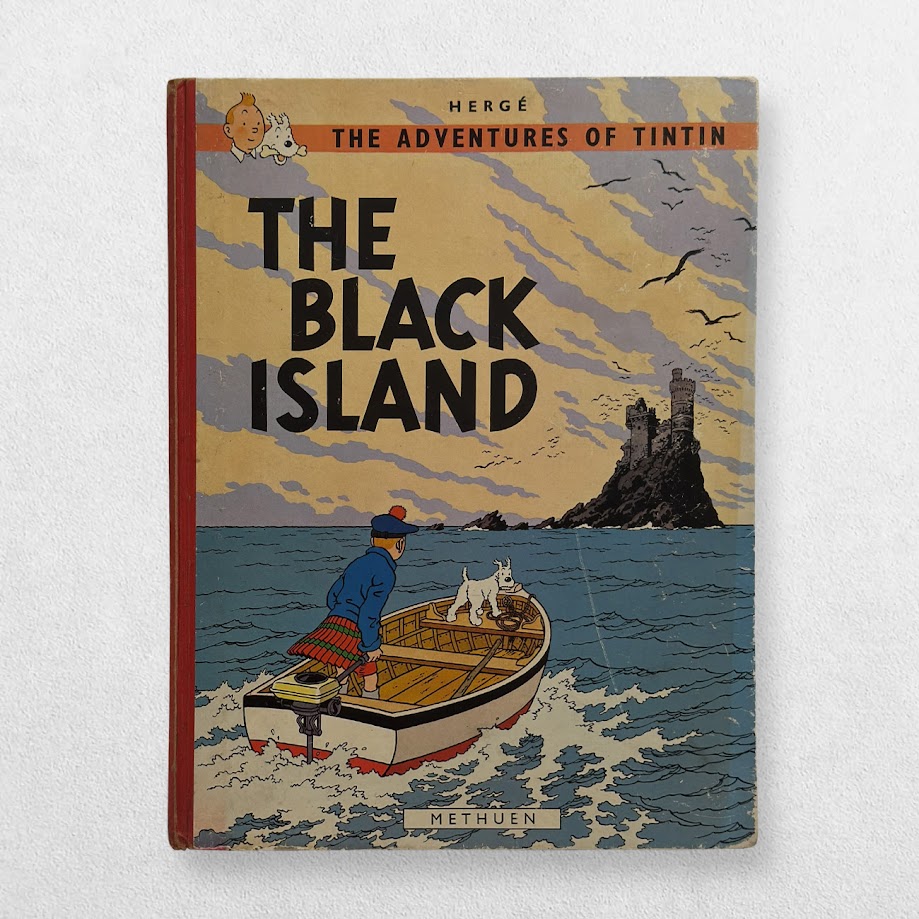
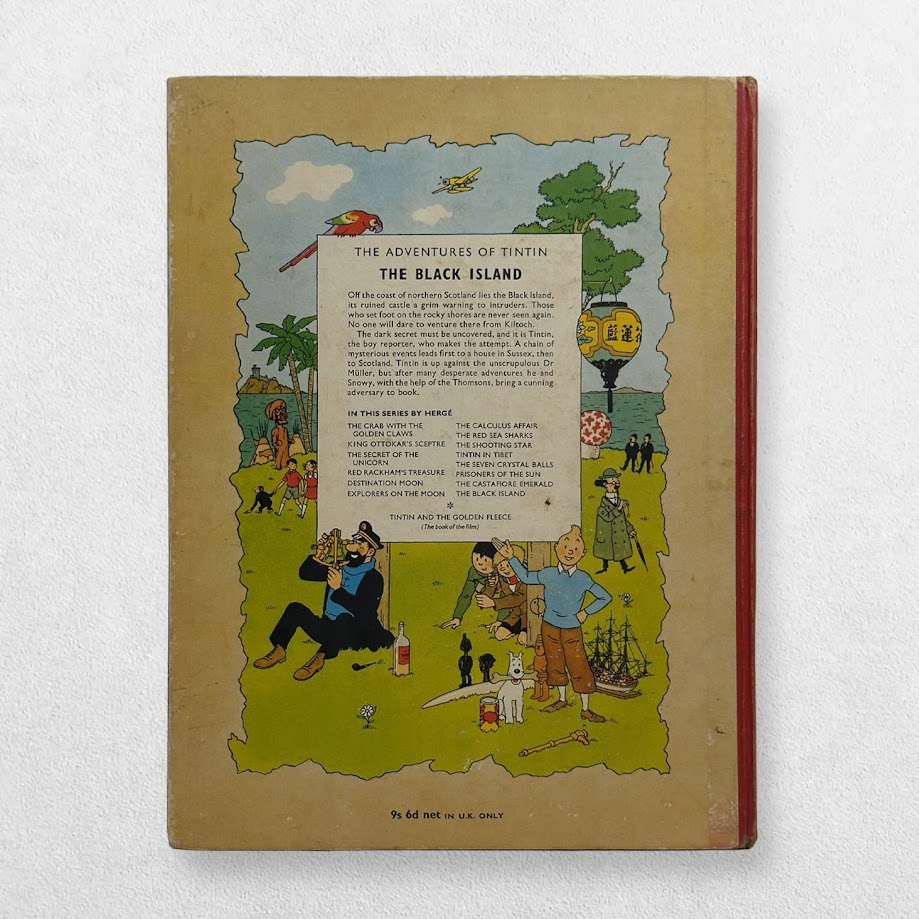
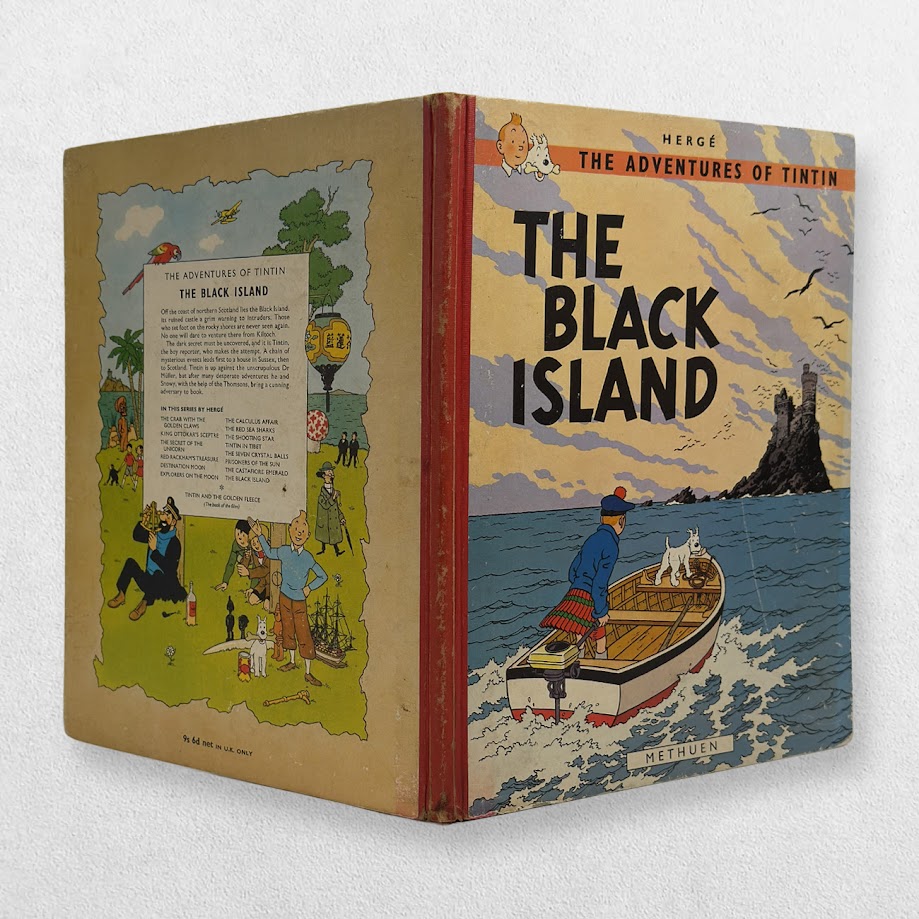
The Adventures Of Tintin – The Black Island – First Edition – 1966
Hergé
£125.00
Availability: In stock
Product Description
The Adventures Of Tintin – The Black Island – First Edition – 1966
Author: Hergé
Price: £125.00
Publisher: Methuen, London, UK
Publication date: 1966
Format: Original cloth-backed boards with pictorial endpapers
Condition: Good
Size: 23.2cm x 30.7cm
Pages: 62
Illustrations: Illustrated throughout in colour by the author
Description:
Published by Methuen, London, UK, 1966. 1st UK edition. Original cloth-backed boards. Pictorial endpapers. Size: 23.2cm x 30.7cm. Pp. 62. Illustrated throughout in colour by the author. Slight age toning to the text block and some age spots. Short closed tears to the lower margin of two pages and very short closed tears to a few of the pages at the lower central margin. Rubbing to the spine, front board and edges of the boards. Binding nice and firm. A good, tight, copy.
The Black Island: A Brief Summary
The Black Island (L’Île noire, first published 1937, revised 1943 and 1966) is the seventh volume in The Adventures of Tintin series by Hergé (Georges Remi). It is a taut and highly cinematic detective adventure that combines espionage, smuggling, and gothic suspense.
Set mainly in Britain and Scotland, it follows Tintin’s pursuit of an international counterfeiting gang whose trail leads him to a mysterious island off the Scottish coast. The story is a turning point in the Tintin canon — the moment Hergé’s storytelling fully embraces realism, atmosphere, and psychological depth.
Publication History and Evolution
The album is unique in Tintin’s bibliography for having been revised three times, each reflecting a distinct phase in Hergé’s artistic and cultural development.
- First Edition (1937–38) — Published in Le Petit Vingtième, the original version reflects pre-war adventure pulp, with brisk pacing and cartoonish caricatures.
- Second Edition (1943) — Redrawn in colour during the German occupation, with tightened plotting and improved continuity.
- Third Edition (1966) — Completely reworked following research trips by Hergé’s British assistants, Bob de Moor and Roger Leloup, to modernise British settings, railways, and landscapes.
This final 1966 version, regarded as definitive, exemplifies Hergé’s perfectionism and commitment to documentary realism — his hallmark during the mature ligne claire period.
Plot Summary
A Chance Encounter
The story begins with Tintin witnessing a small aircraft making an emergency landing in the countryside. When he approaches to offer help, he is shot and wounded by one of the pilots. Suspicious, Tintin begins to investigate the mystery of the aircraft.
A Trail of Clues
With the ever-faithful Snowy at his side, Tintin discovers that the pilots are part of an organised criminal network involved in forging banknotes. His investigation soon brings him into contact with Thomson and Thompson, who provide both comic relief and practical assistance — albeit unintentionally.
Journey to Britain
Travelling from Belgium to England and then north to Scotland, Tintin follows a trail of clues linking the counterfeiters to a remote Scottish island known as the Black Island. Along the way, he faces multiple assassination attempts and evades arrest after being falsely accused of wrongdoing.
The Castle and the Beast
Local villagers warn Tintin that the island is haunted by a terrifying beast, said to have killed anyone who dared to approach. Undeterred, Tintin travels there, discovering an abandoned castle — once the haunt of smugglers — where the counterfeiters have established their secret printing operation.
The “beast” turns out to be a gorilla named Ranko, kept by the gang to frighten intruders. Tintin manages to subdue Ranko, expose the counterfeiters, and alert the authorities, bringing the operation to an end.
The adventure concludes with Tintin’s triumphant return to the mainland — a classic resolution of courage, reason, and moral clarity triumphing over fear and deception.
Principal Characters
Tintin
In The Black Island, Tintin emerges as a mature, self-reliant detective — courageous, ingenious, and compassionate. His investigative instincts and calm under pressure prefigure the composed heroism of later volumes such as The Secret of the Unicorn.
Snowy
Snowy’s intelligence and humour remain vital to the narrative. His loyalty and comic commentary balance the tension of the story, particularly in darker scenes set in the castle and surrounding moors.
Thomson and Thompson
Introduced earlier in the series, the detectives are at their most endearing here — well-meaning but inept, constantly blundering into danger. Their verbal mix-ups and physical comedy provide levity amid the story’s atmosphere of menace.
Dr Müller
The villainous Dr J.W. Müller, a sinister scientist and criminal mastermind, makes his first appearance here. Cold, calculating, and unscrupulous, Müller embodies the corruption of intellect in service of greed. He would later reappear in Land of Black Gold, deepening his reputation as one of Tintin’s most memorable adversaries.
Ranko the Gorilla
A tragic rather than evil figure, Ranko is used by the criminals as an instrument of fear. Tintin’s refusal to harm the creature underscores his compassion and moral decency — a hallmark of Hergé’s hero.
Themes and Analysis
- Rationality versus Fear
At its core, The Black Island is an allegory of enlightenment: reason dispelling superstition. The villagers’ belief in a monster reflects the power of ignorance and rumour; Tintin’s courage and logic expose the truth.
Hergé contrasts the gothic atmosphere of folklore with modern detective rationalism, producing a narrative that bridges myth and modernity.
- Crime and Morality
The counterfeiting plot embodies moral decay within the seemingly ordinary. The criminals’ façade of respectability — hidden behind a castle’s grandeur — symbolises the corruption of trust and social order.
Tintin’s victory restores both economic and moral stability, reinforcing the series’ recurring theme that truth must expose deceit.
- Isolation and Discovery
The island setting heightens the sense of psychological and physical isolation. The castle functions as a metaphor for the mind — dark, labyrinthine, and filled with secrets. Tintin’s journey to its heart becomes a quest for illumination.
- Modernity and Technology
The inclusion of aeroplanes, trains, and printing machinery underscores the mechanised modern world of the 1930s. Yet, Hergé also shows how technology can serve both good and evil — progress alone is morally neutral.
- Cultural Encounter
For Belgian readers in the 1930s, Britain represented both familiarity and foreignness. Hergé’s portrayal of British life — from suburban policemen to Scottish landscapes — reflects affectionate curiosity, not satire. The 1966 revision enhanced this authenticity through field research.
Artistic and Narrative Achievement
The Black Island is often hailed for its atmosphere and visual storytelling.
- Setting and Design: The Scottish landscapes, with their moors, cliffs, and stormy skies, evoke the romantic gothic tradition of Stevenson and Conan Doyle.
- Architecture: The castle’s interiors — spiral staircases, hidden vaults, flickering shadows — are rendered with cinematic precision.
- Pacing: The story’s rhythm alternates between suspense and release, creating a perfect balance of mystery and action.
- Colour and Composition: The 1966 edition introduced subtle, naturalistic colour palettes that heighten realism and mood.
Hergé’s ligne claire achieves a new level of emotional resonance here, with clarity serving atmosphere rather than simplicity alone.
Moral and Philosophical Dimensions
The story reflects a humanist philosophy grounded in reason and compassion. Tintin’s courage lies not in aggression but in integrity — in confronting ignorance with truth and fear with understanding.
Dr Müller’s criminal genius contrasts sharply with Tintin’s moral intelligence: intellect without ethics becomes destruction.
Hergé’s underlying message is clear — civilisation advances not through power or wealth, but through clarity, curiosity, and conscience.
Psychological Interpretation
On a deeper level, The Black Island can be read as a symbolic descent into the unconscious. The journey northwards, culminating in a dark, isolated castle, resembles the archetypal hero’s descent into the unknown.
The “monster” within the castle — ultimately revealed to be innocent — mirrors humanity’s tendency to externalise inner fears. Tintin’s compassion towards Ranko thus represents self-knowledge and reconciliation.
Legacy and Reception
The Black Island has long been celebrated by critics and readers alike as one of Hergé’s most visually beautiful and narratively satisfying adventures.
It introduced Dr Müller, expanded Tintin’s international range, and demonstrated Hergé’s growing mastery of structure, pacing, and realism.
The 1966 revision is particularly praised for its accuracy and atmosphere — so much so that the British landscape itself becomes a character. Many consider it the first Tintin story to achieve the balance between cinematic dynamism and literary depth that defines Hergé’s later masterpieces.
Summary
- Title: The Black Island (L’Île noire)
- First Published: 1937–1938 (revised 1943, definitive edition 1966)
- Main Characters: Tintin, Snowy, Thomson and Thompson, Dr Müller, Ranko
- Setting: England and Scotland
- Themes: Reason versus superstition, crime and morality, isolation and discovery, technology and ethics
- Artistic Style: Ligne claire with gothic atmosphere; refined realism in 1966 edition
- Significance: First appearance of Dr Müller; major stylistic evolution in Hergé’s work; a model of detective adventure and visual storytelling
Conclusion
The Black Island stands as one of Hergé’s most complete and atmospheric achievements. Beneath its thrilling narrative lies a parable of enlightenment — the triumph of knowledge over fear, humanity over cruelty, and clarity over darkness.
By fusing detective intrigue with gothic romance and documentary precision, Hergé transforms a simple tale of counterfeiters into a meditation on truth and illusion.
It is the work of an artist stepping confidently from adventure into art — and of a hero who, by confronting the shadows of the world, teaches us to confront the shadows within ourselves.
Why Buy from Us?
At Hornseys, we are committed to offering items that meet the highest standards of quality and authenticity. Our collection of rare books is carefully curated to ensure each edition is a valuable piece of bibliographical history. Here’s what sets us apart:
- Authenticity and Provenance: Each book is meticulously researched and verified for authenticity and collation.
- Expert Curation: Our selection process focuses on significance, condition, and rarity, resulting in a collection that is both diverse and distinguished.
- Customer Satisfaction: We aim to provide an exceptional customer experience, from detailed descriptions to secure and prompt delivery of your purchase.
- Returns Policy: We offer an unconditional guarantee on every item. If you wish to return a book, it may be sent back to us within fourteen days of receipt. Please notify us in advance if you wish to do so. The book must be returned in the same condition as it was sent for a full refund.
Cataloguer: Daniel Hornsey
Daniel Hornsey has specialised in fine and rare books, ephemera, and collectors’ editions for over thirty years. As a long-standing member of the antiquarian book trade, he has advised private collectors, curated catalogues, and sourced works for leading dealers, libraries and institutions across the world.
Hornseys’ exhibit regularly at book and map fairs in London and throughout the UK and are members of the Provincial Booksellers Fairs Association, the PBFA.
His fascination with Hergé’s work — especially ‘The Adventures of Tintin’ — began in childhood. Daniel recalls reading Tintin in original European editions and quickly recognising that these were not merely children’s books, but finely illustrated narratives crafted with artistic depth and wit.
As noted by the Musée Hergé in Louvain-la-Neuve, Hergé’s ‘ligne claire’ style has influenced generations of European comic artists and his original drawings and paintings command very high prices with his painting of ‘The Blue Lotus’ jar fetching £2.8m at auction in 2021.
By presenting these works through Hornseys’, he hopes to contribute to the continued appreciation of one of the 20th century’s most influential illustrators, helping new generations discover the artistry and legacy of Hergé.
Related products

Paddington Marches On With Card Signed By Michael Bond Loosely Inserted
£545.00Bond, Michael Illustrated By Fortnum, Peggy
Paul Blake Or The Story Of A Boy’s Perils In The Islands Of Corsica And Monte Cristo
£145.00Elwes, Alfred (Leighton Binding)