
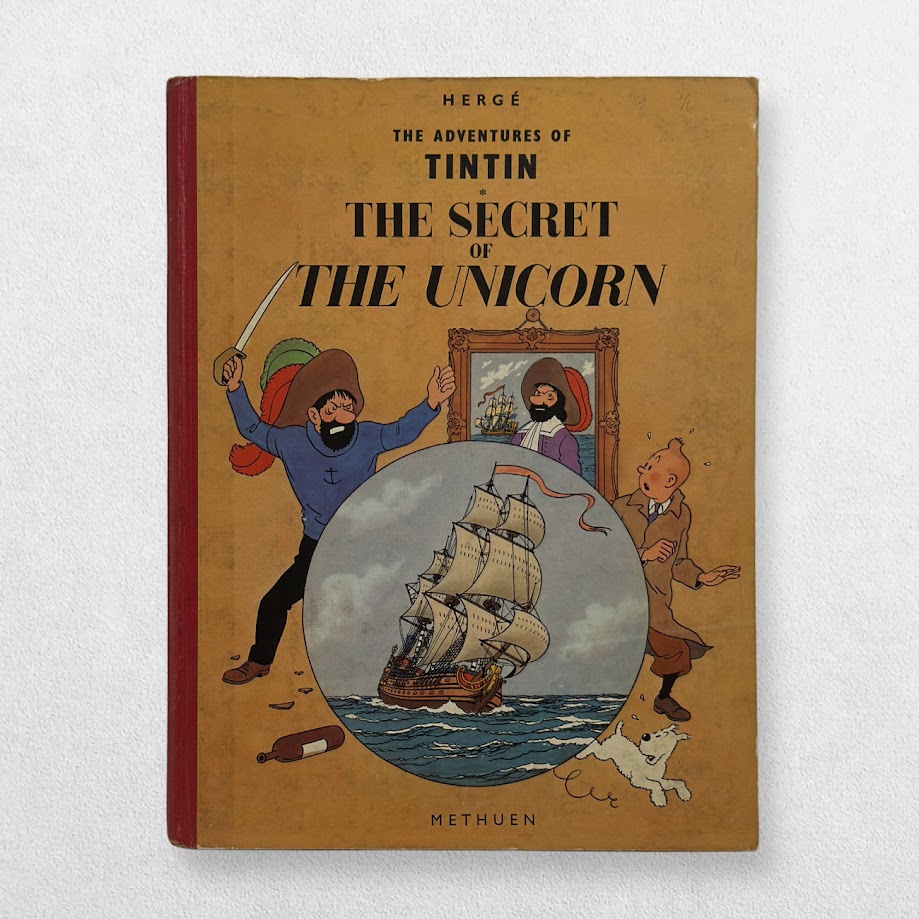
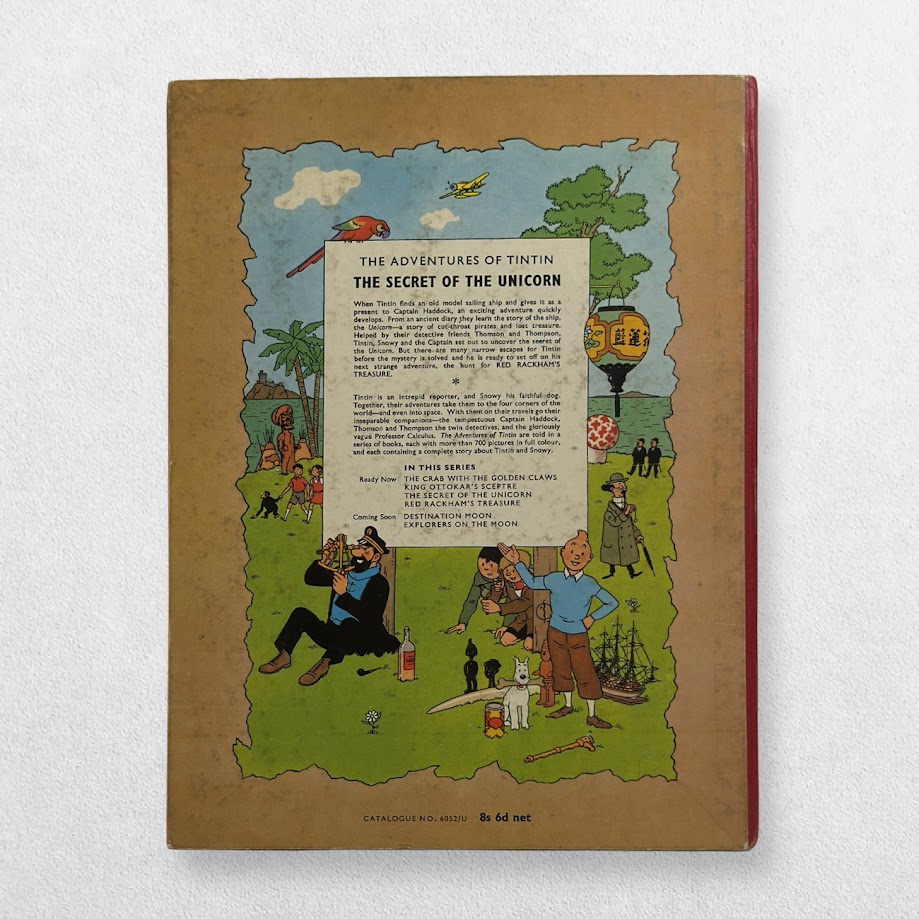
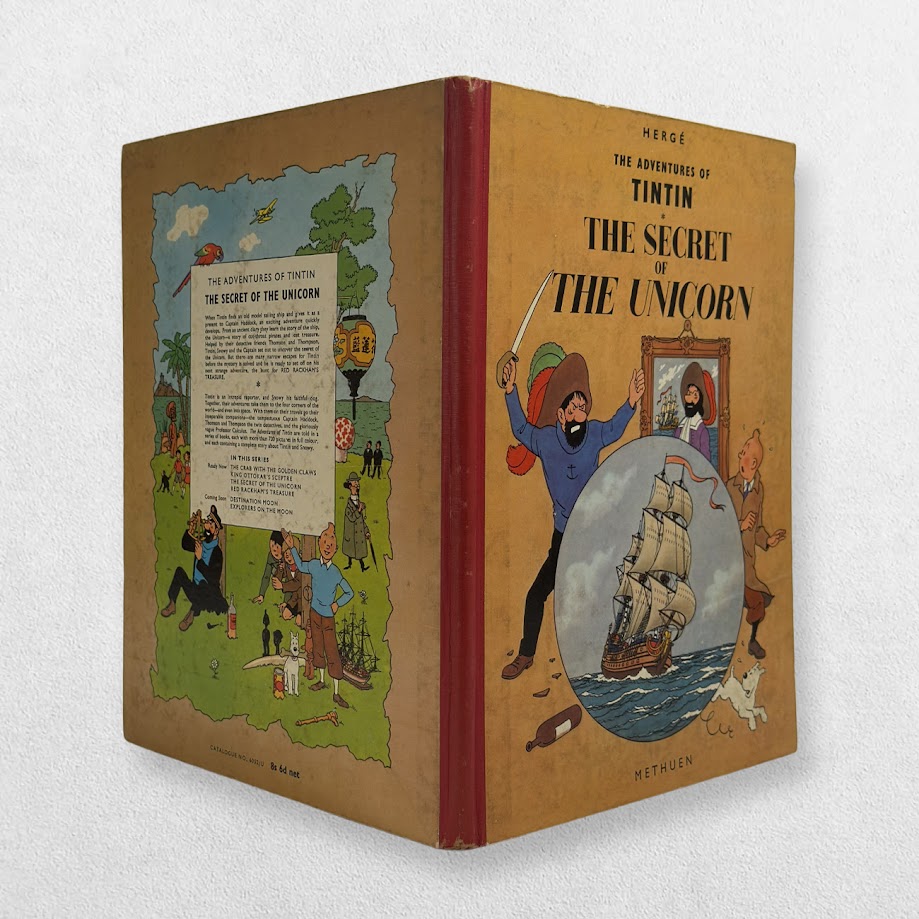
The Adventures Of Tintin – The Secret Of The Unicorn – First Edition – 1959
Hergé
£295.00
Availability: In stock
Product Description
The Adventures Of Tintin – The Secret Of The Unicorn – First Edition – 1959
Author: Hergé
Price: £295
Publisher: Methuen, London, UK
Publication date: 1959
Format: Original cloth-backed boards with pictorial endpapers
Condition: Very good
Size: 23.2cm x 30.7cm
Pages: 62
Illustrations: Illustrated throughout in colour by the author
Description:
Published by Methuen, London, UK, 1959. 1st UK edition. Original cloth-backed boards. Pictorial endpapers. Size: 23.2cm x 30.7cm. Pp. 62. Illustrated throughout in colour by the author. Minor rubbing and marking to the boards. Minor rubbing to the edges. Spine slightly rubbed but with none of the usual fading. Binding nice and tight. Occasional minor age spots and toning to the text but generally pages very nice and clean. A very good, tight, clean copy.
‘The Secret Of The Unicorn’: A Brief Summary
The Secret of the Unicorn (Le Secret de la Licorne, 1943) is the eleventh volume in The Adventures of Tintin series by Hergé (Georges Remi). It represents one of the purest examples of his narrative artistry — a tightly woven detective story, a historical mystery, and a study in courage and curiosity.
The album marks a pivotal transition in The Adventures of Tintin: from globe-trotting political satire to refined, character-driven storytelling. It introduces the ancestral legacy of Captain Haddock and begins the celebrated two-part saga that concludes with Red Rackham’s Treasure.
Publication Background
Hergé created The Secret of the Unicorn between 1942 and 1943, during the German occupation of Belgium. Working under censorship and limited resources, he focused on themes of moral integrity, family honour, and the triumph of intellect over greed — values that transcended the bleakness of wartime Europe.
The story was first serialised in Le Soir Jeunesse before its book publication in 1943. Its tone is elegant and self-contained, displaying Hergé’s mastery of pacing, characterisation, and the ligne claire visual style.
Plot Summary
The Market Discovery
The story begins with Tintin browsing a street market, where he buys an antique model ship called the Unicorn as a gift for his friend Captain Haddock. Soon after, several mysterious men — including the sinister Ivan Ivanovitch Sakharine — attempt to buy the model from him at any price, hinting at its hidden value.
When the model is later stolen and then replaced by a near-identical replica, Tintin realises that it conceals a secret. Inside the mast of the original lies a parchment bearing a cryptic message and coordinates.
The Three Unicorns
Tintin discovers that two other models of the same ship exist, each containing similar parchments. Together, the three documents reveal the location of a hidden treasure belonging to the seventeenth-century naval hero Sir Francis Haddock, Captain Haddock’s ancestor, who once commanded the ship Unicorn and fought the pirate Red Rackham.
The Lineage Revealed
Captain Haddock recounts the dramatic history of his ancestor: how Sir Francis was captured by Red Rackham, fought bravely, destroyed his ship to prevent capture, and later buried the treasure.
This sequence — lavishly illustrated in sepia tones — remains one of Hergé’s most cinematic passages, blending historical adventure with family mythology.
Kidnapping and Escape
Meanwhile, Tintin’s investigation attracts the attention of a gang of criminals led by the cunning Bird brothers, who seek the parchments for themselves. Tintin is kidnapped, imprisoned in their country mansion, and eventually escapes, exposing the villains with the help of Thomson and Thompson, the well-meaning but bumbling detectives.
The story ends with the parchments recovered and the mystery only half-solved, leading directly into Red Rackham’s Treasure, where Tintin and Haddock embark on their quest to find the fabled treasure.
Principal Characters
Tintin
Tintin is presented as both detective and moral compass. His intellect, composure, and bravery drive the narrative. Here, Hergé shifts Tintin from journalist to sleuth, foreshadowing the rational heroism of Red Rackham’s Treasure.
Captain Haddock
Haddock’s ancestry becomes central to his identity. Through the story of Sir Francis, Hergé gives him depth, pride, and purpose. Haddock’s blustering personality — a mix of comic exasperation and noble heart — contrasts beautifully with Tintin’s calm logic.
Thomson and Thompson
The detectives serve as comic relief but also as a foil for Tintin’s methodical intelligence. Their malapropisms and confusion highlight Hergé’s gift for character humour.
The Bird Brothers
Aristocratic, cold, and manipulative, Max and Gustav Bird are among the series’ most sophisticated villains. Their genteel manners mask greed and ruthlessness, embodying moral corruption hidden beneath refinement.
Ivan Ivanovitch Sakharine
Initially presented as a potential villain, Sakharine is later revealed to be an innocent collector — an example of Hergé’s nuanced moral construction, where appearances deceive.
Themes and Analysis
- Heritage and Honour
At its core, The Secret of the Unicorn is a story about inheritance — not of wealth, but of integrity.
Through Captain Haddock’s lineage, Hergé explores the idea that moral courage, not material treasure, defines nobility.
Sir Francis Haddock’s heroism mirrors Tintin’s: both men stand for principle in the face of tyranny and greed.
- Greed Versus Virtue
The story contrasts Tintin’s curiosity and moral purity with the greed of the Bird brothers. The model ship, a symbol of beauty and history, becomes a test of character — those who seek it for profit are undone by their obsession.
Hergé thus transforms a detective plot into a moral allegory: true treasure lies in truth itself.
- The Romance of History
The past is alive in this story. Sir Francis Haddock’s battle with Red Rackham unfolds as both legend and memory, seamlessly blending eras through storytelling.
Hergé evokes the adventure spirit of the Age of Sail — courage, honour, and peril — while anchoring it in modern investigation.
- Rationalism and Deduction
Tintin’s detective work embodies Enlightenment rationality: logic triumphs over superstition, intellect over impulse. The mystery’s resolution depends not on chance, but on observation, reasoning, and moral integrity.
- Art, Collecting, and Possession
The fetishisation of the Unicorn models reflects the fine line between aesthetic appreciation and acquisitive greed. Hergé, himself an art collector, subtly critiques the way beauty becomes commodified.
Artistic and Narrative Achievement
The Secret of the Unicorn is often regarded as one of Hergé’s most visually balanced and narratively precise works.
- Visual Clarity: The ligne claire style reaches perfection — uncluttered panels, precise perspective, and elegant architecture.
- Cinematic Storytelling: The rhythm alternates between suspense, humour, and historical drama, using visual “cuts” reminiscent of film montage.
- Historical Imagery: The flashback to Sir Francis Haddock’s battle is a tour de force of composition, texture, and atmosphere.
- Urban Realism: The opening market scenes showcase Hergé’s meticulous research into 1940s Brussels, grounding fantasy in the everyday.
Every detail, from the glint of the ship’s model to the geometry of the Bird brothers’ mansion, contributes to the story’s polished realism.
Moral and Philosophical Dimensions
The moral tone of The Secret of the Unicorn reflects Hergé’s wartime context: in an age of corruption and fear, truth and decency endure.
Tintin’s pursuit of mystery is not driven by greed but by a quest for understanding. His partnership with Haddock suggests that loyalty and honour survive even amid chaos.
Hergé implies that the greatest inheritance — in families, nations, or humanity itself — is not gold, but virtue and memory.
Psychological Interpretation
The story reflects Hergé’s own fascination with ancestry and moral legacy. Through Captain Haddock, he explores the need to reconcile with one’s past — to turn shame and uncertainty into purpose.
Haddock’s rediscovery of his lineage provides catharsis: he transforms from a self-doubting sailor into a man with roots and dignity. This transformation reaches fulfilment in Red Rackham’s Treasure, where he finds a home.
Relation to Red Rackham’s Treasure
The Secret of the Unicorn functions as the first act of a larger narrative. Where this story raises questions and uncovers the past, Red Rackham’s Treasure resolves them in the present.
If The Secret of the Unicorn is a quest for truth, then Red Rackham’s Treasure is a quest for meaning. Together, they trace Tintin’s evolution from detective to philosopher, and Haddock’s from wanderer to landowner.
Legacy and Reception
Critics and readers have long ranked The Secret of the Unicorn among the best Tintin albums. Its sophisticated plotting, historical imagination, and moral resonance have earned it a place alongside The Blue Lotus and The Castafiore Emerald as one of Hergé’s most complete achievements.
The two-part saga also became one of the best-known Tintin adventures worldwide, inspiring Steven Spielberg’s 2011 film The Adventures of Tintin: The Secret of the Unicorn, which drew heavily from both Unicorn and Red Rackham’s Treasure.
Summary
- Title: The Secret of the Unicorn (Le Secret de la Licorne)
- First Published: 1942–1943 (album 1943)
- Main Characters: Tintin, Captain Haddock, Thomson and Thompson, the Bird Brothers, Sakharine, Sir Francis Haddock
- Setting: Brussels and the countryside; historical scenes at sea
- Themes: Heritage, honour, greed versus virtue, rationalism, historical memory
- Artistic Style: Pure ligne claire, architectural precision, filmic pacing
- Significance: Establishes Haddock’s ancestry; initiates the Red Rackham’s Treasure duology; considered one of Hergé’s narrative masterpieces
Conclusion
The Secret of the Unicorn stands as one of Hergé’s most harmonious and sophisticated works. Blending mystery, history, and morality, it captures the essence of Tintin’s world — intelligence guided by integrity, adventure grounded in compassion.
Through the rediscovery of the past, Hergé offers a vision of continuity amid chaos: that the values of courage, honesty, and friendship endure beyond time and circumstance.
Where The Secret of the Unicorn reveals the legacy of honour, Red Rackham’s Treasure reveals the legacy of belonging. Together, they form not only the heart of the Tintin saga but also one of the great achievements of twentieth-century storytelling.
Why Buy from Us?
At Hornseys, we are committed to offering items that meet the highest standards of quality and authenticity. Our collection of rare books is carefully curated to ensure each edition is a valuable piece of bibliographical history. Here’s what sets us apart:
- Authenticity and Provenance: Each book is meticulously researched and verified for authenticity and collation.
- Expert Curation: Our selection process focuses on significance, condition, and rarity, resulting in a collection that is both diverse and distinguished.
- Customer Satisfaction: We aim to provide an exceptional customer experience, from detailed descriptions to secure and prompt delivery of your purchase.
- Returns Policy: We offer an unconditional guarantee on every item. If you wish to return a book, it may be sent back to us within fourteen days of receipt. Please notify us in advance if you wish to do so. The book must be returned in the same condition as it was sent for a full refund.
Cataloguer: Daniel Hornsey
Daniel Hornsey has specialised in fine and rare books, ephemera, and collectors’ editions for over thirty years. As a long-standing member of the antiquarian book trade, he has advised private collectors, curated catalogues, and sourced works for leading dealers, libraries and institutions across the world.
Hornseys’ exhibit regularly at book and map fairs in London and throughout the UK and are members of the Provincial Booksellers Fairs Association, the PBFA.
His fascination with Hergé’s work — especially ‘The Adventures of Tintin’ — began in childhood. Daniel recalls reading Tintin in original European editions and quickly recognising that these were not merely children’s books, but finely illustrated narratives crafted with artistic depth and wit.
As noted by the Musée Hergé in Louvain-la-Neuve, Hergé’s ‘ligne claire’ style has influenced generations of European comic artists and his original drawings and paintings command very high prices with his painting of ‘The Blue Lotus’ jar fetching £2.8m at auction in 2021.
By presenting these works through Hornseys’, he hopes to contribute to the continued appreciation of one of the 20th century’s most influential illustrators, helping new generations discover the artistry and legacy of Hergé.
Related products
-

When We Were Very Young – Winnie The Pooh – Now We Are Six – The House At Pooh Corner – The Collectors’ Facsimile Edition – Four Volumes In Slipcase
£85.00Milne, A. A. & Shepard, Ernest H
-

-

The Gruffalo & The Gruffalo’s Child: First Deluxe Miniature Editions Both Signed By Julia Donaldson & Axel Scheffler
£495.00Donaldson, Julia & Scheffler, Axel
-

The House At Pooh Corner Signed By Christopher Robin Milne.
£695.00Milne, A. A. With Decorations By Shepard, E. H


