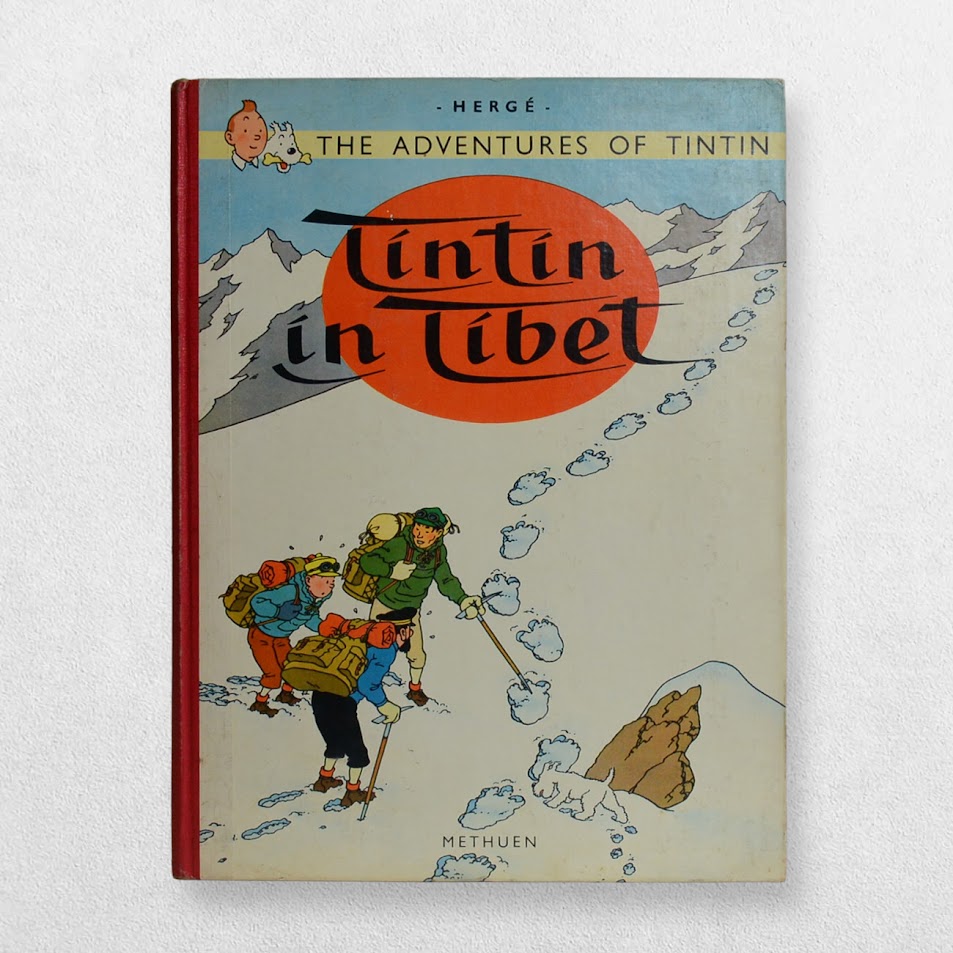

The Adventures Of Tintin – Tintin In Tibet – First Edition – 1962
Hergé
£275.00
Availability: In stock
Product Description
The Adventures Of Tintin – Tintin In Tibet – First Edition – 1962
Author: Hergé
Price: £275.00
Publisher: Methuen, London, UK
Publication date: 1962
Format: Original cloth-backed boards with pictorial endpapers
Condition: Very good
Size: 23.2cm x 30.7cm
Pages: 62
Illustrations: Illustrated throughout in colour by the author
Description:
Published by Methuen, London, UK, 1962. 1st UK edition. Original cloth-backed boards. Pictorial endpapers. Size: 23.2cm x 30.7cm. Pp. 62. Illustrated throughout in colour by the author. Slight foxing to the text block. Slight rubbing to the spine and edges of the boards with none of the usual fading to the spine. A very good indeed, tight, clean copy.
Tintin in Tibet: A Brief Summary
Tintin in Tibet, first published in 1960 in French, is the twentieth volume in Hergé’s The Adventures of Tintin. Unlike many other titles in the series, it is not driven by political intrigue, treasure hunts, or crime. Instead, it stands out as a deeply personal tale of friendship, loyalty, and spiritual endurance. Set against the dramatic backdrop of the Himalayas, the story is widely considered one of Hergé’s finest works for its emotional depth and striking atmosphere.
The Dream and the Call to Action
The narrative begins while Tintin is on holiday with Captain Haddock and Professor Calculus in the Alps. Tintin dreams of his young Chinese friend Chang, whom he last met in The Blue Lotus. In the dream, Chang appears to be in great danger. The following morning, Tintin learns that a plane flying over the Himalayas has crashed, and that Chang was aboard. Despite official reports declaring all passengers dead, Tintin remains convinced Chang has survived. Guided by a sense of loyalty and intuition, he resolves to travel to Tibet to search for his friend.
Journey to the Himalayas
Tintin, Haddock, and Snowy make their way to Kathmandu and then on to the mountain regions of Nepal. Their travels introduce them to local guides, monasteries, and the stark landscapes of the Himalayas. Hergé’s meticulous research is evident in his accurate depictions of Tibetan culture and geography.
Captain Haddock provides much of the comic relief, grumbling about the dangers and discomforts of the journey, yet his loyalty to Tintin never falters. Snowy also contributes to the narrative, braving the harsh conditions and lending both humour and pathos to the expedition.
Encounters with the Unknown
As the group advances through treacherous terrain, they find signs suggesting that Chang may indeed be alive. Footprints in the snow, mysterious sounds, and fleeting glimpses of a shadowy figure point to the presence of the legendary Yeti. These clues sustain Tintin’s belief in Chang’s survival and propel the search further into dangerous territory.
The Yeti becomes a haunting presence throughout the narrative, depicted not as a monster but as a mysterious and ambiguous figure. Hergé’s portrayal blends folklore with compassion, casting the creature as a guardian rather than a threat.
The Rescue
After enduring avalanches, exhaustion, and near despair, Tintin finally discovers Chang, injured but alive, in a remote cave. Chang recounts how he was carried and protected by the Yeti after the crash, offering a moving reversal of expectations about the creature. The Yeti, far from being a terror of the mountains, is shown as a lonely, almost tragic being capable of compassion.
The reunion between Tintin and Chang is one of the most emotional moments in the series, underscoring the themes of loyalty, friendship, and hope that define the book.
Themes and Emotional Depth
Unlike other Tintin adventures, Tintin in Tibet contains no villains, political subplots, or hidden treasures. Instead, the central conflict is man against nature and, more profoundly, Tintin’s unwavering determination to find his friend against all odds. The story reflects values of courage, compassion, and faith in intuition.
The book is often interpreted as a reflection of Hergé’s own state of mind at the time of its creation, when he was undergoing personal struggles. Its purity of narrative and emotional sincerity give it a unique place within the Tintin canon.
Conclusion
Tintin in Tibet is a masterpiece of comic storytelling, notable for its quiet intensity and its exploration of the human spirit. Through Tintin’s relentless search for Chang and the compassionate depiction of the Yeti, Hergé created a narrative that resonates far beyond adventure. The album stands as a moving testament to loyalty, friendship, and hope, ensuring its enduring reputation as one of the greatest entries in The Adventures of Tintin.
Why Buy from Us?
At Hornseys, we are committed to offering items that meet the highest standards of quality and authenticity. Our collection of rare books is carefully curated to ensure each edition is a valuable piece of bibliographical history. Here’s what sets us apart:
- Authenticity and Provenance: Each book is meticulously researched and verified for authenticity and collation.
- Expert Curation: Our selection process focuses on significance, condition, and rarity, resulting in a collection that is both diverse and distinguished.
- Customer Satisfaction: We aim to provide an exceptional customer experience, from detailed descriptions to secure and prompt delivery of your purchase.
- Returns Policy: We offer an unconditional guarantee on every item. If you wish to return a book, it may be sent back to us within fourteen days of receipt. Please notify us in advance if you wish to do so. The book must be returned in the same condition as it was sent for a full refund.
Related products

Newt Scamander: Fantastic Beasts And Where To Find Them: Signed By The Illustrator
£150.00Rowling, J K & Gill, Olivia Lomenech
Snowy The Half-Angel – Figurines Tintin La Collection Officielle – 40 – Milou Mi-Ange
£65.00Hergé & Editions Moulinsart