
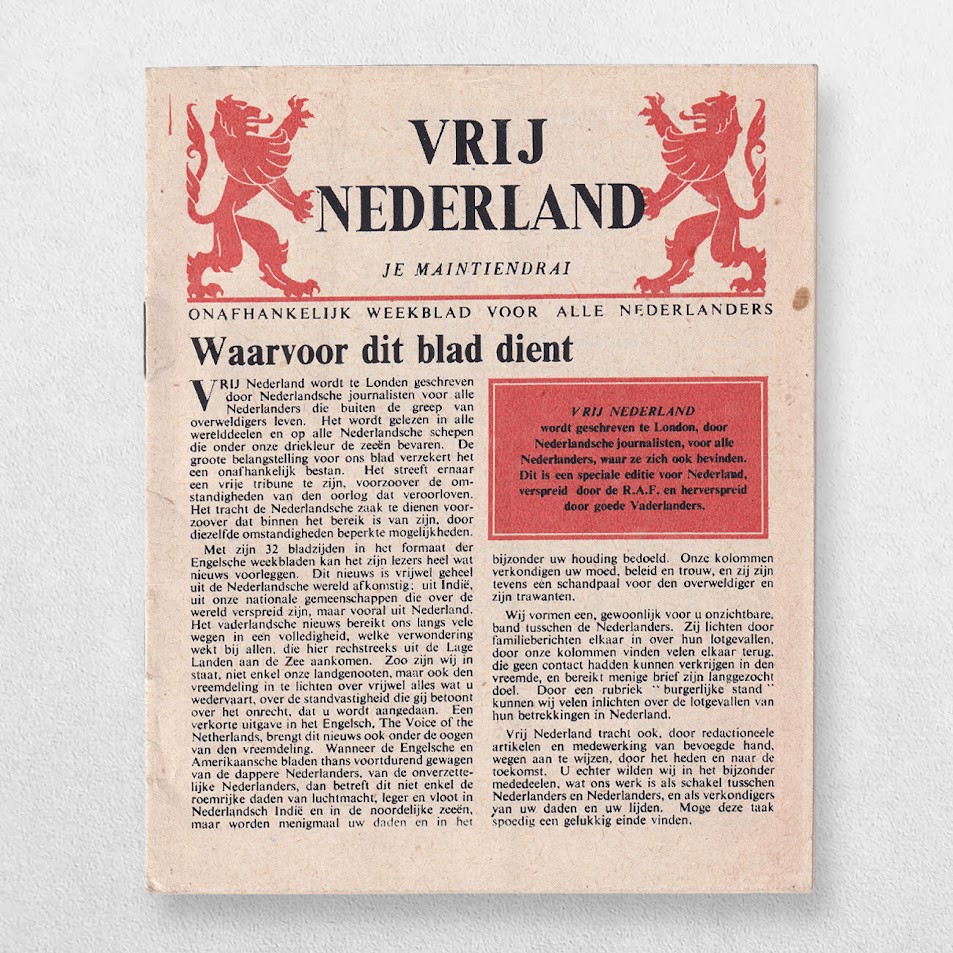
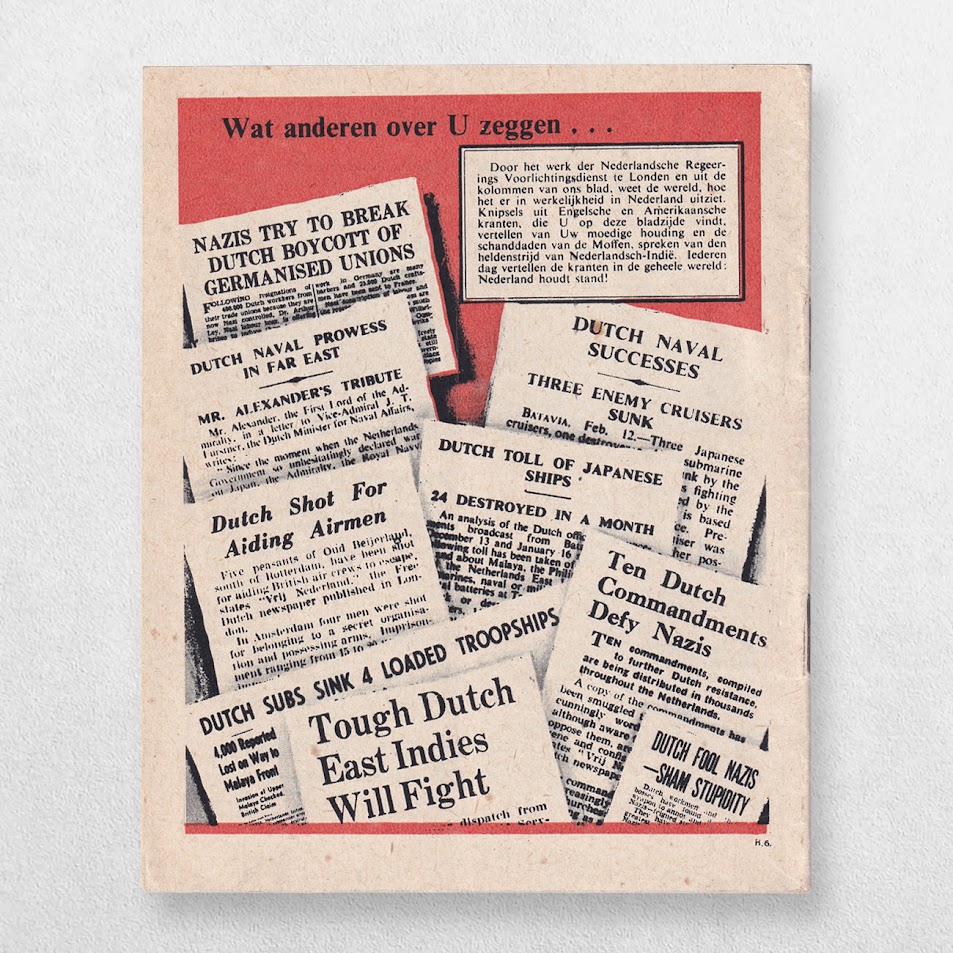
Vrij Nederland – Je Maintiendrai – Onafhankelijk Weekblad Voor Alle Nederlanders
The Dutch Government In Exile & (Churchill, Winston S)
£100.00
Availability: In stock
Product Description
Vrij Nederland – Je Maintiendrai – Onafhankelijk Weekblad Voor Alle Nederlanders
Author: The Dutch Government In Exile & (Churchill, Winston S)
Price: £100
Publisher: The Dutch Government In Exile
Editions: 1st edition
Publication Date: 1942
Format: Original pamphlet
Condition: Very good
Size: 24mo
Description:
24mo newspaper. pp. 16. Speech by Winston Churchill on page three in which he welcomes the publication of the newspaper. Text in Dutch. Very slightly rubbed. A very good copy of a scarce item. From the collection of Steve Forbes, chairman of Forbes Magazine.
Vrij Nederland : A Brief History
The Origins In Resistance
Vrij Nederland was born during the darkest days of the German occupation of the Netherlands in the Second World War. Its roots lay in the Dutch resistance movement, where underground periodicals were an essential means of spreading independent information, countering Nazi propaganda, and sustaining national morale. First appearing in 1940, it was produced clandestinely and distributed at great personal risk. The paper took its title, which translates as “Free Netherlands”, as a direct expression of defiance and hope for liberation.
The Motto “Je Maintiendrai”
The addition of the motto Je Maintiendrai (“I will maintain”), the traditional Dutch national motto with origins in the House of Orange-Nassau, underscored the publication’s commitment to endurance and sovereignty. It symbolised resistance not only to the occupiers but also to the erosion of democratic values. In the context of the underground press, this motto served as a rallying cry, reminding readers of continuity with the Dutch state and its constitutional monarchy, even while official institutions were suppressed.
From Resistance Sheet to National Weekly
After the liberation in 1945, Vrij Nederland emerged from the underground as one of the leading voices in post-war Dutch journalism. No longer constrained by secrecy, it developed into a national weekly magazine under the subtitle Onafhankelijk Weekblad Voor Alle Nederlanders (“Independent Weekly for All Dutch People”). This declared both its broad target readership and its editorial stance: independent of political parties, yet firmly rooted in democratic ideals and critical inquiry.
Intellectual and Cultural Role
In the decades following the war, Vrij Nederland established itself as a progressive, left-liberal platform. It attracted some of the most prominent Dutch journalists, essayists, and intellectuals of the post-war generation. The magazine became renowned for its in-depth political reporting, investigative journalism, and essays on culture, philosophy, and international affairs. It served as a forum where politics and literature intersected, often publishing long-form analyses that shaped public debate.
The weekly gained a reputation for its independence of thought. While sympathetic to social-democratic and progressive causes, it retained the freedom to criticise established parties and policies. Its readership included academics, policymakers, and members of the cultural elite, but also ordinary citizens seeking well-argued perspectives outside mainstream newspapers.
The Post-war Decades
During the 1950s and 1960s, the magazine played a central role in scrutinising post-war reconstruction, the Cold War, and Dutch involvement in decolonisation. The Indonesian independence struggle and later debates around Suriname and the Antilles found ample coverage. As society liberalised in the 1960s and 1970s, Vrij Nederland reflected and often anticipated the cultural and political shifts, aligning itself with debates on democracy, civil rights, and cultural modernisation.
Investigative Tradition
By the late twentieth century, Vrij Nederland had become particularly noted for investigative journalism. Its in-depth reporting frequently exposed political scandals, corporate malpractice, and social injustices. In doing so, the magazine earned a reputation as a watchdog of Dutch democracy, fulfilling the essential role of holding power to account.
Style and Identity
The visual and editorial style of Vrij Nederland evolved over time. Early issues bore the clear imprint of the resistance press: plain layouts, practical typography, and functional design. Later, as it grew into a mainstream periodical, it adopted a modern magazine format. The combination of long essays, political commentary, and cultural criticism gave it an intellectual tone distinct from daily newspapers.
Later Developments
Like many European periodicals, Vrij Nederland faced challenges from the 1990s onwards, as readership habits shifted and the digital era transformed journalism. It underwent several redesigns and editorial changes, seeking to balance its legacy of depth and independence with the need to appeal to new audiences. The title Onafhankelijk Weekblad Voor Alle Nederlanders retained symbolic weight, though over time the magazine experimented with different publishing models, including a stronger digital presence.
Legacy and Continuing Relevance
Despite changing media landscapes, Vrij Nederland remains one of the most historically significant Dutch periodicals. Its journey from an illegal resistance sheet to a respected national weekly encapsulates the story of Dutch resilience and democratic renewal in the twentieth century. The continued invocation of its wartime origins and its motto Je Maintiendrai gives the magazine a unique moral authority, linking contemporary journalism with the fight for freedom during the occupation.
Today, it is remembered not only for its immediate contribution to resistance but also for its lasting role in shaping Dutch intellectual and political discourse. Its history illustrates how a periodical can embody national values, survive dramatic transformations, and continue to serve as a platform for critical debate across generations.
Sir Winston Churchill: A Brief Biography
Early Life and Education
Sir Winston Leonard Spencer Churchill was born on 30 November 1874 at Blenheim Palace in Oxfordshire. He was the elder son of Lord Randolph Churchill, a prominent Conservative politician, and Jennie Jerome, an American socialite. From an early age, Churchill was immersed in the worlds of politics and aristocracy, yet his formative years were marked by academic inconsistency and a yearning for recognition.
Educated at Harrow School, Churchill struggled in traditional subjects but excelled in English and history. He went on to attend the Royal Military College, Sandhurst, where he graduated eighth in his class and was commissioned into the 4th Queen’s Own Hussars in 1895. His military service provided the foundation for his lifelong engagement with strategy, empire, and leadership.
Military Service and Early Writings
Churchill’s early career was defined by adventurous military postings in Cuba, India, the Sudan, and South Africa. He served as both a soldier and a war correspondent, gaining fame for his daring escape from a Boer prison camp in 1899. These exploits not only elevated his public profile but also helped to establish his reputation as a man of action and eloquence.
His early writings, including The Story of the Malakand Field Force and The River War, combined first-hand experience with historical reflection, showcasing a command of language and a talent for narrative that would characterise his later works. These publications also hinted at his imperial convictions and deep-seated belief in Britain’s global mission.
Political Ascent
Churchill entered Parliament in 1900 as the Conservative MP for Oldham but soon defected to the Liberal Party, advocating social reform and free trade. As President of the Board of Trade (1908–1910) and Home Secretary (1910–1911), he promoted progressive policies such as labour exchanges, national insurance, and prison reform.
In 1911, he was appointed First Lord of the Admiralty, a role in which he modernised the Royal Navy in anticipation of global conflict. His strategic vision and reformist zeal were evident, but his judgement would come under scrutiny during the First World War.
The Dardanelles and Political Repercussions
Churchill played a central role in the ill-fated Dardanelles campaign of 1915, a failed naval operation intended to open a new front against the Ottoman Empire. The catastrophic outcome led to his removal from the Admiralty, a political setback that haunted him for years.
In response, Churchill re-joined the army and served on the Western Front. This period of introspection and humility contributed to a deeper understanding of the burdens of leadership, tempering his ambition with a renewed sense of purpose.
Return to Government and Interwar Years
Churchill returned to politics with determination, serving in a range of ministerial posts, including Secretary of State for War and Chancellor of the Exchequer. By the late 1920s, he had rejoined the Conservative Party, but his opposition to Indian self-rule and his handling of the General Strike made him a polarising figure.
During the 1930s, as Hitler rose to power, Churchill warned repeatedly of the growing threat of fascism. Though out of office, his speeches in Parliament and articles in the press demonstrated a prescient understanding of Nazi ambitions. He became increasingly isolated — yet when the moment came, his voice would prove indispensable.
Leadership in the Second World War
In May 1940, following the resignation of Neville Chamberlain, Churchill was appointed Prime Minister. His premiership during the Second World War remains one of the most consequential in modern history. At a time when Britain stood alone against Nazi Germany, Churchill’s oratory galvanised the nation. Phrases such as “We shall fight on the beaches” and “Their finest hour” became emblematic of British resistance.
He forged crucial alliances with the United States and the Soviet Union, coordinating the Allied war effort while maintaining morale at home. Despite the strain of prolonged conflict, Churchill remained a resolute leader, presiding over military decisions, diplomacy, and civil defence.
His relationship with President Franklin D. Roosevelt was central to Britain’s wartime survival, and though complex, his interactions with Stalin helped shape the post-war balance of power. Churchill’s leadership was instrumental in securing ultimate victory in Europe in 1945.
Post-War Politics and the Iron Curtain
In the 1945 general election, Churchill’s Conservative Party was defeated, a result reflecting public demand for social reform rather than a repudiation of his leadership. Nonetheless, he continued as Leader of the Opposition and remained a prominent voice on global affairs.
In 1946, Churchill delivered his famous “Iron Curtain” speech, warning of Soviet expansionism and marking the beginning of the Cold War. This speech underscored his continued relevance on the world stage and his enduring commitment to defending democratic values.
He returned to power as Prime Minister in 1951 at the age of 76, serving until 1955. Although his final term was marked by declining health and limited domestic reform, he remained a revered statesman and a symbol of British resilience.
Literary Achievements and Honours
Churchill was not only a politician and soldier but also a prolific writer and historian. His six-volume work The Second World War and four-volume A History of the English-Speaking Peoples established him as one of the leading historical writers of the 20th century. In 1953, he was awarded the Nobel Prize in Literature for his mastery of historical and biographical narrative.
He was also made a Knight of the Garter and granted honorary citizenship of the United States — a rare honour for a foreign national.
Final Years and Legacy
Churchill retired from active politics in 1955 but remained a member of Parliament until 1964. He died on 24 January 1965 at the age of 90. His state funeral, the first for a non-royal since the Duke of Wellington, was a national event, attended by leaders from across the world.
Churchill’s legacy is profound and complex. He is remembered as the indomitable leader who helped save Western civilisation from tyranny, a gifted writer, and a tireless defender of Britain’s interests. Yet he was also a man of controversy — his views on empire, race, and class have provoked ongoing debate.
Nevertheless, few figures have so deeply shaped the course of modern British and global history. Churchill’s life, marked by courage, intellect, and eloquence, remains a compelling example of leadership in times of both triumph and trial.
Why buy from us?
At Hornseys, we are committed to offering items that meet the highest standards of quality and authenticity. Our book collection is meticulously curated to ensure that each edition is a valuable and authentic piece of bibliographical history. Here’s what sets us apart:
- Authenticity and Provenance: Every book is researched, collated, and verified for authenticity.
- Expert Curation: Each book is selected with a keen eye for significance, condition, and rarity, ensuring a collection that is both diverse and distinguished.
- Customer Satisfaction: We strive to provide an exceptional customer experience, from detailed descriptions and provenance to secure and prompt delivery of your purchase.
- Returns Policy: We offer an unconditional guarantee on every item. If you wish to make a return, books may be sent back to us within fourteen days of receipt for any reason. We request advance notification of returns, and books must be returned in the same condition as sent for a full refund.
Explore Our Collection:
Visit Hornseys to explore our fine collection of rare and signed books. Whether you are an avid collector or looking for a special gift, our selection offers something truly unique. Located in the picturesque Yorkshire Dales, our Ripon gallery has been a haven for book lovers, art enthusiasts, and collectors since 1976.
Related products

Tout Homme Ou Tout Etat Qui Se Bat Contre La Puissance Nazie Aura Notre Aide – Tout Homme Ou Tout Etat Qui Marche Avec Hitler Est Notre Ennemi – Any Man Or Any State That Fights Against Nazi Power Will Have Our Help – Any Man Or Any State That Sides With Hitler Is Our Enemy
£300.00Churchill, Winston Spencer



You may also like…
De Wervelwind Maandblad Voor Vrijheid Waarheid En Recht – No. 13 Augustus 1943 – Monthly Magazine For Freedom, Truth and Justice
£30.00The Dutch Government & (Churchill, Winston S)
What Kind Of A People Do They Think We Are? Two Historic Speeches Made By The Rt. Hon. Winston Spencer Churchill – Second Issue
£25.00Churchill, Winston Spencer
King George VI – The Prime Minister’s Broadcast Thursday February 7 1952
£25.00Churchill, Winston Spencer
The Days Ahead – Speech By The Rt. Hon. Winston Churchill O.M., C.H., M.P At The Ibrox Park Stadium, Glasgow 20th May 1949
£135.00Churchill, Winston Spencer
The National Policy – As Set Forth By Mr Asquith, Sir Edward Grey, Mr Churchill, Mr Lloyd George, Mr Austen Chamberlain, Mr Balfour, Mr Bonar Law, Mr Arthur Henderson And Others
£35.00Churchill, Winston Spencer Contributes
The Naval Memoirs Of Admiral Of The Fleet Sir Roger Keyes: Scapa Flow To The Dover Straits, 1916-1918 Inscribed By Keyes To Commander J H Owen
£225.00Keyes, Admiral Sir Roger & (Churchill, Winston S.)


