
André Derain
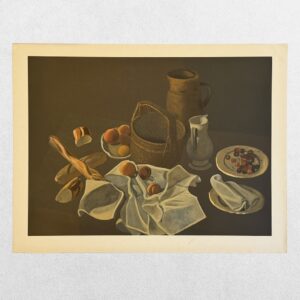
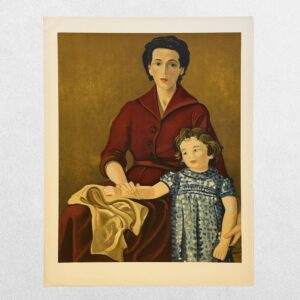
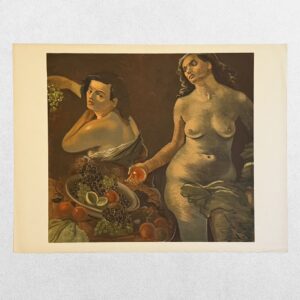
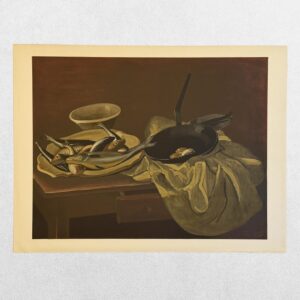
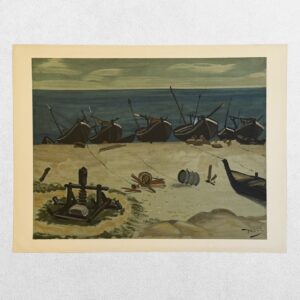
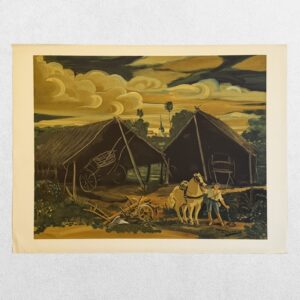
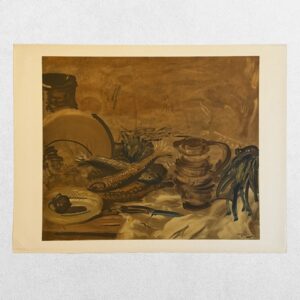
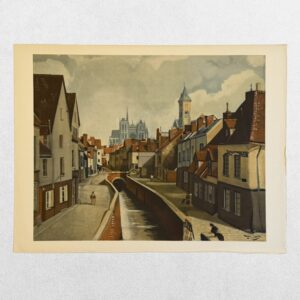
André Derain: A Detailed Biography
Early Life and Education
André Derain was born on 10 June 1880 in Chatou, a small town west of Paris that had strong associations with the Impressionists. His family was solidly middle-class, and his father intended him to pursue a conventional professional career. Accordingly, Derain initially studied engineering, a background that would later inform his structured approach to composition and form.
Despite these expectations, Derain showed an early inclination towards art. He began formal artistic training at the Académie Camillo, where he met Maurice de Vlaminck, a decisive influence on both his artistic development and his rejection of academic conventions. Their shared studio in Chatou became a site of experimentation, debate, and rapid stylistic evolution.
Formation of Fauvism
Derain’s decisive artistic breakthrough occurred in the early 1900s, when he became closely associated with Henri Matisse and other young painters dissatisfied with naturalistic colour and traditional modelling. In 1905, Derain and Vlaminck exhibited alongside Matisse at the Salon d’Automne, an event that gave rise to the term Fauvism—derived from a critic’s description of the painters as “wild beasts” due to their radical use of colour.
During this period, Derain produced some of his most celebrated works, characterised by:
- Bold, non-naturalistic colour
- Simplified forms
- Strong black outlines
- A deliberate rejection of atmospheric perspective
His landscapes of Collioure and views of the Thames in London, painted in 1906, are particularly significant. In these works, colour functions independently of description, creating emotional and structural intensity rather than visual realism.
Move Towards Classicism
Unlike some of his Fauvist contemporaries, Derain did not remain committed to radical colour experimentation. By around 1907–1908, he began to move away from Fauvism, seeking greater solidity, balance, and reference to classical traditions. This shift coincided with his growing interest in Paul Cézanne, as well as in ancient sculpture and Renaissance art.
Derain’s encounter with Cubism, particularly through Pablo Picasso and Georges Braque, further influenced his thinking, though he never fully embraced Cubist fragmentation. Instead, he adopted a more restrained geometry and muted palette, aiming to reconcile modern experimentation with historical continuity.
By the 1910s, Derain had emerged as a leading figure in what would later be termed the “return to order”—a broader European movement favouring clarity, discipline, and classical values in the aftermath of pre-war avant-garde excess.
War and Its Aftermath
Derain’s career was interrupted by the First World War, during which he served in the French army. The experience had a lasting impact on his outlook, reinforcing his scepticism towards artistic radicalism and contributing to his increasingly conservative aesthetic position.
After the war, Derain produced figurative works that drew explicitly on classical sources, including Greco-Roman sculpture and Old Master painting. His figures became monumental, calm, and introspective, often imbued with a sense of timelessness. While technically accomplished, this phase divided critical opinion, with some viewing it as a retreat from innovation and others as a mature synthesis of tradition and modernity.
Theatre, Illustration, and Decorative Arts
In parallel with his painting, Derain was deeply involved in the decorative arts. He designed:
- Stage sets and costumes for ballet and theatre
- Book illustrations, including notable woodcuts
- Tapestries and murals
His work for Sergei Diaghilev’s Ballets Russes demonstrated his ability to adapt his visual language to collaborative, theatrical contexts, balancing expressive power with structural discipline.
Later Years and Controversy
Derain’s reputation suffered significantly during and after the Second World War. His participation in cultural exchanges with Nazi Germany—though framed by him as apolitical—was widely condemned in post-war France. While he was not prosecuted, these actions cast a long shadow over his legacy and contributed to his marginalisation in the narrative of modern art.
In his later years, Derain became increasingly withdrawn and pessimistic about contemporary art, which he viewed as disconnected from craftsmanship and tradition. His work grew darker in tone and more introspective. He suffered from declining health and eyesight before his death.
Death and Legacy
André Derain died on 8 September 1954 following a road accident near Garches, France.
Today, Derain is recognised as:
- A foundational figure of Fauvism
- A key contributor to early twentieth-century modernism
- An artist whose career exemplifies the tensions between innovation and tradition
While his later conservatism remains controversial, his early and middle-period works—particularly those from 1905 to 1914—are regarded as central to the development of modern painting. His art is held in major international collections and continues to be reassessed within a broader, more nuanced understanding of modernism’s complexity.
Why Buy from Us?
At Hornseys, we are committed to offering items that meet the highest standards of quality and authenticity. Our collection of rare prints and engravings is meticulously curated to ensure that each piece is both a valuable and authentic addition to your collection. Here’s what sets us apart:
- Expert Curation: We select each piece with an eye for historical significance, condition, and visual appeal.
- Customer Satisfaction: We strive to provide an exceptional customer experience, from detailed descriptions to secure and prompt delivery.
- Returns Policy: We offer an unconditional guarantee on every item. If you wish to make a return, any item may be sent back to us within fourteen days of receipt for any reason. We request advance notification of returns, and items must be returned in the same condition as sent for a full refund.
Explore Our Collection:
Visit Hornseys to explore our exceptional collection of fine prints, maps and engravings. Located in the picturesque Yorkshire Dales, our Ripon gallery has been a haven for art lovers and collectors since 1976.