
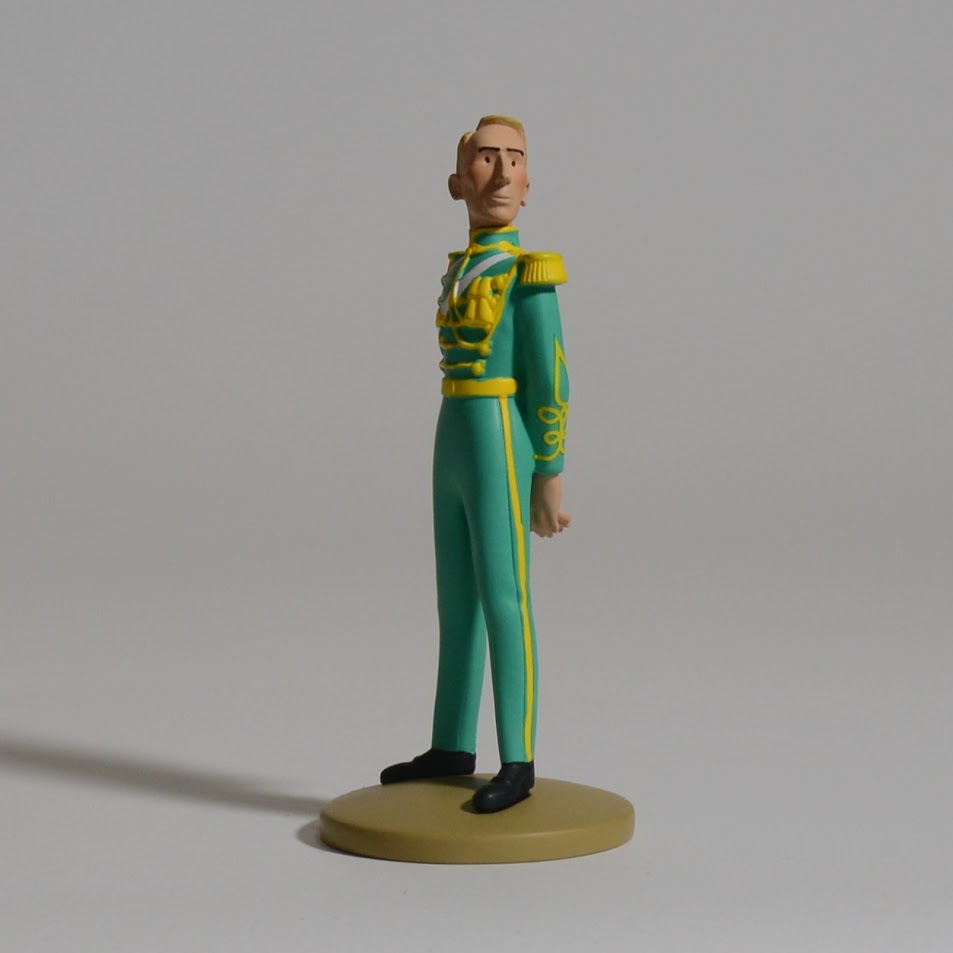
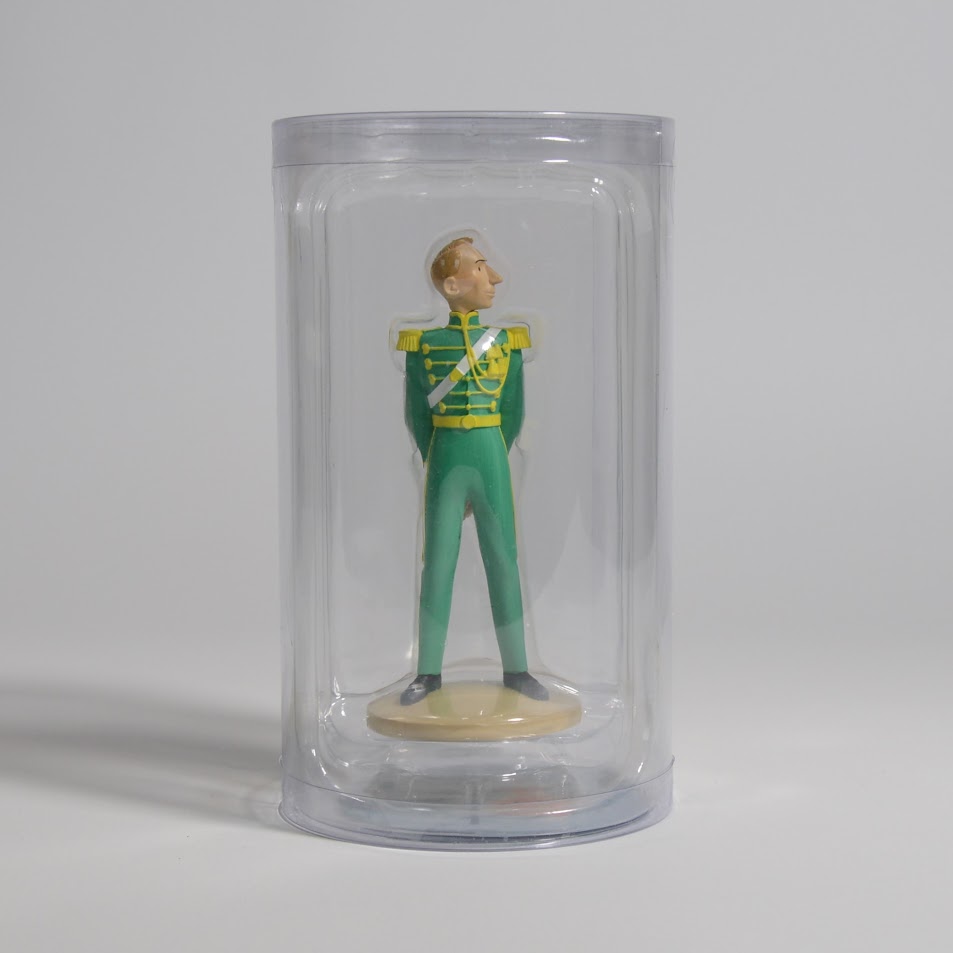
42259 – Hergé En Costume Vert – Hergé En Officier De La Cour Syldave – Figurine Resine 12cm – Hergé In Green Costume – Hergé As An Officer In The Syldavian Court – 12cm Resin Figure
HERGÉ & MOULINSART
£34.00
Availability: In stock
Product Description
42259 – Hergé En Costume Vert – Hergé En Officier De La Cour Syldave – Figurine Resine 12cm – Hergé In Green Costume – Hergé As An Officer In The Syldavian Court – 12cm Resin Figure
Author: Hergé & Editions Moulinsart
Price: £34.00
Publisher: Editions Moulinsart
Publication date: 2025
Format: Resin in original cello tube packaging
Condition: In new condition
Hergé As An Officer In The Syldavian Court: A Brief Account
The unnamed officer in the Syldavian court is a minor supporting character appearing in Hergé’s The Adventures of Tintin, particularly in the albums set in the fictional Eastern European kingdom of Syldavia — most notably **King Ottokar’s Sceptre (Le Sceptre d’Ottokar, 1939)*. Though a background figure, the Syldavian officer represents the discipline, honour, and hierarchical structure of a small monarchy struggling to preserve its sovereignty against internal treachery and foreign aggression. His presence contributes to Hergé’s carefully constructed illusion of a functioning European state with its own military, customs, and ceremonial traditions — all designed to lend realism and political weight to the story.
Character Overview
| Attribute | Description |
| Name | Not specified (simply referred to as “an officer in the Syldavian court”) |
| Nationality | Syldavian |
| Occupation | Military officer serving King Muskar XII |
| First Appearance | King Ottokar’s Sceptre (Le Sceptre d’Ottokar, 1939) |
| Affiliation | Royal household of Syldavia |
| Personality Traits | Dutiful, formal, patriotic, respectful |
| Symbolism | Embodiment of royal loyalty, constitutional order, and national identity |
Context in King Ottokar’s Sceptre
The Syldavian officer appears during key scenes in King Ottokar’s Sceptre, an adventure set in the small, mountainous Balkan-style monarchy of Syldavia. In the story, Tintin uncovers a plot by Bordurian conspirators to steal the royal sceptre of King Muskar XII, an act that would symbolically and legally enable a coup d’état. The Syldavian court — including its guards and officers — is depicted as the final line of defence for the crown. Within this setting, the officer serves as a visual and narrative reminder of duty, order, and national pride in a time of crisis.
Characterisation
Although not named or central to the plot, Hergé gives the Syldavian officer a dignified presence. His bearing, posture, and uniform convey professionalism and respect for the monarchy. He is neither comic nor villainous; rather, he reflects Hergé’s admiration for traditional European discipline, akin to the Swiss or Austrian officers of the interwar period.
Key Traits
- Loyalty: The officer’s allegiance to King Muskar XII is unwavering.
- Professionalism: He acts with calm decorum, even in moments of national threat.
- Pride: His immaculate uniform and ceremonial precision embody Syldavia’s national identity.
- Symbolic Gravity: As a representative of the royal establishment, he stands for the continuity of lawful rule.
Symbolic Significance
The Syldavian officer is not merely decorative. He serves a thematic function, symbolising the moral and institutional stability of Syldavia. In King Ottokar’s Sceptre, the real enemy is not chaos but subversion from within — the conspiracy of the Bordurian Fifth Column. The officer’s quiet integrity stands in contrast to the corruption and deceit of the conspirators, reinforcing Hergé’s faith in the ideals of honour and loyalty.
| Symbolic Role | Interpretation |
| The Loyal Servant | Represents fidelity to legitimate authority. |
| The Guardian of Tradition | Embodies the ceremonial continuity of monarchy. |
| The Moral Counterpoint to Treason | His presence underlines the villainy of those who betray their country. |
Syldavia as a Political Construct
Hergé’s fictional kingdom of Syldavia is one of his most fully realised creations — a constitutional monarchy reminiscent of small Central European states such as Montenegro or Albania. It possesses its own language, flag, national anthem, geography, and military hierarchy. The officer, standing in the background of royal processions or court scenes, contributes to the believability of this world. His presence gives Syldavia a sense of bureaucratic depth and civic order, grounding the fairy-tale monarchy in political realism. In doing so, Hergé turns Syldavia into a mirror of Europe’s own struggles during the late 1930s — a fragile democracy resisting authoritarian invasion (clearly inspired by the annexation of Austria and Czechoslovakia by Nazi Germany).
Visual and Artistic Depiction
In Hergé’s ligne claire style, the Syldavian officer is drawn with crisp lines and meticulous detail, typical of military precision.
- Uniform: Often depicted in blue or dark hues with epaulettes, ceremonial medals, and the crowned S insignia of Syldavia.
- Bearing: Upright and composed, reflecting a sense of pride and authority.
- Setting: Seen in palace interiors, during state ceremonies, or standing guard near King Muskar XII.
The officer’s posture and regalia emphasise order and tradition — recurring visual themes in Hergé’s depiction of Syldavia.
Thematic Parallels
The Syldavian officer’s quiet professionalism can be compared with Tintin’s own integrity. Both figures represent duty above self-interest, a central moral constant in Hergé’s universe. Where Tintin embodies the individual conscience, the officer personifies institutional honour. Together, they form two halves of a stable moral world — the personal and the civic — united in defence of truth and justice.
Broader Influence and Legacy
Although unnamed, the officer symbolises the functional realism that distinguishes The Adventures of Tintin from other adventure comics of the period. Hergé’s decision to populate his stories with background figures who behave believably — soldiers, customs officers, guards, diplomats — gives his fictional worlds depth and authenticity. The Syldavian officer, therefore, is part of a larger system of visual storytelling that underpins the credibility of Tintin’s adventures, especially those involving political intrigue.
Summary
| Aspect | Description |
| Role | Military officer of King Muskar XII’s court |
| Setting | Syldavia (King Ottokar’s Sceptre, 1939) |
| Function | Represents loyalty, hierarchy, and national order |
| Personality | Formal, dignified, dutiful |
| Symbolism | Embodies moral and institutional stability amid political unrest |
| Visual Style | Uniformed, upright, drawn with precision in Hergé’s ligne claire style |
| Narrative Value | Enhances realism and the tone of disciplined statehood |
Conclusion
Though a minor figure, the officer in the Syldavian court plays an important symbolic role in Hergé’s political imagination. He represents duty, continuity, and the moral integrity of lawful service at a time when Europe itself was collapsing into ideological chaos. In the broader tapestry of The Adventures of Tintin, he stands as one of the countless silent pillars that uphold Hergé’s fictional worlds — modest in presence, but essential to their believability. Through him, Hergé affirms that true strength lies not in grand gestures, but in steadfast loyalty, quiet professionalism, and faith in order over ambition.
Why Buy from Us?
At Hornseys, we are committed to offering items that meet the highest standards of quality and authenticity. Our collection of objects and rare books are carefully curated to ensure each edition is a valuable piece of bibliographical history. Here’s what sets us apart:
- Authenticity and Provenance: Each item is meticulously researched and verified for authenticity and collation.
- Expert Curation: Our selection process focuses on significance, condition, and rarity, resulting in a collection that is both diverse and distinguished.
- Customer Satisfaction: We aim to provide an exceptional customer experience, from detailed descriptions to secure and prompt delivery of your purchase.
- Returns Policy: We offer an unconditional guarantee on every item. If you wish to return an item, it may be sent back to us within fourteen days of receipt. Please notify us in advance if you wish to do so. The item must be returned in the same condition as it was sent for a full refund.
Cataloguer: Daniel Hornsey
Daniel Hornsey has specialised in fine and rare books, ephemera, and collectors’ editions for over thirty years. As a long-standing member of the antiquarian book trade, he has advised private collectors, curated catalogues, and sourced works for leading dealers, libraries and institutions across the world.
Hornseys’ exhibit regularly at book and map fairs in London and throughout the UK and are members of the Provincial Booksellers Fairs Association, the PBFA.
His fascination with Hergé’s work — especially ‘The Adventures of Tintin’ — began in childhood. Daniel recalls reading Tintin in original European editions and quickly recognising that these were not merely children’s books, but finely illustrated narratives crafted with artistic depth and wit.
As noted by the Musée Hergé in Louvain-la-Neuve, Hergé’s ‘ligne claire’ style has influenced generations of European comic artists and his original drawings and paintings command very high prices with his painting of ‘The Blue Lotus’ jar fetching £2.8m at auction in 2021.
By presenting these works through Hornseys’, he hopes to contribute to the continued appreciation of one of the 20th century’s most influential illustrators, helping new generations discover the artistry and legacy of Hergé.
Related products

42248 DUPONT SYLDAVIE – FIGURINE RESINE 12CM – THOMSON IN SYLDAVIAN COSTUME – 12CM RESIN FIGURE
£36.00HERGÉ & MOULINSART
42186 TINTIN COSMONAUTE – FIGURINE RESINE 12CM – TINTIN ASTRONAUT – 12CM RESIN FIGURE
£32.00HERGÉ & MOULINSART


