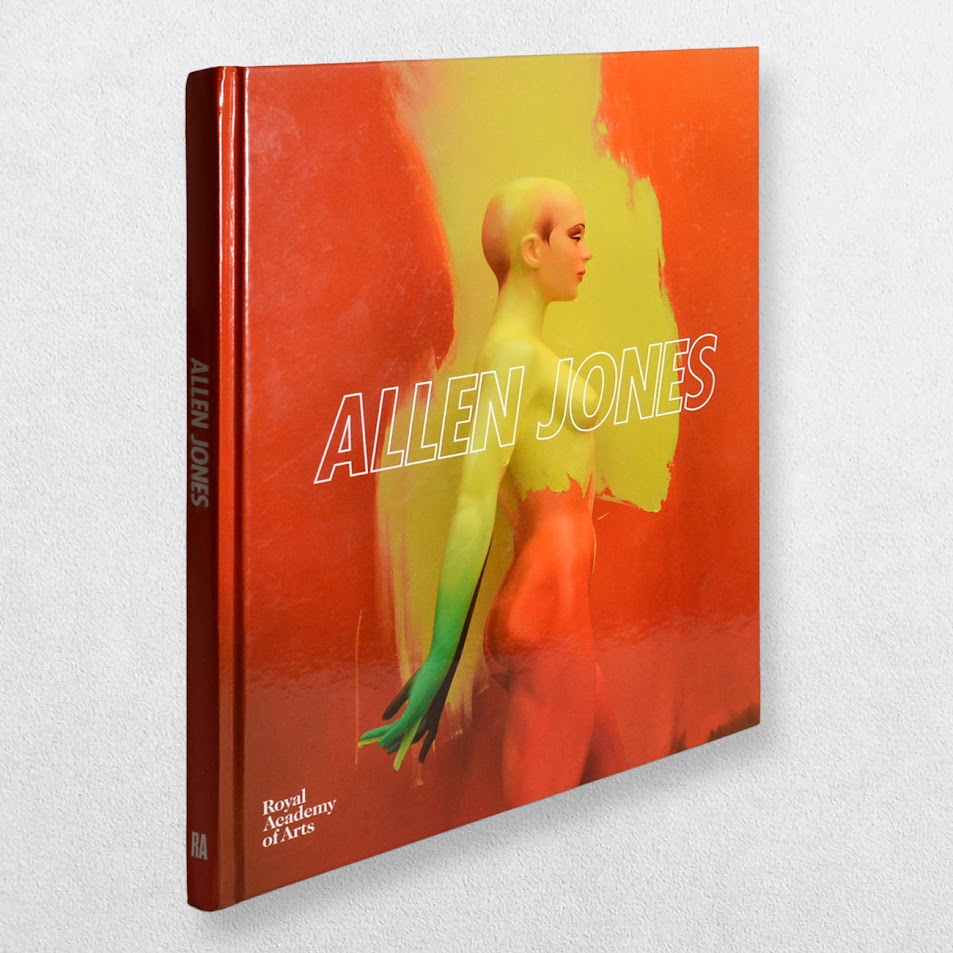
Allen Jones
Author: Christie, Jonathan
Price: £23
Publisher: Royal Academy, UK
Edition: First edition
Publication Date: 2014
Format: Original pictorial boards
Condition: New
Description:
The catalogue of the exhibition. Original hardcover. Illustrated throughout. A brand new copy.
Allen Jones RA: A Short Biography
Allen Jones RA is a leading figure in British contemporary art, widely recognised for his bold, provocative exploration of the human form, gender representation, and popular culture. His work straddles the boundaries between fine art, fashion, commercial design, and fetish imagery, making him one of the most controversial yet influential artists of the post-war period. Known primarily for his involvement in the British Pop Art movement of the 1960s, Jones has maintained a dynamic and diverse practice spanning painting, sculpture, printmaking, and stage design.
Early Life and Education
Born in Southampton in 1937, Allen Jones grew up in the context of post-war Britain, a nation in cultural and economic recovery. He studied at Hornsey College of Art and later at the Royal College of Art (RCA) in London, where he was part of a generation of artists that included David Hockney, R.B. Kitaj, and Patrick Caulfield.
His time at the RCA was formative. Though he was expelled before completing his degree—ostensibly for questioning academic authority—this period shaped his interest in figuration, surrealism, and popular imagery. It also positioned him at the forefront of a new wave of British artists responding to American culture, mass media, and consumerism.
Pop Art and Early Recognition
Allen Jones came to prominence during the 1960s as one of the key British exponents of Pop Art, a movement characterised by its engagement with advertising, celebrity, mass production, and modern iconography. His early paintings combined bold colours, stylised figures, and graphic techniques drawn from commercial art and erotic illustration.
Jones was distinctive among his peers for his focus on the body, particularly the female form, which he rendered with a sense of both celebration and provocation. His work explored the intersection of desire, fetishism, and spectacle, often drawing on the visual language of cabaret, fashion photography, and erotic fiction. While some critics saw this as subversive or transgressive, others viewed it as objectifying, sparking a debate that has accompanied his work throughout his career.
The Furniture Sculptures and Controversy
In 1969, Jones unveiled a series of sculptures—Hatstand, Table, and Chair—that cemented his reputation as both an innovator and a provocateur. These life-size female mannequins, cast in fibreglass and posed as functional furniture, were highly polished, brightly coloured, and dressed in fetish-inspired clothing. While technically impressive and conceptually daring, the sculptures generated significant controversy, particularly among feminist critics, who regarded them as emblematic of the objectification of women.
Jones has consistently defended the work as a commentary on the commodification of the human body and the performative nature of gender roles. He has stressed that the pieces were never intended to degrade but to provoke thought about how eroticism and control are represented in visual culture.
The debate surrounding these sculptures is central to understanding his artistic position. They raise questions not only about art and sex, but about agency, power, and how meaning is shaped by context. Today, they are held in major public and private collections and continue to be referenced in discussions about art and gender politics.
Artistic Range and Interdisciplinary Practice
Although the furniture sculptures dominate public perception, Jones’s wider body of work is expansive and diverse. He has produced vivid paintings of dancers, performers, and fantastical figures, often informed by his deep interest in movement, rhythm, and theatricality. His colour palette is typically rich and saturated, and his compositions dynamic, often evoking the energy of cabaret, cinema, and modern dance.
Jones is also a master printmaker, known for technically sophisticated lithographs and screenprints that explore line, colour, and the eroticised form. In addition to his gallery work, he has designed costumes and sets for theatre and ballet productions, bringing his flair for drama and spectacle into live performance environments.
His engagement with both high art and popular aesthetics places him within a broader lineage of artists who have questioned the distinction between ‘fine’ and ‘applied’ art, and who have embraced a pluralistic vision of visual culture.
Recognition and Influence
Allen Jones was elected a Royal Academician in 1986 and has exhibited widely throughout the United Kingdom and internationally. His work is represented in major museum collections, including the Tate, the Victoria and Albert Museum, and the Museum of Modern Art in New York. He has also been the subject of significant retrospectives, which have revisited his legacy with greater nuance and historical distance.
Though his work has been divisive, its formal innovation and cultural resonance are undeniable. He has influenced successive generations of artists, designers, and performers, particularly those interested in the interplay of sexuality, image, and identity. His art invites viewers to confront their own assumptions about taste, taboo, and the politics of representation.
Conclusion
Allen Jones RA is a figure of enduring significance in British art. With a practice that challenges, entertains, and provokes in equal measure, he occupies a unique space between celebration and critique. His engagement with the human form, eroticism, and theatrical spectacle is both a product of its time and a continuing point of relevance in contemporary visual discourse. Whether admired or contested, his work compels attention—testifying to the power of art to ignite conversation, disrupt norms, and reimagine the familiar.
Why buy from us?
At Hornseys, we are committed to offering items that meet the highest standards of quality and authenticity. Our book collection is meticulously curated to ensure that each edition is a valuable and authentic piece of bibliographical history. Here’s what sets us apart:
- Authenticity and Provenance: Every book is researched, collated, and verified for authenticity.
- Expert Curation: Each book is selected with a keen eye for significance, condition, and rarity, ensuring a collection that is both diverse and distinguished.
- Customer Satisfaction: We strive to provide an exceptional customer experience, from detailed descriptions and provenance to secure and prompt delivery of your purchase.
- Returns Policy: We offer an unconditional guarantee on every item. If you wish to make a return, books may be sent back to us within fourteen days of receipt for any reason. We request advance notification of returns, and books must be returned in the same condition as sent for a full refund.
Explore Our Collection:
Visit Hornseys to explore our fine collection of rare and signed books. Whether you are an avid collector or looking for a special gift, our selection offers something truly unique. Located in the picturesque Yorkshire Dales, our Ripon gallery has been a haven for book lovers, art enthusiasts, and collectors since 1976.