
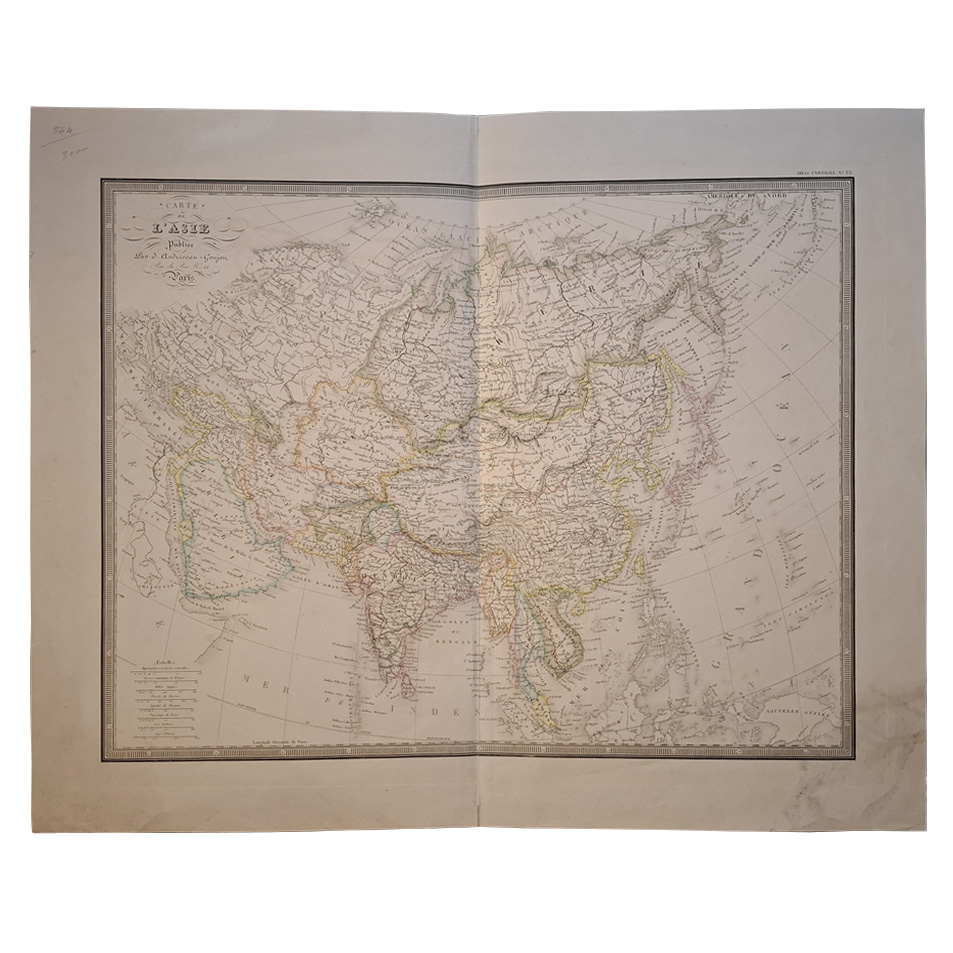
CARTE DE L’ASIE PUBLIÉE PAR J ANDRIVEAU-GOUJON – 1850
Andriveau-Goujon, J
£65.00
Availability: In stock
Product Description
CARTE DE L’ASIE PUBLIÉE PAR J ANDRIVEAU-GOUJON – 1850
Cartographer: J Andriveau-Goujon
Publisher: Andriveau-Goujon, Paris, France
Price: £65 (post-free in the UK)
Publication Date: 1850
Edition: 1st edition
Format: Steel engraving
Condition: In very good condition, unframed
Sheet Size: 56.5cm x 77.5cm
Condition:
The edition from 1850. Scale: 1:26000000. Central fold lines. Original hand-colouring. Minor repairs to the head and tail of the central fold line. Dusty mark to the bottom right hand corner which is mainly confined to the margin. Reverse is blank. In very good condition overall.
Location: Map Drawer C: FS: Folder M2000 002564
Asia in 1850: A Short History
Asia in 1850 was a vast and diverse continent marked by profound political, economic, and cultural changes. The mid-19th century was a time of significant upheaval and transformation, as traditional empires grappled with internal challenges and external pressures, while new powers emerged to assert their influence. This period also witnessed the intensification of colonial expansion by European powers, reshaping the region’s geopolitical landscape.
The Major Powers of Asia in 1850
1. The Qing Dynasty (China)
The Qing Dynasty, ruled by the Manchu elite, was the dominant power in East Asia during this period. However, by 1850, the empire faced serious challenges:
- Internal Struggles: The population had grown rapidly, putting immense strain on resources and governance. Corruption and inefficiency plagued the bureaucracy, leading to widespread dissatisfaction.
- The Taiping Rebellion: In 1850, the Taiping Rebellion erupted in southern China. This massive civil war, led by Hong Xiuquan, sought to overthrow the Qing government and establish a “Heavenly Kingdom of Great Peace.”
- Foreign Intrusions: The Opium Wars with Britain in the 1830s and 1840s had left China weakened, with the Treaty of Nanking (1842) forcing China to cede Hong Kong to Britain and open several ports to foreign trade.
2. The Tokugawa Shogunate (Japan)
Japan, under the Tokugawa Shogunate, maintained a policy of isolation (sakoku) since the early 17th century. However, by 1850, external pressures to open its ports were increasing:
- The United States, under Commodore Matthew Perry, would soon force Japan to end its isolation in 1853.
- Japan’s economy remained largely feudal, though signs of modernisation were beginning to emerge in urban centres.
3. The Ottoman Empire
The Ottoman Empire, which controlled parts of the Middle East and Anatolia, was in a period of decline known as the “Sick Man of Europe.” By 1850:
- Tanzimat Reforms: The Ottoman government implemented a series of modernising reforms to strengthen the empire and stave off European encroachment.
- Territorial Challenges: The empire faced threats from Russia, Britain, and France, particularly concerning influence over the Balkans and the eastern Mediterranean.
4. The Mughal Empire and British India
In South Asia, the once-powerful Mughal Empire was a shadow of its former self by 1850. The British East India Company had established de facto control over much of the subcontinent:
- British Dominance: The Doctrine of Lapse, a policy implemented by Lord Dalhousie, allowed the British to annex Indian princely states that lacked a direct heir.
- Socio-Economic Impact: British policies transformed India’s economy, introducing railways and new agricultural practices while also exploiting resources for export.
Colonial Expansion and European Influence
European colonial powers had a significant presence in Asia by 1850:
- British Empire: Besides controlling much of India, Britain exerted influence over parts of Southeast Asia, including Burma (Myanmar), and maintained trade dominance in China through the Treaty Ports.
- French Indochina: France had begun to establish control in Vietnam, Cambodia, and Laos, consolidating its influence in Southeast Asia.
- Russia: The Russian Empire expanded eastward, annexing territories in Central Asia and Siberia, while seeking access to warm-water ports in the Far East.
Key Regional Developments
Central Asia
The region was a contested space between the Russian and British Empires, known as the “Great Game.” Russia expanded into Central Asia, while Britain sought to secure its interests in India by influencing Afghanistan and Persia.
Southeast Asia
Southeast Asia was a patchwork of colonial territories and independent kingdoms:
- Thailand (Siam): Maintained its independence by modernising and balancing relations with European powers.
- Dutch East Indies: The Netherlands consolidated its control over Indonesia, exploiting its resources for the benefit of the Dutch economy.
Korea and Vietnam
Korea remained a tributary state of the Qing Dynasty but pursued its own isolationist policies. Vietnam, under the Nguyễn dynasty, faced growing pressure from French missionaries and colonial forces.
Cultural and Economic Transformations
Asia in 1850 experienced significant cultural and economic changes:
- Trade: The opening of China to foreign trade brought an influx of goods and ideas but also led to economic dependency and social disruption.
- Technological Change: Railways, telegraphs, and steamships began to appear, particularly in British-controlled territories, laying the groundwork for modernisation.
- Religious Movements: Across the continent, religious and spiritual movements emerged, often as responses to political and social upheaval.
Conclusion
Asia in 1850 was a continent in flux, shaped by the interplay of traditional empires, emerging powers, and expanding colonial influence. The events of this period laid the groundwork for the dramatic transformations that would unfold in the latter half of the 19th century, as modernisation, nationalism, and imperialism continued to reshape the region.
Andriveau-Goujon: Publishers: A Short Cartographic History
The Andriveau-Goujon publishing house stands as one of the most illustrious names in 19th-century French cartography, renowned for producing maps and atlases of exceptional quality and precision. Operating from Paris, this firm played a significant role in shaping geographic understanding during a period marked by exploration, scientific advancement, and colonial expansion.
Origins and Formation
The Andriveau-Goujon enterprise was established in 1825 through the union of two influential cartographic families. Eugène Andriveau, an accomplished mapmaker, married the daughter of Jean Goujon, a respected publisher of maps and globes. This alliance merged their expertise and resources, resulting in a firm that quickly rose to prominence within the cartographic community.
Cartographic Excellence
Andriveau-Goujon earned a reputation for producing maps that combined scientific accuracy with artistic finesse. Their works included detailed atlases, wall maps, and globes, which were frequently updated to reflect the latest geographic discoveries and political changes. These publications catered to a diverse audience, including explorers, merchants, government officials, and academics.
The firm’s atlases often included comprehensive annotations and legends, making them both visually appealing and highly informative. Their wall maps, meanwhile, became popular fixtures in institutions and private homes, admired for their clarity and elegance.
Collaboration with Notable Cartographers
Throughout its operation, Andriveau-Goujon collaborated with some of the leading cartographers of the era, including Adrien-Hubert Brué and Victor Levasseur. These partnerships enabled the firm to incorporate cutting-edge geographic data and cartographic techniques into its products. Such collaborations ensured that Andriveau-Goujon remained at the forefront of the field, setting standards for quality and innovation.
A Global Perspective
The firm’s output encompassed a wide range of geographic regions, reflecting the growing interest in global exploration and imperial expansion during the 19th century. From detailed maps of Asia and Africa to localised charts of France, Andriveau-Goujon provided invaluable tools for navigation, trade, and academic study. Their publications often emphasised both physical geography and political boundaries, offering a comprehensive view of the regions they depicted.
Decline and Legacy
By the late 19th century, the cartographic landscape had begun to change, with advancements in printing technology and competition from emerging publishers reshaping the industry. In 1892, the Andriveau-Goujon company ceased independent operations, with its stock acquired by M. Barrère. Despite this, the firm’s legacy endured, with its maps continuing to be celebrated for their historical significance and aesthetic quality.
Enduring Influence
Today, the works of Andriveau-Goujon are preserved in museums, libraries, and private collections around the world. They are not only prized for their cartographic excellence but also serve as historical artefacts that provide insight into 19th-century perceptions of geography and geopolitics. The firm’s commitment to accuracy and artistic craftsmanship ensures its place in the annals of cartographic history, a testament to the enduring value of its contributions.
SHOP WITH CONFIDENCE AT HORNSEYS
At Hornseys, we are dedicated to offering items that uphold the highest standards of quality and authenticity. Our collection of artwork is carefully curated to ensure that each item we offer is authentic, collated, and complete.
Here’s what sets us apart:
- Authenticity and Provenance: Each map is researched and verified for authenticity.
- Expert Curation: We entirely own all our artworks. We trust our taste and have invested heavily in it. We have confidence in all artwork that we offer for sale.
- Customer Satisfaction: We strive to provide an exceptional customer experience, from detailed descriptions and provenance to secure and prompt delivery of your purchase.
- Returns Policy: We offer an unconditional guarantee on every item. If, however, you wish to make a return, artworks may be sent back to us within fourteen days of receipt for whatever reason. We request that we are notified in advance if you wish to do so. They must be returned to us in the same condition as they were sent for a full refund.
OUR COMMITMENT TO QUALITY AND SERVICE
Understanding the value and rarity of these items, we ensure that every aspect of your purchase meets the highest standards of quality and service. This includes:
- Free Expedited, Tracked, and Insured Delivery within the UK: Ensuring that your artwork arrives safely and promptly.
- Fully-Insured Worldwide Delivery: Offering peace of mind for international collectors with reliable and secure shipping options.
EXPLORE OUR COLLECTION
Visit Hornseys today to explore our fine collection of maps and other artworks. Whether you are an avid collector or looking for a special gift, our selection offers something truly unique. Located since 1976 in Ripon in the picturesque Yorkshire Dales, we are recognized as a destination gallery for tastefully curated artwork, rare maps, design, and fine books.
Related products


You may also like…

ANTIQUORUM AFRICAE EPISCOPA TUUM GEOGRAPHIA DESCRIPTIO – 1640 – NORTHERN AFRICA
£95.00Tavernier, Melchior


