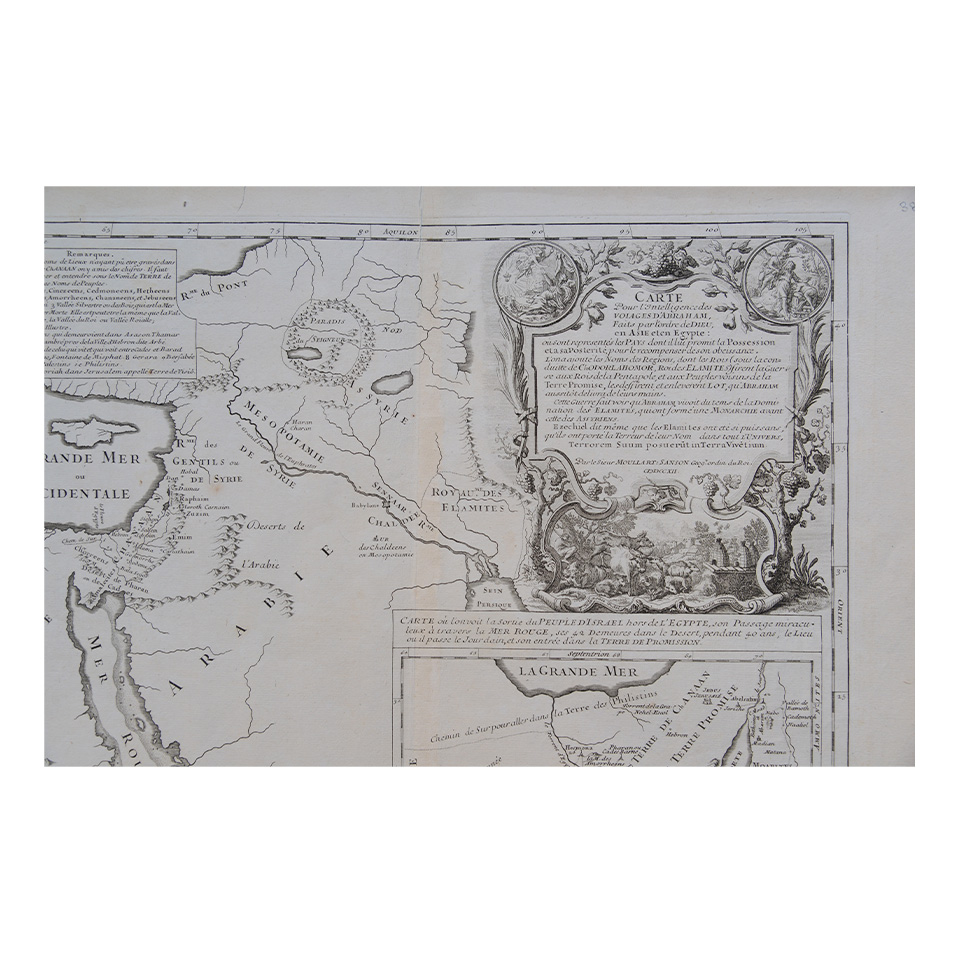
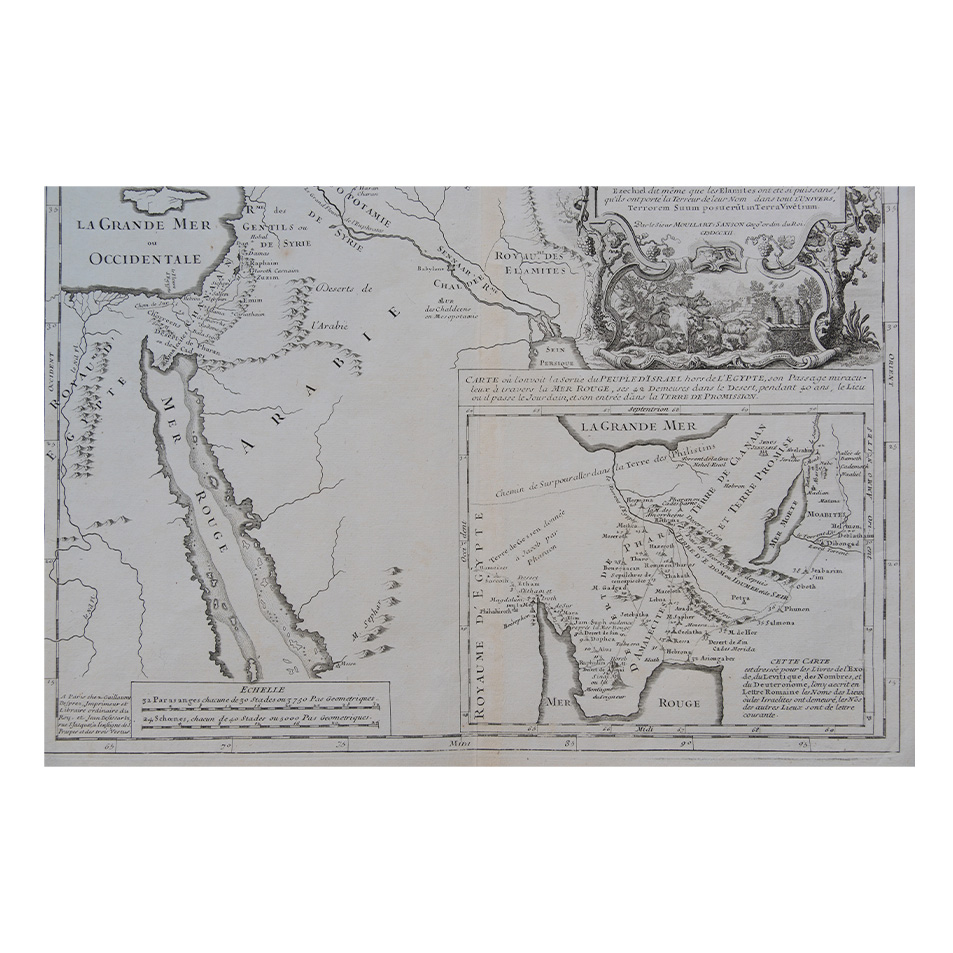
Egypt – Middle East – The Holy Land – Carte Pour L’Intelligence Des Voyages D’Abraham Faits Par L’Ordre De Dieu En Asie Et En Egypte
Moullart-Sanson, Pierre
£135.00
Availability: In stock
Product Description
Egypt – Middle East – The Holy Land – Carte Pour L’Intelligence Des Voyages D’Abraham Faits Par L’Ordre De Dieu En Asie Et En Egypte
Cartographer: Moullart-Sanson, Pierre
Publisher: Guillaume Desprez et Jean Desessartz
Price: £135 including postage in the UK
Publication Date: 1717
Edition: Not stated
Sheet Size: 45.5cm x 39.8cm
Condition: Very good
Condition:
Original copper engraved map. Dated 1712 but 1717. Sheet size: 45.5cm x 39.8cm. Reverse is blank. A detailed and early 18th century map of the Holy Land showing the travels of Abraham and the Israelites. Shows the Middle East from the Eastern Mediterranean to the Persian Gulf. Highly decorative title cartouche showing the life of Abraham and below an inset map showing the Exodus. The map is very slightly dusty, age-toned and rubbed and has a short closed tear to the upper fold line but is in very good indeed condition overall.
The Travels of Abraham: A Brief Overview
Abraham’s journeys form one of the foundational travel narratives of the ancient world. His movements across Mesopotamia, Syria, Canaan, and Egypt helped shape the later identities of Israel, Judaism, Christianity, and Islam. The biblical text presents his travels not merely as geographical relocations but as acts of obedience, faith, and cultural encounter. The sequence below follows the broadly accepted chronology of events and their geographical settings.
- Origins in Ur of the Chaldeans
Cultural and Geographical Setting
Abraham (originally Abram) was born in Ur, a major Sumerian city in southern Mesopotamia near the Euphrates. Ur was:
- A centre of trade and literacy
- A city of monumental architecture and organised religion
- Connected to caravan routes leading northwest toward Syria
Departure
Abraham’s family—Terah, Abram, Sarai, and Lot—left Ur, a move interpreted as both a familial decision and the beginning of Abraham’s divinely guided journey.
The text does not give a definitive reason for the departure, but later tradition associates it with:
- Dissatisfaction with local religious practices
- A divine call towards a new land and purpose
- Family relocation after personal or political changes
- Haran: A Transitional Homeland
Settlement in Haran
The family travelled northwest along the Fertile Crescent to Haran, a thriving trade city in northern Mesopotamia (modern-day Turkey/Syria border region). Haran was known for:
- Caravan commerce
- A significant moon-god cult
- Strategic location on the route between Mesopotamia and the Levant
The family settled there and prospered. After Terah’s death, Abraham experienced the explicit divine call instructing him to journey to a land that would be shown to him.
Abraham’s Response
In obedience, Abraham:
- Departed with his household, including Sarai and Lot
- Took servants, livestock, and goods
- Set out towards Canaan
This departure signals the beginning of Abraham’s identity as a sojourner, travelling not for trade alone but for covenantal purpose.
- Entry into Canaan: Shechem and Bethel
Arrival in Shechem
Abraham entered Canaan from the north, stopping first at Shechem, a fertile region framed by Mount Ebal and Mount Gerizim. This place is significant for:
- Its central position in the hill country
- Its status as an early cultic and political centre
At Shechem, Abraham built an altar after receiving a promise that the land would be given to his descendants.
Journey to Bethel
From Shechem he moved south to the highlands between Bethel and Ai, another important ridge-route location. He built a second altar and invoked the name of the Lord. This site became a recurring base in his early wanderings.
- Journey into the Negev and Famine-Driven Travel to Egypt
Movement into the Negev
Abraham then travelled further south into the Negev, a semi-arid region that served as pastureland for nomadic and semi-nomadic herders.
Famine and Descent to Egypt
A severe famine in Canaan compelled Abraham to travel to Egypt, one of the few regions in antiquity with reliable agricultural output due to the Nile’s flooding cycle.
Abraham in Egypt
While in Egypt:
- Abraham and Sarai encountered Pharaoh
- The household increased in wealth and livestock
- The journey brought both material gain and moral complexity
Eventually Abraham returned to Canaan, retracing his route through the Negev and back to the Bethel/Ai region.
- Separation from Lot and Settlement in Hebron
Division of Pasturelands
As Abraham’s and Lot’s herds grew, conflicts arose among their herdsmen. To avoid strife, the two separated:
- Lot moved eastward toward the Jordan Valley, settling near Sodom
- Abraham remained in the southern hill country
Hebron
Abraham made Hebron his principal residence. Hebron became:
- The site of the oaks of Mamre
- A centre for grazing, trade, and political relationships
- Later the burial place of the patriarchs and matriarchs
Abraham built another altar here, indicating Hebron’s spiritual and physical significance.
- Military Expedition to Rescue Lot
A coalition war among kings of the region led to Lot’s capture. Abraham responded by:
- Assembling trained men from his household
- Pursuing the captors as far north as Dan (near Lebanon)
- Defeating them and recovering Lot and his goods
This expedition demonstrates Abraham’s:
- Influence
- Military capacity
- Standing among local rulers
Afterwards, he met Melchizedek, king of Salem, a figure who blesses Abraham and receives gifts from him.
- Renewed Covenant and Divine Promises
Several key encounters follow:
- A formal covenant ritual in which the land is promised from the Nile to the Euphrates
- The promise of numerous descendants
- The prophecy concerning future enslavement and ultimate deliverance of Abraham’s offspring
These events deepen Abraham’s role as a foundational figure in sacred history.
- The Hagar Episode and Ishmael
Sarai’s barrenness leads to the socially accepted but emotionally complex decision to give Hagar, the Egyptian servant, to Abraham. Ishmael is born, and Abraham’s household experiences internal tension.
Subsequent divine encounters reaffirm that a future son, Isaac, will arise from Sarai herself.
- Covenant of Circumcision and Further Travels
Abraham is instructed to institute circumcision as the sign of the covenant. He travels between Hebron and surrounding areas, maintaining ties across the southern Levant.
Three divine visitors later announce Isaac’s birth and reveal the fate of Sodom.
- The Destruction of Sodom and Gomorrah
Abraham intercedes on behalf of Sodom, engaging in one of the Bible’s most sophisticated exchanges on justice and mercy. Though the cities are ultimately destroyed, Lot is rescued.
This episode underscores Abraham’s role as:
- A moral advocate
- A figure engaged in the ethical governance of the world
- Encounters with Regional Powers: Gerar and the Philistine Region
Abraham moves into the territory of Gerar, ruled by Abimelech. As in Egypt, Abraham again faces tension regarding Sarai’s identity. The narrative emphasises:
- Diplomacy
- Misunderstanding
- Divine protection
Abraham establishes treaties with Abimelech and uses wells in the region, showing his practical engagement with local politics.
- Birth of Isaac and Family Developments
Isaac’s birth transforms Abraham’s household:
- Ishmael’s position is altered
- Hagar and Ishmael depart into the wilderness
- Covenant inheritance is clarified through Isaac
This episode signals the beginning of the patriarchal lineage that will define Israel.
- The Binding of Isaac (Akedah)
One of the most dramatic episodes of Abraham’s travels takes place when he journeys to the land of Moriah, traditionally associated with Jerusalem. There he is tested with the command to sacrifice Isaac.
The episode highlights:
- Total trust in divine purpose
- The establishment of Abraham as a model of faith
- A turning point in covenantal history
After the event, Abraham returns to Beersheba and later Hebron.
- Final Years: Hebron, Beersheba, and Burial at Machpelah
Abraham spends his late life between:
- Hebron (his family base)
- Beersheba, where he makes treaties and plants a tamarisk tree
Upon Sarah’s death, he purchases the Cave of Machpelah near Hebron as a burial site, establishing the first permanent landholding associated with the patriarchal family.
Abraham himself is later buried there alongside Sarah.
Conclusion: Character and Purpose of Abraham’s Travels
Abraham’s journeys were far more than geographic migrations. They reveal:
- The shaping of a covenantal identity
- Diplomatic, economic, and spiritual leadership
- Encounters with diverse cultures and political powers
- A life lived in movement, negotiation, and trust
From Mesopotamia to Canaan, Egypt, and back again, Abraham’s travels embody the themes of faith, displacement, promise, and the forging of a people. These journeys underpin the entire narrative arc of the Hebrew Bible and reverberate through Jewish, Christian, and Islamic tradition.
Why buy from us?
At Hornseys, we are committed to offering items that meet the highest standards of quality and authenticity. Our collection is meticulously curated to ensure that each item is a valuable and authentic piece of history. Here’s what sets us apart:
- Authenticity and Provenance: Every item is researched, collated, and verified for authenticity.
- Expert Curation: Each item is selected with a keen eye for significance, condition, and rarity, ensuring a collection that is both diverse and distinguished.
- Customer Satisfaction: We strive to provide an exceptional customer experience, from detailed descriptions and provenance to secure and prompt delivery of your purchase.
- Returns Policy: We offer an unconditional guarantee on every item. If you wish to make a return, items may be sent back to us within fourteen days of receipt for any reason. We request advance notification of returns, and items must be returned in the same condition as sent for a full refund.
Explore Our Collection:
Visit Hornseys to explore our fine collection of rare and signed books, maps, artwork and objects. Whether you are an avid collector or looking for a special gift, our selection offers something truly unique. Located in the picturesque Yorkshire Dales, our Ripon gallery has been a haven for book lovers, art enthusiasts, and collectors since 1976.
Thank you for looking.
Related products

Moirang, Manipur – Restricted British Fourteenth Army Battle Map – Road to Imphal – June 1944 – Second Edition
£195.00Survey H.Q., Fourteenth Army



You may also like…
Saudi Arabia With City Maps Of Riyadh Jeddah And Dammam – Second Edition
£250.00GEOprojects Arab World Map Library