
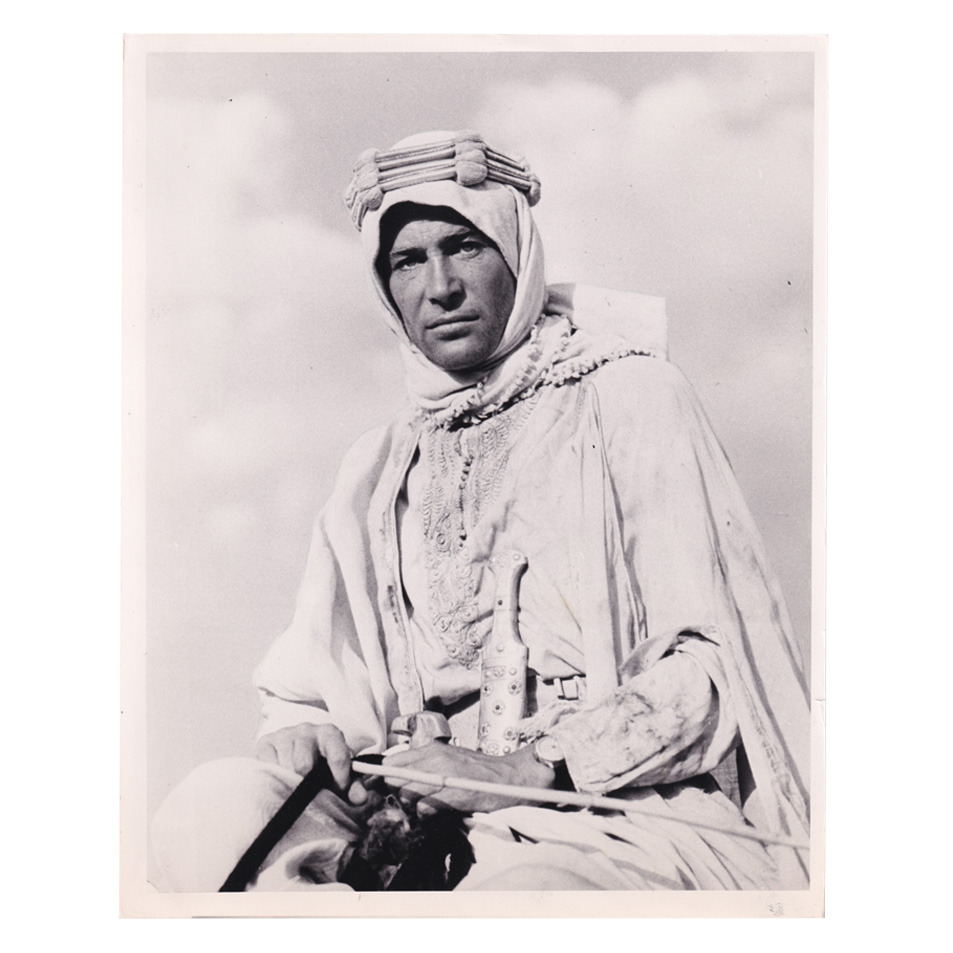
Lawrence Of Arabia Starring Peter O’Toole As T E Lawrence – Original Press Photograph – December 22nd 1975
For Tyne Tees
£30.00
Availability: In stock
Product Description
Lawrence Of Arabia Starring Peter O’Toole As T E Lawrence – Original Press Photograph – December 22nd 1975
Publisher: For Tyne Tees
Price: £30.00
Date: December 22nd, 1975
Photograph Size: 20.3cm x 25.4cm including margins
Format: Original Press Photograph
Edition: Not stated.
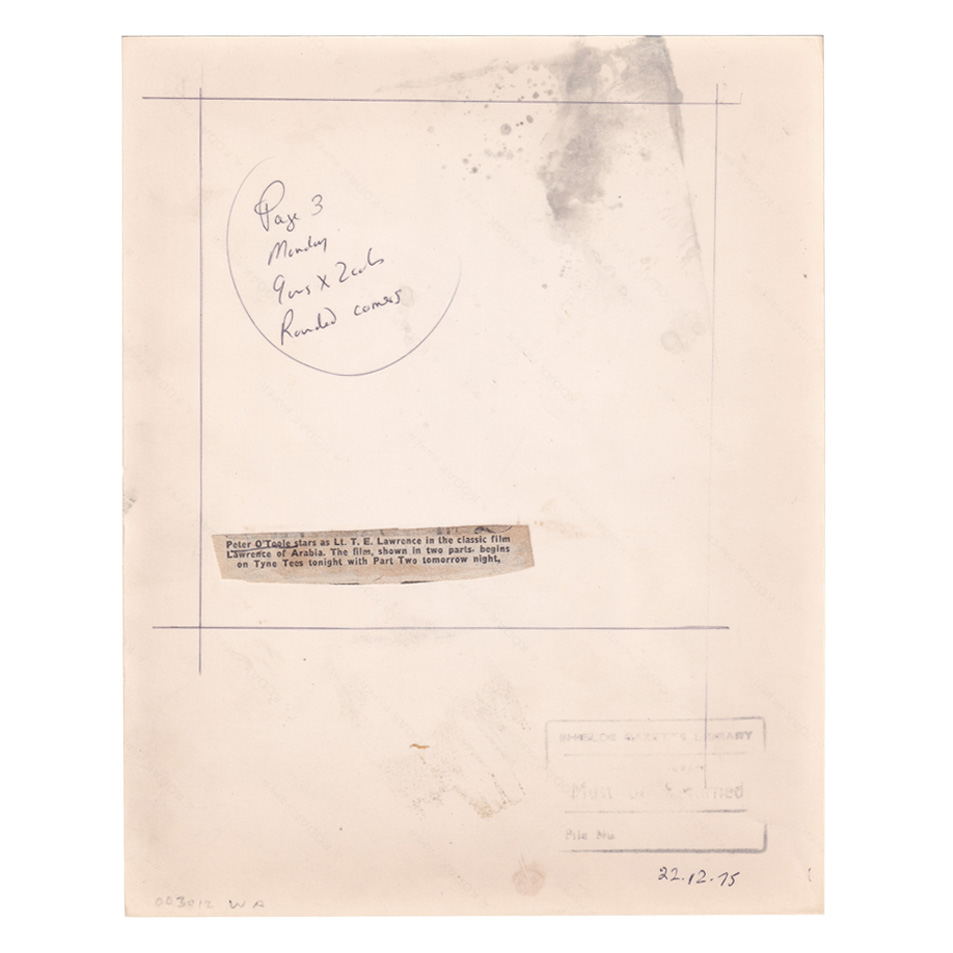
Special Features: Shields Gazette stamp verso.
Condition:
Photograph Size: 20.3cm x 25.4cm including margins. A silver gelatin press publicity photograph of Peter O’Toole as Lawrence of Arabia for the film that was aired on Tyne Tees in 1975. The film was originally released on the 10th of December 1962 and remains one of the greatest films ever made. Very slight marking and creasing. In very good condition.
Peter O’Toole and Lawrence of Arabia: A Brief Description
Peter O’Toole’s portrayal of T.E. Lawrence in Lawrence of Arabia (1962) is one of cinema’s most iconic and complex performances, establishing O’Toole as a magnetic screen presence and forever linking his legacy to this role. Leaning into both the charismatic and tormented facets of Lawrence, O’Toole’s nuanced performance captures the evolution of a British officer from eccentric outsider to a revered, yet deeply troubled, leader within the Arab Revolt.
O’Toole begins with Lawrence as an enigmatic and somewhat awkward officer, contrasting with the traditional military demeanour of his peers. His piercing blue eyes, expressive gestures, and slender build accentuate his distinctiveness, setting him apart visually and psychologically. He brings a boyish charm and wit to Lawrence, yet beneath this lies an intensity hinting at the inner conflict that will soon define him. This portrayal emphasises Lawrence as an outsider—not only in the Arabian desert but also within his own culture.
As the narrative unfolds, O’Toole reveals Lawrence’s growing confidence and connection to the Arab people. Interactions with figures such as Sherif Ali and Prince Faisal demonstrate his adaptability, courage, and passion for Arab independence. His transformation is symbolised by his adoption of traditional Arab attire and customs, yet O’Toole goes beyond the external changes, portraying Lawrence’s deepening emotional attachment to his new comrades.
O’Toole’s range shines in exploring Lawrence’s darker side. The film’s second half reveals a man increasingly disillusioned by British imperialism and consumed by his own thirst for power. Subtle tonal shifts show his inner turmoil, recklessness, and eventual loss of control. The haunted look in his eyes conveys the toll of fame and warfare, culminating in moments of vulnerability that expose his fragility and isolation.
His physical performance evolves alongside Lawrence’s mental state—from a measured, confident gait to erratic, desperate energy. Scenes such as the assault on Aqaba and the ordeal in Deraa blend bravado with trauma, capturing a hero who is both inspiring and tragic.
O’Toole’s performance cemented his reputation as one of the great actors of his generation. Balancing Lawrence’s nobility with his flaws, he avoids idealisation, presenting a conflicted figure disillusioned by his own legend. The film’s closing moments, where Lawrence confronts his hollow victory, demonstrate O’Toole’s mastery in embodying a hero whose greatest battles are internal. This role remains iconic for its depth, complexity, and emotional intensity, leaving an indelible mark on film history.
Lawrence of Arabia: A Brief Description
Lawrence of Arabia (1962), directed by David Lean, is an epic historical drama chronicling the life of T.E. Lawrence, the British officer who united and led Arab tribes during the First World War against the Ottoman Empire. Renowned for its breath-taking cinematography, layered characterisation, and epic scope, the film examines identity, imperialism, and the personal cost of heroism.
The story begins with Lawrence, an eccentric and restless British Army officer, assigned to the Arabian desert. Initially tasked with assessing the situation, he becomes captivated by Arab culture and the cause of independence. As liaison to Prince Faisal, he earns the respect of Arab leaders through his charisma and cultural sensitivity, forging a key alliance with Sherif Ali.
One of the film’s most memorable sequences is the Nefud Desert crossing, where Lawrence’s endurance and determination win him a place among Arab fighters. His transformation from a clean-shaven British officer to a robed desert leader mirrors his deepening commitment. His achievements culminate in the bold raid on Aqaba, a pivotal victory in the Arab Revolt.
However, fame brings internal conflict. Lawrence begins to doubt British intentions and struggles with his own identity, torn between two worlds. His once noble actions become reckless, and he confronts the darker aspects of his nature.
Lean’s direction and Freddie Young’s cinematography capture vast desert vistas that reflect Lawrence’s isolation and moral struggle. Maurice Jarre’s sweeping score adds emotional resonance to the visual grandeur.
In the end, Lawrence’s successes are undercut by political betrayal and personal disillusionment. While he plays a decisive role in the revolt, he returns home haunted, questioning the meaning of his achievements. The film remains a meditation on heroism, cultural collision, and the complexities of war, standing as one of cinema’s most celebrated works.
Seven Pillars of Wisdom by T.E. Lawrence: A Brief Description
Seven Pillars of Wisdom is T.E. Lawrence’s autobiographical account of his experiences in the Middle East during the First World War, focusing on his role in the Arab Revolt (1916–1918) against the Ottoman Empire. The work blends historical narrative with philosophical reflection, offering insight into Lawrence’s thoughts on war, politics, and the Arab culture he came to admire.
Background and Writing Process
Before the war, Lawrence was an archaeologist with extensive knowledge of the Middle East, giving him a deep understanding of its cultures and geography. During the war, he worked for the Arab Bureau in Cairo, liaising with Emir Faisal in organising guerrilla warfare against Ottoman forces.
Lawrence began writing Seven Pillars of Wisdom in 1919, revising it multiple times after losing an early draft. The final limited edition appeared in 1926, lavishly illustrated and privately printed, followed by the abridged Revolt in the Desert in 1927.
Structure and Themes
The book is part memoir, part philosophical treatise. It recounts key events of the Arab Revolt, from the planning of raids to the capture of Aqaba, alongside Lawrence’s observations of tribal politics, desert life, and the ethics of warfare.
Military Campaigns and Strategy: Lawrence details the tactics of mobility, railway sabotage, and hit-and-run warfare, emphasising the strategic role of the desert in shaping the conflict.
Arab Culture and Tribal Dynamics: His respect for the Bedouin is clear, though tempered by an awareness of their internal rivalries. He contrasts their honour and simplicity with the bureaucracy of the British Empire.
Conflict of Loyalties: Lawrence struggled with the knowledge that British promises to the Arabs might not be honoured, creating a moral dilemma that permeates his narrative.
Landscape and Symbolism: The desert is described both as a harsh battlefield and a place of purity and freedom, reflecting his own feelings of awe and alienation.
Key Figures: Emir Faisal is portrayed as a noble leader, while warriors like Auda abu Tayi are given vivid, complex depictions. British officials are often criticised for their detachment from Arab realities.
Reflections on War: Lawrence questions the legitimacy of foreign intervention and considers the cost of violence, both to the land and to the human spirit.
Legacy and Reception
Seven Pillars of Wisdom received critical acclaim for its literary quality, vivid descriptions, and introspective depth. Though some critics have questioned its accuracy, it remains a cornerstone of war literature, shaping the enduring image of Lawrence of Arabia. Its influence extended to David Lean’s 1962 film, which further cemented Lawrence’s legend.
Location: Map Drawer C – Folder 6001 – 003012
Why Buy from Us?
At Hornseys, we offer only items that meet the highest standards of quality and authenticity. Our collection of prints and photographs is carefully curated to ensure that every piece is genuine and of exceptional merit.
What Sets Us Apart
- Authenticity and Provenance: Every photograph is thoroughly researched, collated, and verified to confirm its authenticity.
- Expert Curation: Each piece is chosen with a discerning eye for historical significance, condition, and rarity, resulting in a collection that is both diverse and distinguished.
- Customer Satisfaction: We are committed to delivering an outstanding customer experience, from detailed descriptions and documented provenance to secure and prompt delivery.
- Returns Policy: We provide an unconditional guarantee on every item. Returns are accepted within fourteen days of receipt for any reason. We request advance notification, and items must be returned in the same condition as received to qualify for a full refund.
Explore Our Collection
Visit Hornseys to discover our exceptional range of rare and antique prints and photographs. Whether you are a seasoned collector or seeking a unique historical treasure, our selection offers something remarkable.
Situated in the picturesque Yorkshire Dales, our Ripon gallery has been a destination for art enthusiasts, historians, and collectors since 1976.
Thank you for looking.
Related products

Yehudi Menuhin Plays The Lady Blunt Stradivarius – June 6th 1971 – Original Press Photograph
£50.00Menuhin, Yehudi & The BBC


You may also like…
Lawrence Of Arabia – Starring Peter O’Toole As T E Lawrence – Original Press Photograph – May 31st 1963
£200.00Columbia Pictures Press Office
Lawrence Of Arabia – Starring Peter O’Toole As T E Lawrence – Original Press Photograph – May 31st 1963
£250.00Columbia Pictures Press Office


