Les Aventures De Tintin – Au Pays De L’Or Noir – The Adventures Of Tintin – The Land Of Black Gold – First Edition – 1950
Hergé
£250.00
Availability: In stock
Product Description
Les Aventures De Tintin – Au Pays De L’Or Noir – The Adventures Of Tintin – The Land Of Black Gold – First Edition – 1950
Author: Hergé
Price: £250.00
Publisher: Casterman
Publication date: 1950
Format: Original cloth-backed boards with pictorial endpapers
Condition: Good plus
Pages: 62
Illustrations: Illustrated throughout in colour by the author
Description:
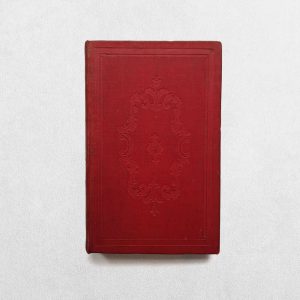
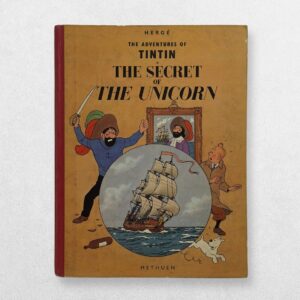
Casterman Tournai Paris, 1950. Printed in Belgium. First edition. Original cloth-backed boards. Pictorial blue endpapers. Pp. 62. Illustrated throughout in colour by the author. Binding nice and tight with minor rubbing and creasing to the spine and edges of the boards. Wear to the head of the spine and a small amount of loss to the cloth to the base of the spine. Slight age toning to the pages as usual. A good plus, tight, copy. Scarce.
Au Pays De L’Or Noir: A Brief Summary
The story begins in Belgium, where motorists experience a disturbing phenomenon: petrol suddenly becomes dangerously unstable, causing engines to explode. The crisis threatens transport, industry, and public safety. The authorities suspect deliberate sabotage, and Tintin is asked to investigate.
Early clues point towards the Middle East, a region whose oil reserves are of growing strategic importance. The instability of fuel supplies hints at political manipulation as well as criminal intent.
Journey east and political tension
Tintin travels to the fictional Middle Eastern emirate of Khemed, a land rich in oil but riven by internal and external conflict. Khemed is ruled by Emir Mohammed Ben Kalish Ezab, whose position is under threat from rival factions seeking control of the oilfields.
The political situation is volatile. Oil is not merely an economic resource but the foundation of power, sovereignty, and international influence. Tintin quickly realises that the fuel sabotage is part of a broader struggle to destabilise Khemed and seize its oil wealth.
Kidnapping and pursuit
Shortly after his arrival, Tintin is kidnapped by conspirators attempting to neutralise him. He escapes, but the experience confirms that powerful interests are at work. His investigation brings him into contact with arms dealers, mercenaries, and shadowy intermediaries operating behind diplomatic façades.
Throughout this phase, Tintin navigates shifting alliances, unsure whom to trust. The desert setting emphasises vulnerability and isolation, while the political intrigue deepens.
Dr Müller and the sabotage plot
The mastermind behind the crisis is revealed to be Dr Müller, a recurring antagonist in the Tintin series. Müller has developed a chemical additive that renders petrol explosive after a short period. His aim is to sabotage Khemed’s oil exports, ruin its credibility, and create the conditions for a hostile takeover by rival interests.
Müller’s scheme operates on both scientific and political levels: chemistry is weaponised to reshape international power relations.
Abdallah and personal stakes
Alongside the geopolitical plot runs a more personal storyline involving Prince Abdallah, the Emir’s young son. Abdallah becomes a target for kidnappers seeking leverage over the Emir.
Tintin repeatedly risks his life to protect the child, whose mischievous and anarchic behaviour provides comic relief but also highlights the human cost of political conflict. Abdallah’s safety becomes inseparable from the stability of Khemed itself.
Climax: exposure and defeat
Tintin succeeds in uncovering Müller’s laboratory and exposing the fuel sabotage. After a series of chases, escapes, and confrontations, Müller is captured. The chemical threat is neutralised, and normal petrol production can resume.
With the conspiracy dismantled, the immediate danger to Khemed’s oil industry is removed. The Emir’s position is stabilised, and foreign interference is thwarted.
Resolution
The story concludes with order restored, but without triumphalism. The political structures of Khemed remain fragile, and the narrative makes clear that oil wealth brings not security but permanent vulnerability.
Tintin departs having prevented catastrophe, but the broader forces driving conflict—greed, imperial ambition, and technological misuse—remain unresolved.
Narrative significance
Au Pays de l’Or Noir is one of the most overtly political Tintin adventures. It reflects contemporary anxieties about:
- Oil dependency
- Middle Eastern geopolitics
- Corporate and state manipulation of resources
The album is notable for its repeated revisions over time, which progressively adjusted its political references while preserving its core themes.
Thematic overview
Key themes include:
- Oil as power and source of instability
- Science in the service of destruction
- Intervention versus sovereignty
- The vulnerability of states dependent on single resources
Unlike many earlier adventures, the antagonist is not a simple criminal but a figure operating within complex international systems.
Concluding assessment
Au Pays de l’Or Noir stands as one of Hergé’s most prescient works. It anticipates modern concerns about energy security and geopolitical interference, framing them within a fast-paced adventure narrative. Tintin functions here less as explorer and more as crisis mediator, navigating a world where technology, politics, and profit intersect dangerously.
Why Buy from Us?
At Hornseys, we are committed to offering items that meet the highest standards of quality and authenticity. Our collection of rare books is carefully curated to ensure each edition is a valuable piece of bibliographical history. Here’s what sets us apart:
- Authenticity and Provenance: Each book is meticulously researched and verified for authenticity and collation.
- Expert Curation: Our selection process focuses on significance, condition, and rarity, resulting in a collection that is both diverse and distinguished.
- Customer Satisfaction: We aim to provide an exceptional customer experience, from detailed descriptions to secure and prompt delivery of your purchase.
- Returns Policy: We offer an unconditional guarantee on every item. If you wish to return a book, it may be sent back to us within fourteen days of receipt. Please notify us in advance if you wish to do so. The book must be returned in the same condition as it was sent for a full refund.
Cataloguer: Daniel Hornsey
Daniel Hornsey has specialised in fine and rare books, ephemera, and collectors’ editions for over thirty years. As a long-standing member of the antiquarian book trade, he has advised private collectors, curated catalogues, and sourced works for leading dealers, libraries and institutions across the world.
Hornseys’ exhibit regularly at book and map fairs in London and throughout the UK and are members of the Provincial Booksellers Fairs Association, the PBFA.
His fascination with Hergé’s work — especially ‘The Adventures of Tintin’ — began in childhood. Daniel recalls reading Tintin in original European editions and quickly recognising that these were not merely children’s books, but finely illustrated narratives crafted with artistic depth and wit.
As noted by the Musée Hergé in Louvain-la-Neuve, Hergé’s ‘ligne claire’ style has influenced generations of European comic artists and his original drawings and paintings command very high prices with his painting of ‘The Blue Lotus’ jar fetching £2.8m at auction in 2021.
By presenting these works through Hornseys’, he hopes to contribute to the continued appreciation of one of the 20th century’s most influential illustrators, helping new generations discover the artistry and legacy of Hergé.