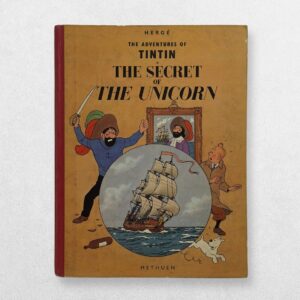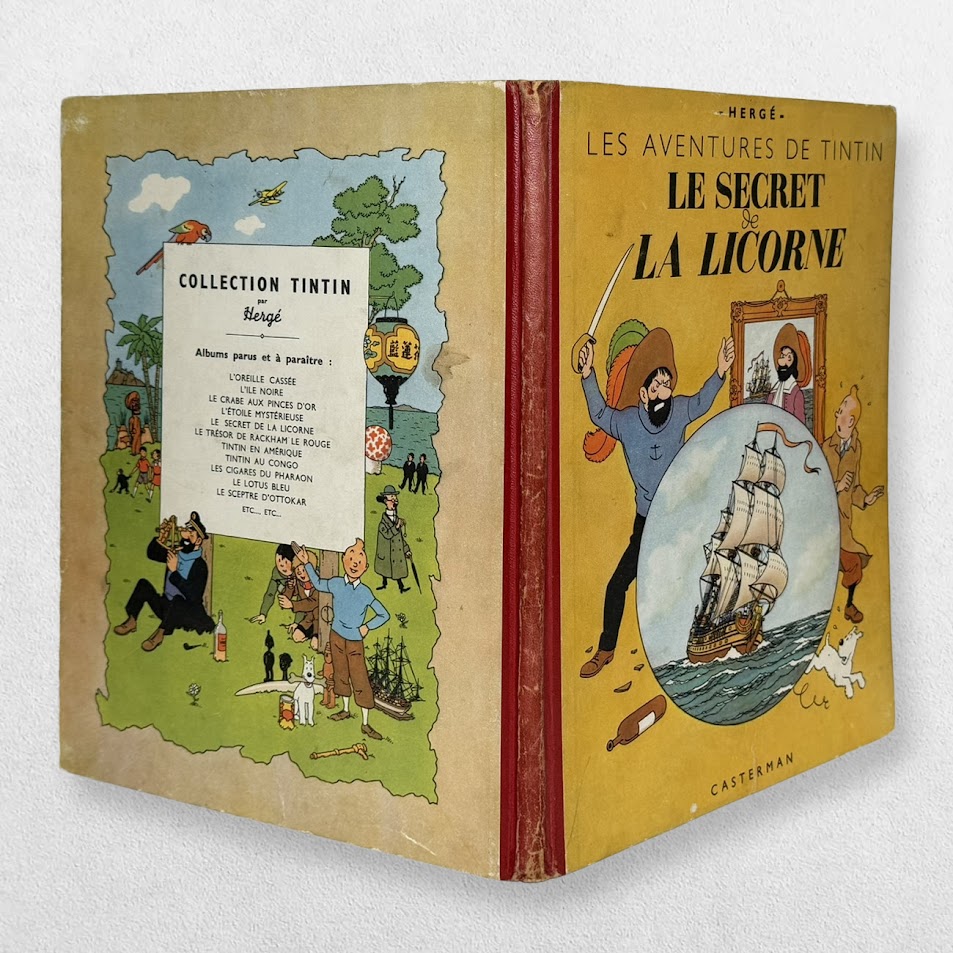
Les Aventures De Tintin – Le Secret De La Licorne – The Adventures Of Tintin – The Secret Of The Unicorn – Early Edition – 1947
Hergé
£300.00
Availability: In stock
Product Description
Les Aventures De Tintin – Le Secret De La Licorne – The Adventures Of Tintin – The Secret Of The Unicorn – Early Edition – 1947
Author: Hergé
Price: £300.00
Publisher: Casterman
Publication date: 1947
Format: Original cloth-backed boards with pictorial endpapers
Condition: Very good plus
Pages: 62
Illustrations: Illustrated throughout in colour by the author
Description:
Casterman Tournai Paris, 1947. Printed in Belgium. Early edition. Original cloth-backed boards. Pictorial blue endpapers. Pp. 62. Illustrated throughout in colour by the author. Binding nice and tight with minor rubbing and creasing to the spine and edges of the boards. Slight age toning to the pages as usual. A very good plus, tight, copy. Scarce.
Le Secret De La Licorne: A Brief Summary
The story opens in Brussels, where Tintin purchases a model of a seventeenth-century sailing ship, La Licorne (“The Unicorn”), from a street market. Almost immediately, two men show intense interest in the model: Ivan Ivanovitch Sakharine, a sinister collector, and Barnaby, a nervous elderly man who appears desperate to speak with Tintin.
Shortly after Tintin takes the model home, it is stolen from his flat. Tintin recovers it, but soon realises that the mast is missing. When the mast later turns up separately, Tintin discovers a parchment hidden inside it, bearing an enigmatic message written in old French and signed by Sir Francis Haddock.
The riddle of the parchments
The message recounts events from the late seventeenth century, referring to a battle between La Licorne and the pirate Red Rackham the Red. The parchment hints at a hidden treasure but makes clear that the message is incomplete.
Tintin soon learns that three identical models of La Licorne exist, each containing a fragment of the full message. Someone is systematically tracking them down. Barnaby attempts to warn Tintin but is violently attacked and left gravely injured, reinforcing the danger surrounding the mystery.
Captain Haddock and the ancestral connection
Tintin brings the matter to Captain Archibald Haddock, who is astonished to learn that Sir Francis Haddock was his ancestor. Through family papers and Sir Francis’s account, the story moves into an extended historical flashback.
In the past, Sir Francis commanded La Licorne when it was attacked by Red Rackham. After a fierce naval engagement and a dramatic duel, Sir Francis defeats the pirate. Realising that Rackham’s stolen treasure cannot be safely transported, Sir Francis hides it, records its location in three separate parchments, conceals them in model ships, and deliberately sinks La Licorne to protect the secret.
This episode establishes a moral opposition between honour and restraint (Sir Francis) and greed and violence (Red Rackham), which mirrors the conflict in the present.
Sakharine’s true identity
As Tintin and Haddock search for the remaining models, they uncover Sakharine’s true role. He is revealed to be a descendant of Red Rackham, driven by inherited obsession rather than historical curiosity. Sakharine acquires one of the remaining models through intimidation and theft, bringing him closer to the full message.
After a series of chases, surveillance, and narrow escapes, Tintin and Haddock manage to secure the third model. When the three parchments are assembled, they form a complete set of coordinates and instructions.
The apparent solution
The combined message leads Tintin and Haddock to a precise location in Brussels. Expecting to find the treasure at last, they dig and search—only to discover nothing at all. The solution appears correct, yet the treasure is absent.
This failure is not accidental. Sir Francis Haddock deliberately designed the riddle to mislead anyone who followed it mechanically. The true solution requires interpretation rather than literal obedience to the instructions.
Conclusion and transition
Sakharine is temporarily thwarted, but not definitively defeated. Tintin realises that the secret of the treasure lies elsewhere and that the parchments contain a second, subtler meaning.
The story ends without resolving the central mystery. Instead, it closes on a note of anticipation and intellectual suspense, leading directly into the sequel, Le Trésor de Rackham le Rouge (Red Rackham’s Treasure), where the final secret is uncovered.
Narrative significance
Le Secret de La Licorne represents a major development in the Tintin series. It introduces:
- A sustained mystery spanning generations
- Complex use of historical flashback
- A shift from episodic adventure to structured, puzzle-driven narrative
It also deepens Captain Haddock’s character, rooting his present weaknesses in a lineage marked by courage and moral integrity.
Thematic overview
The story explores:
- Inheritance and responsibility
- The ethics of wealth and power
- Intelligence over brute force
- History as an active force shaping the present
The treasure itself is secondary to the idea that truth is concealed not by distance, but by misunderstanding.
Why Buy from Us?
At Hornseys, we are committed to offering items that meet the highest standards of quality and authenticity. Our collection of rare books is carefully curated to ensure each edition is a valuable piece of bibliographical history. Here’s what sets us apart:
- Authenticity and Provenance: Each book is meticulously researched and verified for authenticity and collation.
- Expert Curation: Our selection process focuses on significance, condition, and rarity, resulting in a collection that is both diverse and distinguished.
- Customer Satisfaction: We aim to provide an exceptional customer experience, from detailed descriptions to secure and prompt delivery of your purchase.
- Returns Policy: We offer an unconditional guarantee on every item. If you wish to return a book, it may be sent back to us within fourteen days of receipt. Please notify us in advance if you wish to do so. The book must be returned in the same condition as it was sent for a full refund.
Cataloguer: Daniel Hornsey
Daniel Hornsey has specialised in fine and rare books, ephemera, and collectors’ editions for over thirty years. As a long-standing member of the antiquarian book trade, he has advised private collectors, curated catalogues, and sourced works for leading dealers, libraries and institutions across the world.
Hornseys’ exhibit regularly at book and map fairs in London and throughout the UK and are members of the Provincial Booksellers Fairs Association, the PBFA.
His fascination with Hergé’s work — especially ‘The Adventures of Tintin’ — began in childhood. Daniel recalls reading Tintin in original European editions and quickly recognising that these were not merely children’s books, but finely illustrated narratives crafted with artistic depth and wit.
As noted by the Musée Hergé in Louvain-la-Neuve, Hergé’s ‘ligne claire’ style has influenced generations of European comic artists and his original drawings and paintings command very high prices with his painting of ‘The Blue Lotus’ jar fetching £2.8m at auction in 2021.
By presenting these works through Hornseys’, he hopes to contribute to the continued appreciation of one of the 20th century’s most influential illustrators, helping new generations discover the artistry and legacy of Hergé.
Related products

E H Shepard, The Man Who Drew Pooh: The Story Of E H Shepard: Signed By The Author
£35.00Chandler, Arthur R