Les Aventures De Tintin – Tintin Au Tibet – The Adventures Of Tintin – Tintin In Tibet – First Or Very Early Issue – 1960
Hergé
£250.00
Availability: In stock
Product Description
Les Aventures De Tintin – Tintin Au Tibet – The Adventures Of Tintin – Tintin In Tibet – First Or Very Early Issue – 1960
Author: Hergé
Price: £250.00
Publisher: Casterman
Publication date: 1960
Format: Original cloth-backed boards with pictorial endpapers
Condition: Very good
Pages: 62
Illustrations: Illustrated throughout in colour by the author
Description:
First or very early French edition. Editions Casterman, Paris – No. 715 – 1960, 3rd trimestre. Printed in France by Danel-Loos. Copyright page dated 1960. Original cloth-backed boards. Pictorial blue endpapers. Red spine cloth. Pp. 62. Illustrated throughout in colour by the author. Rear panel shows last printed title as ‘Tintin Au Tibet’. Rear endpaper has ‘Redoutable’ written on the Thompson Twins’ sailors hats and the press report on page 2 refers to ‘Indian Airways’. Binding nice and tight with minor rubbing and creasing to the spine and edges of the boards and with a scuff to the base of the front panel. Slight age toning to the pages as usual. A very good, tight, clean copy.
Tintin Au Tibet: A Brief Summary
The story opens in Belgium, where Tintin is enjoying a period of calm when he experiences a vivid and disturbing dream. In it, his close friend Chang Chong-Chen calls out to him from the snow, insisting that he is alive and in danger.
Shortly afterwards, Tintin learns that Chang was believed to have died in a plane crash in the Himalayas, en route from China to Europe. The authorities are certain there were no survivors. Tintin, however, is unwavering: he is convinced that Chang is alive and that the dream was not imagination but truth.
This certainty—emotional rather than evidential—drives the entire narrative.
Journey to India and the Himalayas
Ignoring expert opinion and official conclusions, Tintin sets out for India, accompanied reluctantly by Captain Haddock, who is deeply sceptical but loyal. In Delhi, they meet Professor Cuthbert Calculus, whose accidental involvement complicates the journey.
From India, the group travels north towards the Himalayas, entering increasingly remote and hostile terrain. As civilisation recedes, the story sheds almost all political or criminal subplots, focusing instead on endurance, belief, and friendship.
The climb and growing danger
The expedition ascends into the mountains, guided by local porters and monks. Conditions become brutal:
- Extreme cold
- Avalanches
- Treacherous paths and crevasses
- Oxygen deprivation
Captain Haddock struggles physically and emotionally, voicing doubts that Tintin refuses to entertain. Yet he continues out of loyalty, even as the journey becomes life-threatening.
Professor Calculus is eventually lost in an avalanche and presumed dead, heightening the sense of isolation and danger.
The Yeti and fear of the unknown
Local guides warn of the Yeti, a mysterious creature said to inhabit the high mountains. Haddock is terrified by the idea, interpreting every sound and shadow as evidence of its presence.
Tintin, by contrast, remains focused solely on Chang. The Yeti, whether real or not, is secondary to his certainty that his friend is alive.
Discovery and truth
Against all expectations, Tintin eventually finds Chang, alive but injured, having survived the crash and taken refuge in a remote cave. Chang explains that he was rescued by the Yeti, who protected and fed him.
The creature is revealed not as a monster but as a solitary, gentle being, driven by instinctive compassion rather than violence.
Escape and loss
As Tintin and Chang attempt to escape the mountains, the Yeti watches from afar, torn between attachment and fear. It does not attack or pursue them, instead retreating into isolation.
The creature’s quiet grief is one of the most emotionally charged moments in the Tintin series.
Resolution
Tintin, Chang, and Haddock return safely. Professor Calculus is later found alive, having survived with the help of monks.
The story ends without villains defeated, crimes punished, or mysteries exposed. The victory is purely human and emotional: a friend saved, faith justified, compassion affirmed.
Narrative significance
Tintin au Tibet is unique within the Tintin canon. It contains:
- No antagonist
- No criminal conspiracy
- No political intrigue
Conflict arises entirely from nature, doubt, and inner struggle.
Thematic overview
Key themes include:
- Absolute friendship and loyalty
- Faith versus rational certainty
- Compassion beyond humanity
- Solitude and loss
Tintin’s moral authority here does not come from intelligence or courage alone, but from refusal to abandon belief in another human being.
Concluding assessment
Tintin au Tibet is widely regarded as Hergé’s most personal and spiritual work. Stripped of satire, adventure mechanics, and antagonists, it presents Tintin at his most vulnerable and most resolute. The story’s power lies in restraint: silence, snow, and persistence replace spectacle.
Rather than conquering the unknown, Tintin listens to it—and in doing so, affirms the possibility of goodness where none is expected.
Why Buy from Us?
At Hornseys, we are committed to offering items that meet the highest standards of quality and authenticity. Our collection of rare books is carefully curated to ensure each edition is a valuable piece of bibliographical history. Here’s what sets us apart:
- Authenticity and Provenance: Each book is meticulously researched and verified for authenticity and collation.
- Expert Curation: Our selection process focuses on significance, condition, and rarity, resulting in a collection that is both diverse and distinguished.
- Customer Satisfaction: We aim to provide an exceptional customer experience, from detailed descriptions to secure and prompt delivery of your purchase.
- Returns Policy: We offer an unconditional guarantee on every item. If you wish to return a book, it may be sent back to us within fourteen days of receipt. Please notify us in advance if you wish to do so. The book must be returned in the same condition as it was sent for a full refund.
Cataloguer: Daniel Hornsey
Daniel Hornsey has specialised in fine and rare books, ephemera, and collectors’ editions for over thirty years. As a long-standing member of the antiquarian book trade, he has advised private collectors, curated catalogues, and sourced works for leading dealers, libraries and institutions across the world.
Hornseys’ exhibit regularly at book and map fairs in London and throughout the UK and are members of the Provincial Booksellers Fairs Association, the PBFA.
His fascination with Hergé’s work — especially ‘The Adventures of Tintin’ — began in childhood. Daniel recalls reading Tintin in original European editions and quickly recognising that these were not merely children’s books, but finely illustrated narratives crafted with artistic depth and wit.
As noted by the Musée Hergé in Louvain-la-Neuve, Hergé’s ‘ligne claire’ style has influenced generations of European comic artists and his original drawings and paintings command very high prices with his painting of ‘The Blue Lotus’ jar fetching £2.8m at auction in 2021.
By presenting these works through Hornseys’, he hopes to contribute to the continued appreciation of one of the 20th century’s most influential illustrators, helping new generations discover the artistry and legacy of Hergé.
Related products

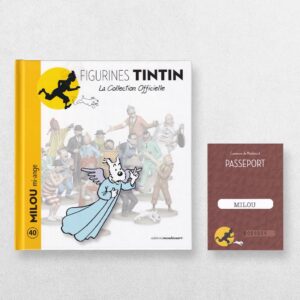
Snowy The Half-Angel – Figurines Tintin La Collection Officielle – 40 – Milou Mi-Ange
£65.00Hergé & Editions Moulinsart
The House At Pooh Corner Signed By Christopher Robin Milne.
£695.00Milne, A. A. With Decorations By Shepard, E. H