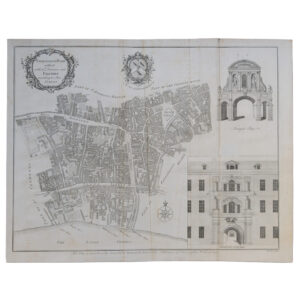
London – Farringdon Ward Without With Its Division Into Parishes According to A New Survey – 1755
Engraver: Benjamin Cole
Publisher: William Maitland
Price: £70 including postage in the UK
Publication Date: 1756
Edition: Not stated
Sheet Size: 49.7cm x 39.4cm
Condition: Good
Condition:
From ‘The History and Survey of London from its Foundation to the Present Time’. Original copper-engraved map. Sheet size: 49.7cm x 39.4cm. Original fold lines. Remnants of old tabs to verso. Minor age-toning and foxing. Repaired tears to lower edge. In good condition overall.
The History and Survey of London from its Foundation to the Present Time: A Brief Overview
Published in 1756, The History and Survey of London from its Foundation to the Present Time is one of the most substantial and ambitious eighteenth-century topographical histories of London. Compiled by William Maitland, a Scottish historian and antiquary active in London, the work sought to combine historical narrative, antiquarian research, civic description, and urban survey into a single, authoritative account of the metropolis.
It stands at the intersection of antiquarian scholarship and Enlightenment urban history, reflecting both a reverence for the past and a systematic desire to document London as a functioning modern city.
- Authorial Background and Purpose
William Maitland
William Maitland was a historian, biographer, and compiler with strong antiquarian interests. Although not formally affiliated with the great scholarly institutions of his day, he worked within the same intellectual milieu as:
- London antiquaries
- Civic historians
- Enlightenment compilers of knowledge
His London history represents the culmination of his scholarly ambitions.
Purpose of the Work
Maitland’s stated and implicit aims were to:
- Correct errors in earlier histories of London
- Consolidate documentary evidence into a coherent narrative
- Provide a systematic survey of the city’s physical and institutional structure
- Demonstrate London’s historical continuity and civic importance
The work was designed both for educated readers and for those engaged in law, commerce, governance, and scholarship.
- Structure and Scope of the Work
Multi-Volume Format
The book was issued in two large folio volumes, reflecting its scale and seriousness. It combines:
- Chronological history
- Topographical description
- Institutional analysis
This hybrid structure was typical of major eighteenth-century urban histories.
- Historical Narrative
From Legendary Origins to the Saxons
Maitland begins with London’s mythical and Roman origins, engaging critically with earlier traditions while drawing on:
- Classical sources
- Medieval chronicles
- Archaeological reasoning (as understood at the time)
He treats legendary material cautiously, often distinguishing between tradition and evidence.
Medieval and Early Modern London
Substantial attention is given to:
- Norman governance
- The development of civic liberties
- Guilds and livery companies
- The growth of trade and population
Maitland places particular emphasis on legal charters and municipal rights, reflecting the Enlightenment interest in constitutional development.
- The Survey of the City
Parishes, Wards, and Streets
A major portion of the work consists of a detailed parish-by-parish and ward-by-ward survey of London.
For each area, Maitland typically records:
- Boundaries
- Principal streets
- Churches and public buildings
- Notable houses and former landmarks
This makes the book invaluable as a snapshot of London before large-scale Victorian redevelopment.
Topographical Precision
While not a surveyor in the modern sense, Maitland aimed at:
- Accuracy of description
- Consistency of organisation
- Cross-referencing of historical and physical detail
His method reflects Enlightenment ideals of order and classification.
- Institutions and Civic Life
Government and Law
Maitland devotes extensive attention to:
- The Corporation of London
- Courts and legal jurisdictions
- Offices such as the Lord Mayor and aldermen
This institutional focus distinguishes his work from more anecdotal city histories.
Religion
Churches, religious houses, and ecclesiastical history receive careful treatment:
- Parish churches are described individually
- The impact of the Reformation is traced
- Dissolved monasteries are documented as historical sites
- Use of Sources and Scholarship
Documentary Foundations
Maitland relied heavily on:
- Charters
- Legal records
- Earlier historians (notably Stow and Strype)
However, he did not merely reproduce these sources; he often:
- Corrected dates
- Challenged received narratives
- Offered reasoned judgements
This critical stance marks him as part of the maturing historical discipline of the eighteenth century.
- Illustrations and Maps
The work included:
- Engraved maps
- Plans of the city
- Architectural and antiquarian plates
These visual elements:
- Supported the text
- Reinforced claims to accuracy
- Enhanced the work’s authority and prestige
They also contribute significantly to its modern historical value.
- Intellectual and Cultural Context
Enlightenment Urban History
Maitland’s London reflects Enlightenment priorities:
- Rational organisation
- Documentary authority
- Civic progress
London is presented not merely as a place of commerce, but as:
- A constitutional city
- A historical organism
- A centre of national life
Response to Earlier Works
Maitland positioned his book as an improvement on:
- John Stow’s Survey of London
- John Strype’s expanded editions
Where Stow was personal and anecdotal, Maitland aimed to be systematic and corrective.
- Reception and Influence
Contemporary Reception
The work was respected for its:
- Scale
- Seriousness
- Evident labour
However, its dense style meant it appealed more to scholars and professionals than to casual readers.
Long-Term Significance
Maitland’s History and Survey became:
- A standard reference for later historians
- A key source for understanding pre-industrial London
- An important bridge between antiquarianism and modern urban history
- Modern Historical Value
Today, the work is valued for:
- Detailed descriptions of vanished streets and buildings
- Documentation of institutional structures
- Insight into eighteenth-century historical method
It is frequently consulted by:
- Urban historians
- Architectural historians
- Genealogists
- Scholars of London’s development
Conclusion
The History and Survey of London from its Foundation to the Present Time stands as one of the most ambitious attempts to comprehend London in its entirety before the transformations of the Industrial and Victorian eras. William Maitland combined historical narrative, institutional analysis, and topographical description to produce a work that reflects both the scholarly aspirations of the Enlightenment and the enduring complexity of London itself.
Though dense and methodical, the book remains a cornerstone of London historiography—less vivid than Stow, but more systematic and critical—offering an indispensable record of the city at a pivotal moment in its long history.
Why buy from us?
At Hornseys, we are committed to offering items that meet the highest standards of quality and authenticity. Our collection is meticulously curated to ensure that each item is a valuable and authentic piece of history. Here’s what sets us apart:
- Authenticity and Provenance: Every item is researched, collated, and verified for authenticity.
- Expert Curation: Each item is selected with a keen eye for significance, condition, and rarity, ensuring a collection that is both diverse and distinguished.
- Customer Satisfaction: We strive to provide an exceptional customer experience, from detailed descriptions and provenance to secure and prompt delivery of your purchase.
- Returns Policy: We offer an unconditional guarantee on every item. If you wish to make a return, items may be sent back to us within fourteen days of receipt for any reason. We request advance notification of returns, and items must be returned in the same condition as sent for a full refund.
Explore Our Collection:
Visit Hornseys to explore our fine collection of rare and signed books, maps, artwork and objects. Whether you are an avid collector or looking for a special gift, our selection offers something truly unique. Located in the picturesque Yorkshire Dales, our Ripon gallery has been a haven for book lovers, art enthusiasts, and collectors since 1976.
Thank you for looking.