


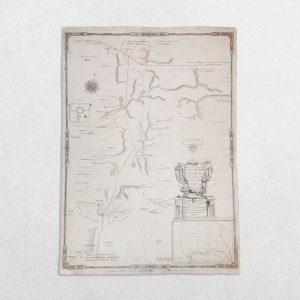
This Trigonometrical Plan Of The Town And Port Of Liverpool Including The Environs Of Kirkdale Everton Low Hill & Toxteth Park From Actual Survey Is By Permission Most Respectfully Dedicated To The Worshipful Mayor And Common Council By Their Most Obedient And Obliged Humble Servant Michael Alexander Gage
Gage, Michael Alexander
£1,200.00
Availability: In stock
Product Description
This Trigonometrical Plan Of The Town And Port Of Liverpool Including The Environs Of Kirkdale Everton Low Hill & Toxteth Park From Actual Survey Is By Permission Most Respectfully Dedicated To The Worshipful Mayor And Common Council By Their Most Obedient And Obliged Humble Servant Michael Alexander Gage
Cartographer: Gage, Michael Alexander
Publisher: M.A. Gage
Price: £1200 including postage in the UK
Publication Date: 1836
Edition: First edition
Map Size: 166cm x 105cm
Binding: Original red morocco slipcase
Condition: Very good plus in very good slipcase
Condition:
Folding map. Dissected on linen. Map has very slight age-toning and offsetting which is much less evident than usual and no apparent fading with bright and original hand-colouring. The red morocco slipcase is rubbed and worn and in very good condition overall. A very nice copy indeed.
Michael Gage’s Plan of Liverpool: A Brief Overview
Overview
Michael Alexander Gage’s Trigonometrical Plan is one of the most important early nineteenth-century large-scale maps of Liverpool, produced during a period of rapid urban expansion, escalating maritime trade, and major civic investment. Created from meticulous “actual survey” and published in the 1830s, the work reflects Gage’s ambition to bring mathematical precision and scientific surveying practice to the representation of a city that was, at the time, one of the most dynamic ports in the world.
The dedication — “Most respectfully dedicated to the Worshipful Mayor and Common Council” — signals both the civic significance of the map and its intended role as an authoritative reference for municipal planning, land management, and commercial development.
About Michael Alexander Gage
Michael Alexander Gage (c.1800–1840s) was a surveyor, cartographer, and civil engineer active during a transformative era for Liverpool. His work demonstrates:
- Technical competence in trigonometrical surveying, a method that allowed unprecedented accuracy before the advent of modern geodetic instruments.
- Professional integrity, evidenced by his insistence on data collected from field measurement rather than derivative copying.
- Relevance and authority, as Gage’s maps were used by landowners, merchants, surveyors, estate trustees, and municipal officials.
Gage is also associated with the extensive map series produced for the Liverpool Improvement Act, further underscoring his professional stature.
Key Features of the Trigonometrical Plan
- Scientific Surveying and Precision
The term “trigonometrical plan” signifies that the map was constructed using triangulation, a method involving measured baselines and angular observations. For the period, this was state-of-the-art practice, comparable to the techniques being formalised by the Ordnance Survey.
This approach allowed Gage to:
- Accurately record street layouts, property boundaries, and elevations
- Represent significant engineering works, quays, and docks with reliable proportions
- Capture the expanding urban periphery with consistency and mathematical rigour
- Coverage of Liverpool and Its Developing Environs
The map encompasses both the urban core and surrounding districts, each of which was undergoing substantial change:
- Kirkdale – transitioning from rural township to industrial suburb
- Everton – formerly a village on higher ground, becoming a fashionable residential area
- Low Hill – a semi-rural fringe area, soon to be absorbed by Liverpool’s expansion
- Toxteth Park – historically a royal hunting park, by the 1830s developing into a major residential and industrial district
Gage’s inclusion of these areas provides invaluable documentation of their pre-Victorian landscapes before later redevelopment obscured earlier patterns.
- Detailed Representation of the Port
Liverpool’s harbour complex was one of the most sophisticated in Britain. The plan includes:
- Docks, basins, and quays (existing and under construction)
- Warehouses and bonded storage
- Access routes critical for the transatlantic timber, cotton, and provisioning trades
- Coastal defences and sea walls
- River Mersey soundings in adjacent charts on some impressions
The map thus serves as both a record of maritime infrastructure and a working tool for merchants and maritime officers.
- Civic, Social, and Infrastructural Elements
The plan marks a wealth of features including:
- Churches, chapels, and parish boundaries
- Workhouses, hospitals, and philanthropic institutions
- The growing railway corridors: the Liverpool & Manchester Railway had opened in 1830, influencing subsequent editions and associated plans
- Turnpike roads, canals, ropewalks, mills, and early gasworks
- Estate boundaries and names of major landowners, crucial for legal and planning purposes
Because Liverpool was a city of migrants, merchants, and industrialists, such maps had real practical utility for taxation, boundary disputes, and public works.
Historical Significance
A Mirror of Liverpool’s Industrial Emergence
By the 1830s, Liverpool was expanding at a remarkable pace due to:
- The Atlantic cotton trade
- Shipbuilding
- Warehousing and international commerce
- The pioneering Liverpool & Manchester Railway
- The accelerating integration of surrounding townships
Gage’s plan captures the city at a crucial juncture, when Georgian Liverpool was giving way to the Victorian metropolis.
A Foundation for Later Mapping
The plan forms a link between:
- Earlier eighteenth-century mapping (Eyes, Perry, Horwood)
- Later Victorian surveys and Ordnance Survey large-scale coverage
It is frequently consulted by historians, genealogists, conservation officers, and architectural researchers because it preserves street names, building footprints, and topographical details that no longer survive.
Cartographic Qualities and Artistic Detail
Although fundamentally a technical artefact, the map also exhibits aesthetic refinement:
- Fine engraved linework
- Elegant hachuring to indicate relief
- Clear lettering styles suited to both scholarly and commercial readerships
- Insets, scales, and compass roses executed with formal precision
Such qualities make original impressions highly collectable.
Use and Legacy
The plan endures as a primary source for:
- Urban historians studying Liverpool’s pre-Victorian form
- Heritage professionals assessing historic landscapes
- Maritime historians examining port logistics
- Archivists, map libraries, and collectors
- Legal researchers concerned with historical property boundaries
Its continued relevance is a testament to Gage’s methodological rigour and the map’s clarity.
Conclusion
Michael Alexander Gage’s Trigonometrical Plan of Liverpool stands as one of the most authoritative and technically advanced surveys of the city in the early nineteenth century. Combining scientific precision with civic purpose, it documents a metropolis on the cusp of industrial modernity. For historians, archivists, and enthusiasts of Liverpool’s past, it remains an indispensable and beautifully crafted resource.
Why buy from us?
At Hornseys, we are committed to offering items that meet the highest standards of quality and authenticity. Our collection is meticulously curated to ensure that each item is a valuable and authentic piece of history. Here’s what sets us apart:
- Authenticity and Provenance: Every item is researched, collated, and verified for authenticity.
- Expert Curation: Each item is selected with a keen eye for significance, condition, and rarity, ensuring a collection that is both diverse and distinguished.
- Customer Satisfaction: We strive to provide an exceptional customer experience, from detailed descriptions and provenance to secure and prompt delivery of your purchase.
- Returns Policy: We offer an unconditional guarantee on every item. If you wish to make a return, items may be sent back to us within fourteen days of receipt for any reason. We request advance notification of returns, and items must be returned in the same condition as sent for a full refund.
Explore Our Collection:
Visit Hornseys to explore our fine collection of rare and signed books, maps, artwork and objects. Whether you are an avid collector or looking for a special gift, our selection offers something truly unique. Located in the picturesque Yorkshire Dales, our Ripon gallery has been a haven for book lovers, art enthusiasts, and collectors since 1976.
Thank you for looking.
Related products

SCOTIA REGNUM CUM INSULIS ADJACENTIBUS ROBERTUS GORDONIUS A STRALOCH DESCRIPSIT – ORIGINAL COPPER ENGRAVED MAP PUBLISHED BY JOAN BLAEU
£650.00Blaeu, Joan & Gordon, Robert
Bristol – City And County Of – Brightstowe Vulgo; Quondam Venta, Flore Tissimum Angliae Emporium
£295.00Braun, Georg & Hogenberg, Franz
Yorkshire: An Accurate Survey Of Some Stupendous Remains Of Roman Antiquity On The Wolds In Yorkshire
£195.00Haynes, John & Vertue, George



You may also like…
Tom Finney – The Splash – Stamford Bridge – Original Press Photograph – August 25th 1956
£450.00Finney, Tom & P. A. Reuter

