


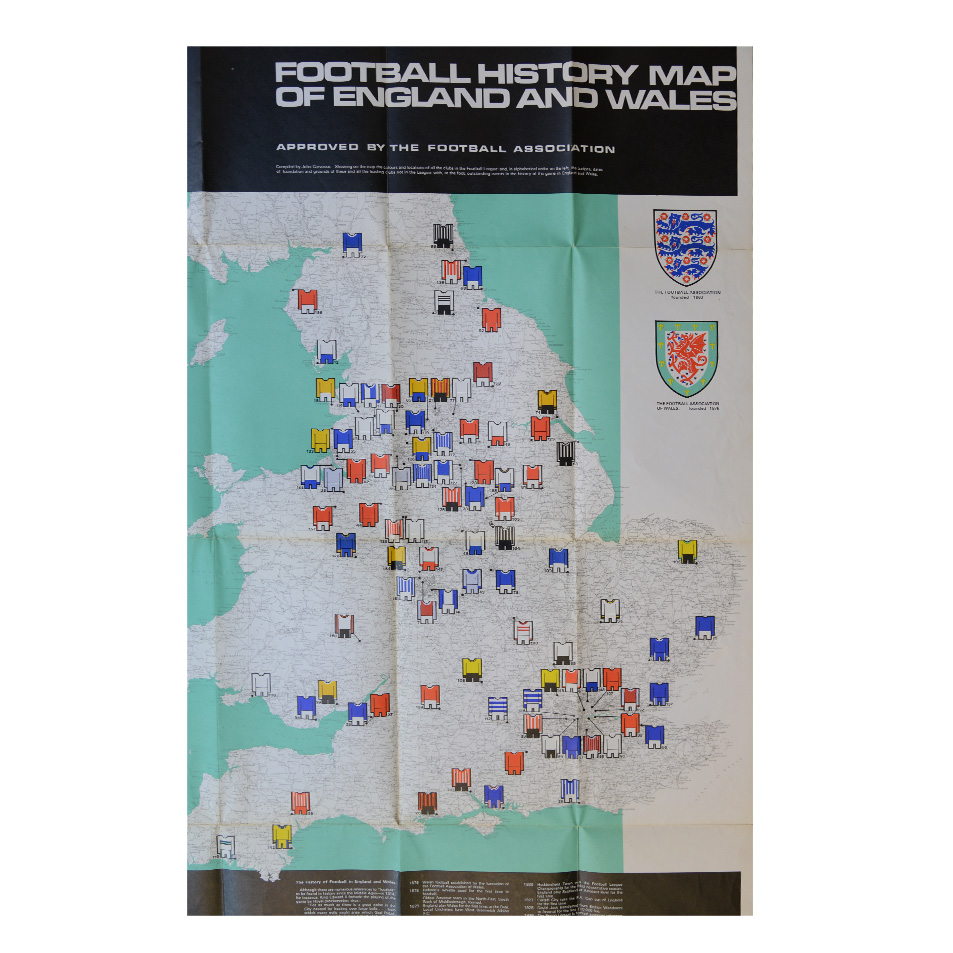
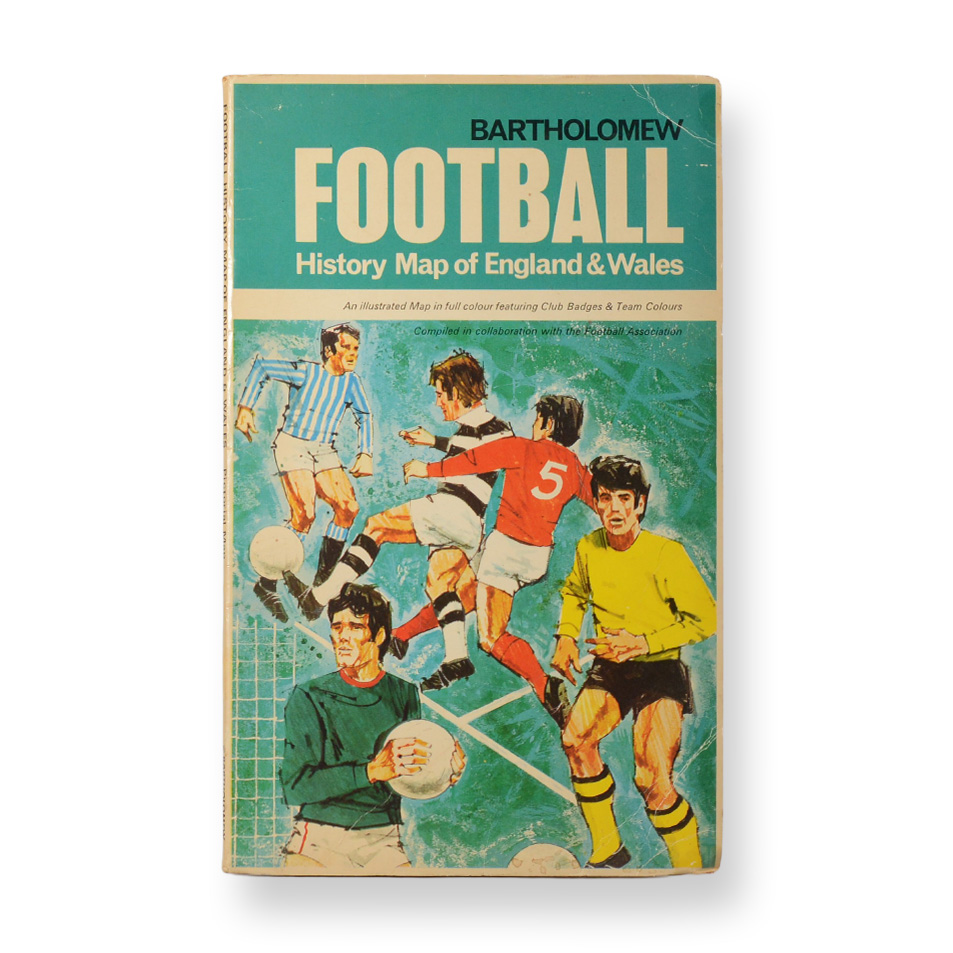
Bartholomew Football History Map Of England And Wales – An Illustrated Map In Full Colour Featuring Club Badges And Team Colours Compiled In Collaboration With The Football Association
Carvosso, John
£95.00
Availability: In stock
Product Description
Bartholomew Football History Map Of England And Wales – An Illustrated Map In Full Colour Featuring Club Badges And Team Colours Compiled In Collaboration With The Football Association
Compiler: John Carvosso
Publisher: Bartholomew
Price: £95 including postage in the UK
Publication Date: 1972
Edition: 1972 edition
Size: Quarto
Map Size: 70cm x 100cm
Binding: Original printed wrappers
Condition: Very good
Condition:
Folding map. Wrappers slightly creased. Map has slight age-toning and original fold lines but is in very good condition indeed. A very nice copy.
Football In England And Wales In The 1970s: A Brief Overview
Introduction
The 1970s were a decade of contrasts for football in England and Wales. On the pitch, clubs enjoyed moments of brilliance, with English teams emerging as a force in European competition and the Welsh national side producing one of its strongest post-war squads. Off the pitch, however, the game faced serious problems: declining stadium infrastructure, rising hooliganism, economic hardship, and poor crowd safety.
This combination makes the 1970s one of the most fascinating—and complex—periods in the history of British football.
The Football Landscape at the Start of the 1970s
League Structure
The four-division Football League system remained largely unchanged:
- Division One: the top tier
- Division Two
- Division Three
- Division Four
Promotion and relegation were firmly established, but money and facilities varied wildly between clubs.
Attendances
Crowds were passionate but often unpredictable. After the post-war boom, attendances in the early 1970s stagnated or fell due to:
- economic recession
- competition from television
- deteriorating stadiums
- safety concerns
Nevertheless, major fixtures could still attract vast numbers, and the FA Cup remained a national event.
English Club Success in Europe
The 1970s saw English clubs rise to prominence in European competition.
- 1970: Chelsea win the European Cup Winners’ Cup
A replayed final against Real Madrid marked the beginning of English success on the continent.
- 1971 & 1972: Leeds United and Tottenham Hotspur succeed in Europe
Leeds won the Inter-Cities Fairs Cup; Spurs the UEFA Cup.
- 1977–79: Liverpool dominate Europe
Liverpool won the European Cup in 1977, 1978, and, along with Nottingham Forest, began a period of English dominance that carried into the early 1980s.
- Nottingham Forest’s extraordinary rise
Promoted to the First Division in 1977, Forest went on to win the league in 1978 and the European Cup in 1979—one of the greatest achievements in football history.
Domestic Highlights in England
Leeds United
Don Revie’s Leeds were the defining English league team of the early 1970s:
- League champions in 1973–74
- Known for their strength, tactical discipline and combative style
Liverpool
Under Bill Shankly and later Bob Paisley:
- League champions in 1972–73, 1975–76, 1976–77
- FA Cup winners in 1974
- Built the foundation for 1980s dominance
Derby County
Under Brian Clough and later Dave Mackay:
- League champions in 1971–72 and 1974–75
- Punched above their weight in Europe and domestically
Other notable developments
- Manchester United struggled during much of the decade, even suffering relegation in 1974.
- The FA Cup continued to produce iconic finals, including Sunderland’s shock win over Leeds in 1973 and Southampton’s triumph in 1976
Football in Wales During the 1970s:
Welsh Clubs in the English System
Three Welsh clubs competed in the Football League:
- Cardiff City
- Swansea City
- Wrexham
Cardiff City
Mostly a Second Division side, with fluctuating performances.
Swansea City
Under John Toshack (from 1978), Swansea began their remarkable ascent through the divisions—though the peak would come in the early 1980s.
Wrexham
One of the most exciting Welsh stories of the decade:
- Famous FA Cup runs
- Promotion to the Second Division in 1978
- Strong European performances thanks to Welsh Cup victories
Welsh National Team
Although they did not qualify for a major tournament, the Welsh team of the mid-1970s featured:
- John Toshack
- Leighton James
- Brian Flynn
- Terry Yorath
- This side came agonisingly close to qualifying for Euro 1976.
Stadiums And Infrastructure
Football grounds in the 1970s were often:
- largely unchanged since the 1930s
- standing-room terraces
- poorly lit and inadequately maintained
- vulnerable to overcrowding
- lacking modern safety standards
The decade saw several serious crowd-related incidents, increasing pressure for reform.
Football Hooliganism
The 1970s witnessed the rise of organised football violence in Britain.
Factors included:
- economic decline and youth unemployment
- tribalism between clubs
- poor policing and inadequate segregation
- media sensationalism
Clubs such as Chelsea, Millwall, West Ham, Leeds, Manchester United, and Cardiff City gained reputations for notorious hooligan groups.
This era laid the groundwork for policing changes, stadium redesign, and legislation in the 1980s and 1990s.
Football Culture and the Matchday Experience
The matchday atmosphere of the 1970s was markedly different from today:
- Standing terraces created intense, noisy crowds
- The smell of beer, cigarette smoke and meat pies was characteristic
- Programmes cost pennies
- Fans often travelled by coach or “football special” trains
- Songs, chants and club scarves were integral parts of supporter identity
Television coverage expanded, with “Match of the Day” and ITV’s regional football shows becoming essential viewing.
Decline and the Seeds of Reform
By the late 1970s, English and Welsh football faced:
- declining attendances
- financial instability
- rising violence
- outdated stadiums
- inconsistent refereeing standards
Yet the decade also laid foundations for:
- the influx of better coaching
- tactical sophistication
- modern sports science
- commercial expansion
- the European success that continued into the early 1980s
Conclusion
Football in England and Wales during the 1970s was a decade of grit, brilliance, danger and transformation. The era produced some of the greatest teams and players in British football history, while also exposing deep structural problems that would take decades to address.
Its legacy lives on in the passion of supporters, the folklore of clubs, and the enduring importance of football in British culture.
Why buy from us?
At Hornseys, we are committed to offering items that meet the highest standards of quality and authenticity. Our book collection is meticulously curated to ensure that each edition is a valuable and authentic piece of bibliographical history. Here’s what sets us apart:
- Authenticity and Provenance: Every book is researched, collated, and verified for authenticity.
- Expert Curation: Each book is selected with a keen eye for significance, condition, and rarity, ensuring a collection that is both diverse and distinguished.
- Customer Satisfaction: We strive to provide an exceptional customer experience, from detailed descriptions and provenance to secure and prompt delivery of your purchase.
- Returns Policy: We offer an unconditional guarantee on every item. If you wish to make a return, books may be sent back to us within fourteen days of receipt for any reason. We request advance notification of returns, and books must be returned in the same condition as sent for a full refund.
Explore Our Collection:
Visit Hornseys to explore our fine collection of rare and signed books. Whether you are an avid collector or looking for a special gift, our selection offers something truly unique. Located in the picturesque Yorkshire Dales, our Ripon gallery has been a haven for book lovers, art enthusiasts, and collectors since 1976.
Thank you for looking.
Related products


You may also like…

Tom Finney – The Splash – Stamford Bridge – Original Press Photograph – August 25th 1956
£450.00Finney, Tom & P. A. Reuter
The Hong Kong Cricket Tour of England, July 1976 – Official Tour Programme with Original Printed Itinerary
£75.00Hong Kong Cricket Association

