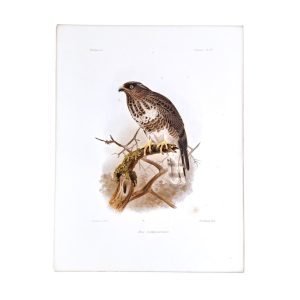
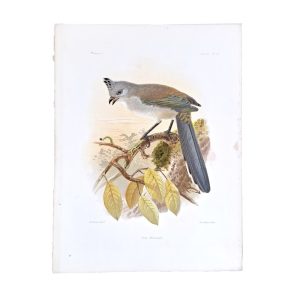
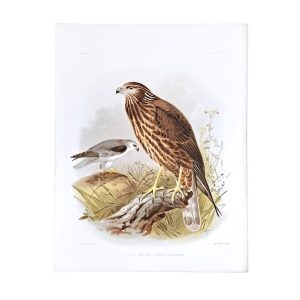
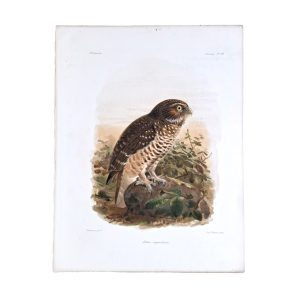
Machaeramphus Andersonii – Bat Hawk – Original Hand-Coloured Lithograph
Keulemans, John Gerrard
£85.00
Availability: In stock
Product Description
Machaeramphus Andersonii – Bat Hawk – Original Hand-Coloured Lithograph
Engraver: John Gerrard Keulemans
Publisher: L’Imprimerie Nationale
Price: £85
Publication Date: Not dated but c.1876
Format: Original hand-coloured lithograph
Condition: In very good condition, unframed
Sheet Size: Sheet Size: 32.5cm x 25cm
Condition:
Original hand-coloured lithograph. Minor age-toning to the margins. In very good indeed, clean condition overall. A rare plate from this important work.
Location: Map Drawer B: FS: Folder JGK 001815
Bat Hawk: A Brief Description
Machaeramphus andersonii, commonly known as the Bat Hawk, is a species of bird of prey in the family Accipitridae. The Bat Hawk is named for its specialised diet of bats, and it is known for its agile and fast hunting abilities. Here’s an overview of this fascinating raptor:
Physical Characteristics:
- The Bat Hawk is medium-sized, with a length of about 40–45 cm and a wingspan of approximately 1 metre.
- It has a distinctive appearance with predominantly dark plumage, typically black or dark brown, with some white markings on the throat and lower belly.
- Its sharp, hooked beak and strong talons are adapted for catching and consuming flying prey like bats and large insects.
- The bird has long, pointed wings and a short, square tail, features that enhance its manoeuvrability and speed in flight, especially during its dusk and dawn hunts.
Habitat and Distribution:
- Machaeramphus andersonii is found across sub-Saharan Africa and parts of Southeast Asia, including regions of Indonesia, Malaysia, and Thailand.
- It inhabits a range of environments, including savannas, forested areas, and regions near water bodies, as long as there are abundant bat populations.
- The Bat Hawk is mostly active during twilight hours, making it a crepuscular species, although it may also hunt during the night if bats are available.
Behaviour and Diet:
- As the name suggests, the Bat Hawk specialises in hunting bats, which make up the majority of its diet. It is known for its incredible agility in flight, enabling it to catch bats in mid-air as they emerge from roosts at dusk.
- In addition to bats, the Bat Hawk may also feed on swifts, swallows, and large insects, particularly during times when bats are scarce.
- The Bat Hawk’s hunting strategy involves perching near bat roosts, such as caves or tree hollows, waiting for the bats to take flight at dusk, then launching a rapid attack to catch them mid-flight.
Breeding:
- The breeding season for the Bat Hawk typically aligns with the availability of food, so it varies across its range.
- The bird builds large nests made of sticks, usually high up in trees, where the female lays 1-2 eggs. Both parents participate in incubating the eggs and feeding the young.
- The chicks are fed a diet primarily of freshly caught bats, and they fledge after about six weeks.
Conservation Status:
- The Bat Hawk is currently listed as Least Concern on the IUCN Red List, meaning that it is not considered to be at immediate risk of extinction.
- However, habitat destruction, especially the loss of forests and roosting sites for bats, poses a potential threat to the species in some parts of its range.
- Conservation efforts focused on preserving bat populations and their habitats indirectly benefit the Bat Hawk as well.
Unique Features:
- The Bat Hawk’s highly specialised diet sets it apart from many other raptors. Its ability to hunt such fast-moving prey with precision is a remarkable example of evolutionary adaptation.
- Its crepuscular hunting habits are also quite unique among birds of prey, as most raptors are diurnal (active during the day).
In summary, Machaeramphus andersonii is a fascinating bird of prey that showcases the adaptability and specialization found in the natural world. Its ability to hunt bats in flight, combined with its twilight hunting habits, make it a rare and interesting species among raptors.
John Gerrard Keulemans: A Short Biography
John Gerrard Keulemans (1842–1912) was a prolific and influential Dutch bird illustrator whose work remains celebrated for its accuracy and artistic detail. He was born on June 8, 1842, in Rotterdam, Netherlands. From a young age, he showed an interest in natural history, particularly in birds, and this passion guided him toward a career in scientific illustration.
Early Life and Career
Keulemans studied under Hermann Schlegel at the Natural History Museum in Leiden, where he honed his skills as a naturalist and artist. This connection led to one of his early assignments: joining an expedition to West Africa in 1864 to collect specimens. His work during this period helped him establish his reputation as both a naturalist and an illustrator. He documented various species of birds, adding greatly to the knowledge of African avifauna.
Move to London and Prolific Period
In 1869, Keulemans moved to England, where he would spend the rest of his career. London at that time was a hub of scientific research and publishing, making it an ideal base for an artist like Keulemans. He quickly became a leading illustrator for many of the major ornithological works of the 19th century.
Major Works
Keulemans illustrated more than 100 books on natural history, with his most famous contributions to:
- “The Birds of Great Britain” (1862–1873) by John Gould – Keulemans contributed to many of Gould’s other works, but this publication remains one of the most significant.
- “A History of the Birds of New Zealand” (1873, 1888, 1906) by Sir Walter Buller – Keulemans’ illustrations were essential to the understanding of New Zealand’s birdlife.
- “The Ibis” and “Proceedings of the Zoological Society of London” – leading ornithological journals where Keulemans’ works regularly appeared.
- “The Avifauna of Laysan” and “The Birds of the Hawaiian Islands” by R. C. L. Perkins.
Keulemans’ distinctive style involved the meticulous depiction of birds in natural, life-like poses. His plates were highly detailed, showcasing the nuances of feathers and anatomy, and he often portrayed birds in natural habitats to highlight their behaviour and environment.
Style and Techniques
Keulemans mainly worked in lithography, a printmaking process that allowed for mass production of his artwork while maintaining high-quality detail. He was known for his ability to bring a bird’s plumage and colour to life on paper, despite the limitations of the printing techniques of the time. His method involved working with specimens, either from museums or from field collections, to create scientifically accurate and dynamic illustrations.
Personal Life
Keulemans lived in England for much of his life and married in 1871. He fathered 11 children, though only six survived into adulthood. Despite his immense output and contributions to science, Keulemans often struggled financially, a common challenge for many illustrators of his era.
Legacy
John Gerrard Keulemans passed away on March 29, 1912, in Ilford, Essex, England. His legacy is firmly cemented in the world of ornithological illustration. His works continue to be highly regarded for their scientific value and artistic beauty. Many of his original illustrations are held in museums and private collections, and his detailed depictions are still referenced by ornithologists and bird enthusiasts today.
Keulemans’ work represents an important bridge between the art of the natural world and scientific inquiry, providing invaluable insight into bird species from around the world during a period when photography was still in its infancy. His illustrations remain among the finest examples of ornithological art.
SHOP WITH CONFIDENCE AT HORNSEYS
At Hornseys, we are dedicated to offering items that uphold the highest standards of quality and authenticity. Our collection of artwork is carefully curated to ensure that each item we offer is authentic, collated, and complete.
Here’s what sets us apart:
- Authenticity and Provenance: Each lithograph is researched and verified for authenticity, guaranteeing that you receive a genuine item.
- Expert Curation: We wholly own all our artworks. We trust our taste and have invested heavily in it. We have confidence in all artwork that we offer for sale.
- Customer Satisfaction: We strive to provide an exceptional customer experience, from detailed descriptions and provenance to secure and prompt delivery of your purchase.
- Returns Policy: We offer an unconditional guarantee on every item. If, however, you wish to make a return, artworks may be sent back to us within fourteen days of receipt for whatever reason. We request that we are notified in advance if you wish to do so. They must be returned to us in the same condition as they were sent for a full refund.
OUR COMMITMENT TO QUALITY AND SERVICE
Understanding the value and rarity of these items, we ensure that every aspect of your purchase meets the highest standards of quality and service. This includes:
- Free Expedited, Tracked, and Insured Delivery within the UK: Ensuring that your artwork arrives safely and promptly.
- Fully-Insured Worldwide Delivery: Offering peace of mind for international collectors with reliable and secure shipping options.
EXPLORE OUR COLLECTION
Visit Hornseys today to explore our fine collection of maps and other artworks. Whether you are an avid collector or looking for a special gift, our selection offers something truly unique. Located sine 1976 in Ripon in the picturesque Yorkshire Dales, we are recognized as a destination gallery for tastefully curated artwork, rare maps, design, and fine books.
Related products

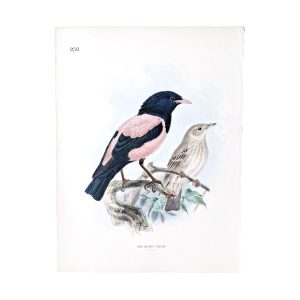
Rose-Coloured Starling – Pastor roseus – Original Hand-Coloured Lithograph
£65.00Keulemans, John Gerrard
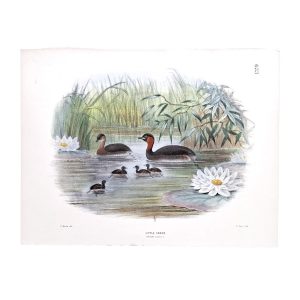
Little Grebe – Podiceps fluviatilis – Original Hand-Coloured Lithograph
£65.00Keulemans, John Gerrard
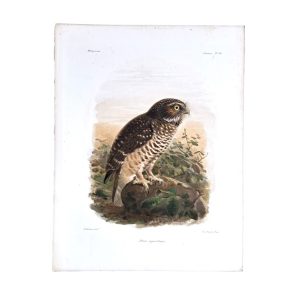
Athene Superciliaris – White Browed Hawk Owl – Original Hand-Coloured Lithograph
£95.00Keulemans, John Gerrard
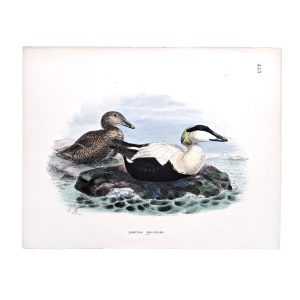
Somateria Mollissima – Common Eider – Original Hand-Coloured Lithograph
£65.00Keulemans, John Gerrard
You may also like…
Baza Madagascariensis – Madagascar Baza – Original Hand-Coloured Lithograph
£85.00Keulemans, John Gerrard
Circus Humbloti – Madagascar Harrier – Elanus Melanopterus – Black-winged Kite – Original Hand-Coloured Lithograph
£85.00Keulemans, John Gerrard
Athene Superciliaris – White Browed Hawk Owl – Original Hand-Coloured Lithograph
£95.00Keulemans, John Gerrard