

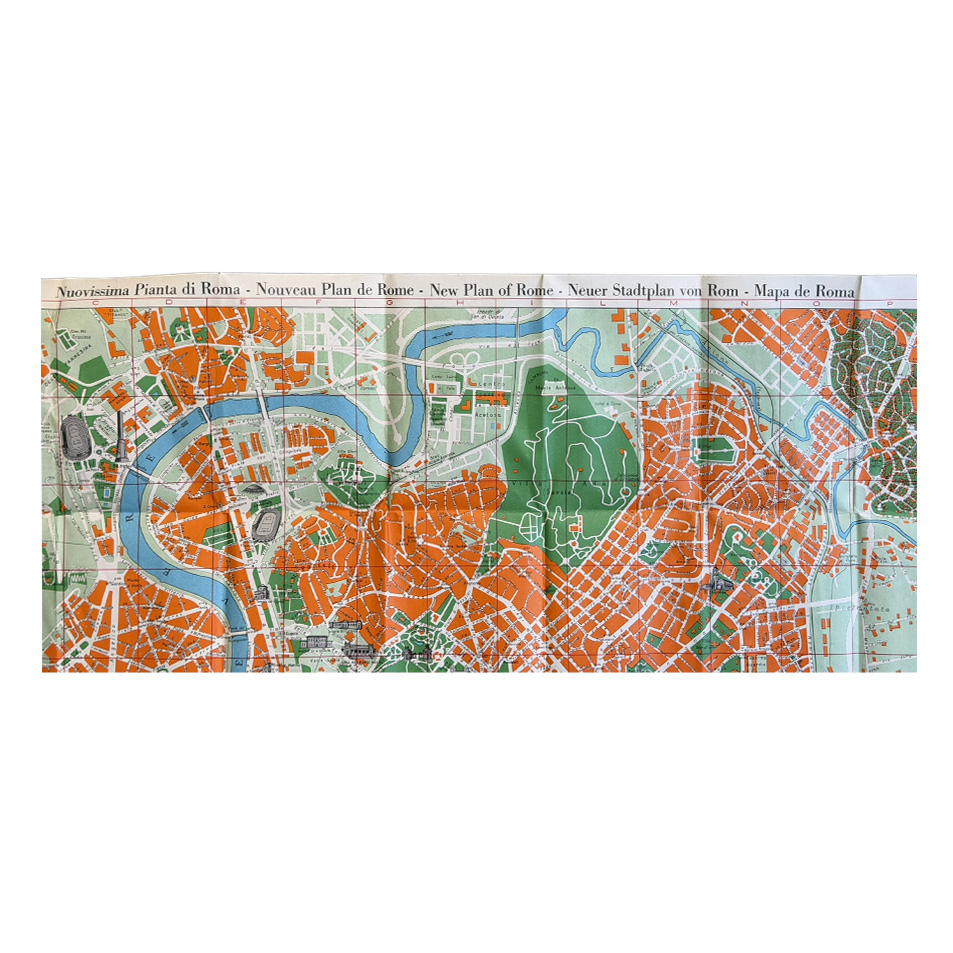


New Plan Of Rome – Roma – Nuovissima Pianta Di Roma
Editore Enrico Verdesi
£85.00
Availability: In stock
Product Description
New Plan Of Rome – Roma – Nuovissima Pianta Di Roma
Publisher: Editore Enrico Verdesi
Price: £85
Publication Date: Not dated but c.1950-1960
Format: Lithograph
Condition: In very good plus condition
Sheet Size: 99.2cm x 76.7cm
Condition:
Date: c.1950-1960. Lithograph. Sheet size: 99.2cm x 76.7cm. 1:12000. Original fold lines. A substantial and detailed city plan. Slight creasing and very minor wear. In very good plus condition overall.
Rome In The Mid-20th Century: A Brief Account
Overview
In the mid-twentieth century, Rome stood at the crossroads of ancient prestige, authoritarian modernisation, wartime devastation, and post-war rebirth. Between the 1930s and the late 1950s, the city experienced dramatic political, social, and cultural transformations that reshaped its physical fabric and international identity. It moved from being the symbolic capital of Fascist Italy, through occupation and liberation, to becoming a global centre of diplomacy, cinema, and mass tourism.
Rome’s mid-century history is defined by layers rather than replacements: Fascist monumentalism coexisted with medieval streets; post-war poverty with new consumer culture; and deep Catholic influence with increasingly secular, cosmopolitan life.
- Political Context: From Fascism to Republic
Rome under Fascism (1922–1943)
As the capital of Fascist Italy, Rome was central to Benito Mussolini’s political theatre. The regime sought to present Rome as the rightful heir to imperial grandeur, using the city as a stage for ideology.
Key features included:
- Large-scale urban interventions designed to evoke ancient Rome
- Emphasis on axial roads, vistas, and monumental spaces
- Selective demolition of medieval and early modern neighbourhoods
Projects such as new ceremonial avenues and administrative districts were intended to symbolise order, authority, and continuity with the Roman Empire, even as they disrupted long-standing communities.
Rome was less industrialised than northern Italian cities, but it was deeply politicised: ministries, party offices, and symbolic architecture dominated central districts.
War, Occupation, and Liberation
After the collapse of the Fascist regime in 1943, Rome endured:
- German occupation
- Shortages of food, fuel, and housing
- Political uncertainty and fear
The city was declared an open city, limiting large-scale destruction, but civilian hardship was severe. Liberation in 1944 marked the beginning of a prolonged transition rather than an immediate transformation.
The Republican Capital
Following the abolition of the monarchy and the establishment of the Italian Republic, Rome became the seat of a new democratic state. Government institutions expanded rapidly, bringing bureaucrats, politicians, and civil servants into the city, reinforcing Rome’s role as administrative rather than industrial capital.
- Urban Fabric and Planning
Fascist Interventions and Their Legacy
Mid-century Rome still bore the imprint of Fascist planning:
- Monumental districts with stripped classical aesthetics
- Broad roads cutting through older urban fabric
- New suburbs intended to house displaced populations
These interventions altered Rome’s spatial logic, privileging spectacle and symbolism over social cohesion.
Post-War Expansion and Housing
After 1945, Rome expanded rapidly:
- Large numbers of rural migrants arrived from southern Italy
- Informal settlements and peripheral housing grew quickly
- State-led and speculative building reshaped the urban fringe
Housing shortages were acute. Many new arrivals lived in precarious conditions, often far from employment and services, creating sharp contrasts between the historic centre and the expanding periphery.
- Population and Social Change
Migration and Demography
Mid-twentieth-century Rome was transformed by internal migration. People arrived seeking:
- Employment in administration, construction, and services
- Access to welfare, education, and opportunity
- Escape from rural poverty
This influx altered the city’s social composition, producing tensions between long-established Roman families and newcomers.
Class Structure
Rome’s social hierarchy in this period included:
- Political and bureaucratic elites
- Professional and clerical middle classes
- Service workers, artisans, and small traders
- A large and often precarious urban working class
The city lacked a strong industrial proletariat, and this shaped both labour politics and everyday social relations.
- Economy: Administration, Services, and the Informal City
An Administrative Capital
Rome’s economy was dominated by:
- Government ministries and public administration
- Diplomacy and international organisations
- Education, publishing, and cultural institutions
This gave the city relative economic stability compared to industrial centres, but also limited opportunities for manual labour.
Informal and Marginal Economies
Alongside official employment, Rome supported a vast informal economy:
- Street trading and small-scale commerce
- Casual construction labour
- Domestic service
These activities were essential to survival for many residents and shaped the character of neighbourhood life.
- The Vatican and Catholic Influence
Rome as a Dual Capital
Rome was unique in being both the capital of Italy and the seat of the Roman Catholic Church. The Vatican’s presence shaped:
- International diplomacy
- Cultural and ceremonial life
- Moral discourse
Mid-century Rome was marked by major religious events, pilgrimages, and the visible authority of Catholic institutions.
Religion and Society
While Catholicism remained culturally dominant, the period also saw:
- Growing secularism among intellectuals and artists
- Political tensions between Catholic and left-wing worldviews
- Negotiation between tradition and modernity in everyday life
- Culture and Intellectual Life
Cinema and International Prestige
By the late 1940s and 1950s, Rome emerged as a global centre of film production. Film studios on the city’s outskirts attracted international actors, directors, and technicians.
The city became associated with:
- Artistic experimentation
- Glamour and celebrity
- A distinctive blend of realism and spectacle
This cultural prominence reshaped Rome’s international image, presenting it as both ancient and vibrantly modern.
Writers, Artists, and Intellectuals
Rome attracted writers, artists, and intellectuals from Italy and abroad. Cafés, studios, and informal networks fostered debate on politics, art, and identity in a city that was once conservative and increasingly cosmopolitan.
- Everyday Life and Material Conditions
Living Standards
Material conditions improved gradually after the war:
- Consumer goods became more available in the 1950s
- Electricity, transport, and infrastructure expanded
- Diets diversified, though inequalities remained stark
For many, daily life was still shaped by scarcity well into the post-war years.
Streets and Social Life
Rome’s streets functioned as social spaces:
- Markets, cafés, and piazzas remained central to everyday interaction
- Informal social networks helped compensate for weak formal welfare
- Neighbourhood identity remained strong, particularly in older districts
- Rome and the World
Mid-twentieth-century Rome became increasingly international:
- Diplomatic missions and international agencies expanded
- Tourism grew steadily, accelerating in the 1950s
- Foreign artists, students, and intellectuals settled temporarily or permanently
Rome’s global image balanced antiquity, spirituality, and modern cultural vitality.
Concluding Characterisation
Rome in the mid-twentieth century was a city of profound transition. It was:
- Politically transformed but institutionally cautious
- Architecturally layered rather than unified
- Socially fragmented yet culturally magnetic
Neither fully traditional nor fully modern, Rome absorbed the shocks of dictatorship, war, and reconstruction while preserving its distinctive rhythms of life. By the end of the 1950s, it had reinvented itself as a symbolic, cultural, and diplomatic capital, poised between memory and reinvention—an ancient city learning how to live in the modern world.
SHOP WITH CONFIDENCE AT HORNSEYS
At Hornseys, we are dedicated to offering items that uphold the highest standards of quality and authenticity. Our collection of artwork is carefully curated to ensure that each item we offer is authentic, collated, and complete.
Here’s what sets us apart:
- Authenticity and Provenance: Each map is researched and verified for authenticity.
- Expert Curation: We wholly own all our artworks. We trust our taste and have invested heavily in it. We have confidence in all artwork that we offer for sale.
- Customer Satisfaction: We strive to provide an exceptional customer experience, from detailed descriptions and provenance to secure and prompt delivery of your purchase.
- Returns Policy: We offer an unconditional guarantee on every item. If, however, you wish to make a return, artworks may be sent back to us within fourteen days of receipt for whatever reason. We request that we are notified in advance if you wish to do so. They must be returned to us in the same condition as they were sent for a full refund.
OUR COMMITMENT TO QUALITY AND SERVICE
Understanding the value and rarity of these items, we ensure that every aspect of your purchase meets the highest standards of quality and service. This includes:
- Free Expedited, Tracked, and Insured Delivery within the UK: Ensuring that your artwork arrives safely and promptly.
- Fully-Insured Worldwide Delivery: Offering peace of mind for international collectors with reliable and secure shipping options.
EXPLORE OUR COLLECTION
Visit Hornseys today to explore our fine collection of maps and other artworks. Whether you are an avid collector or looking for a special gift, our selection offers something truly unique. Located since 1976 in Ripon in the picturesque Yorkshire Dales, we are recognized as a destination gallery for tastefully curated artwork, rare maps, design, and fine books.
Related products


You may also like…

Andalucia Continens Sevillam Et Cordubam – Andalucia – Seville – Cordoba – Original Copper Engraved Map – 1642
£250.00Blaeu, Jan & Blaeu, Willem
SCOTIA REGNUM CUM INSULIS ADJACENTIBUS ROBERTUS GORDONIUS A STRALOCH DESCRIPSIT – ORIGINAL COPPER ENGRAVED MAP PUBLISHED BY JOAN BLAEU
£650.00Blaeu, Joan & Gordon, Robert


