NORTHUMBERLAND ELECTION BALLAD – Alnwick Hustings – An Electioneering Ballad – 1826
Alnwick: J. Graham, printer, [1826].
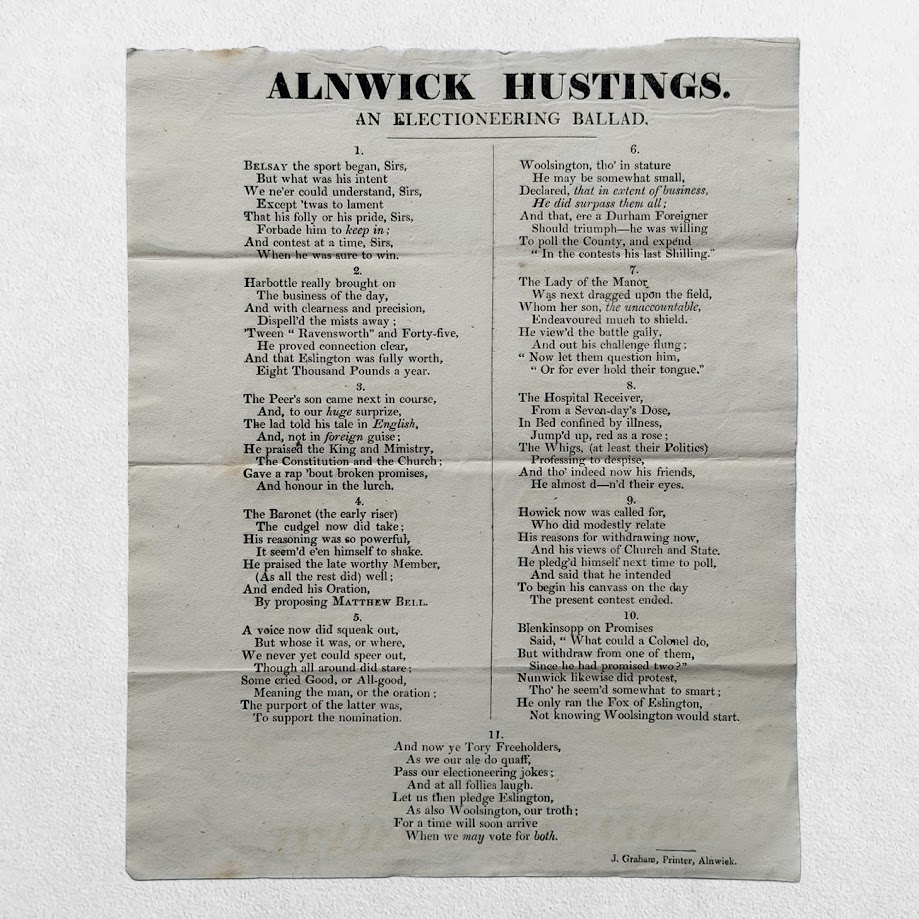
Rare and apparently unrecorded Georgian election ballad issued during the Northumberland election campaign of 1826. Single sheet, letterpress on paper. 27.6 × 22 cm.
A lively and unusually detailed satirical ballad describing the proceedings at the Alnwick hustings during the fiercely contested Northumberland election of 1826. Printed in two columns beneath the bold heading “ALNWICK HUSTINGS”, the ballad gives a comic account of the nomination proceedings, the speeches, rival interests and county personalities involved in the contest between Matthew Bell of Woolsington and Henry Thomas Liddell of Eslington.
The ballad is written from a Tory perspective and ends by urging Tory freeholders to pledge both “Eslington” and “Woolsington”:
“And now ye Tory Freeholders,
As we our ale do quaff,
Pass our electioneering jokes;
And at all follies laugh.
Let us then pledge Eslington,
As also Woolsington, our troth;
For a time will soon arrive
When we may vote for both.”
This closing passage is especially revealing. It reflects the political awkwardness of the early 1826 by-election, in which two men associated with the Tory interest — Liddell of Eslington and Bell of Woolsington — stood against one another. Later in the year, at the general election, both were returned for the county. The ballad therefore offers a sharp and contemporary glimpse into the factional tensions within Northumberland Tory politics before that eventual accommodation.
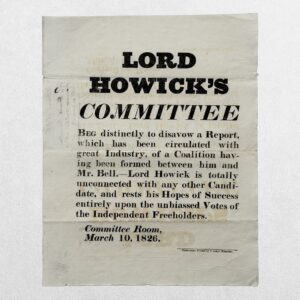
The verses satirise a succession of local figures and election speakers, including allusions to Belsay, Harbottle, Ravensworth, Woolsington, Howick and Blenkinsopp. Bell is praised for his determination and expenditure, being described as willing to poll the county and expend “in the contests his last shilling”. Liddell appears through “Eslington”, while “Ravensworth” points to the Liddell family interest. The text also references “Howick”, modestly late to the proceedings and announcing his intention to begin his canvass once Parliament ended, thereby linking the sheet to the wider political landscape that culminated in the four-candidate Northumberland general election of June–July 1826.
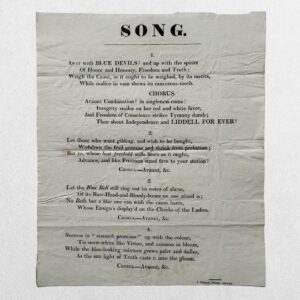
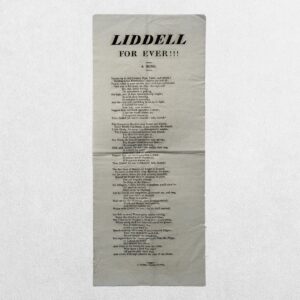
The title is particularly important. Alnwick was one of the principal centres of Northumberland election activity, and the hustings were the public theatre of county politics: the place where candidates were nominated, speeches delivered, supporters mobilised, and reputations made or damaged. Election ballads such as this were part of the popular performative culture of Georgian elections, circulating the language of the hustings beyond the immediate crowd and transforming political proceedings into comic verse for taverns, dinners, committees and freeholder gatherings.
The piece is also valuable for its density of local political reference. Names such as Belsay, Harbottle, Ravensworth, Eslington, Woolsington and Blenkinsopp situate the contest within a network of Northumberland estates, family interests and political loyalties. Rather than offering abstract political argument, the ballad depends on local knowledge, private jokes, reputational hints and estate-based identity. This makes it a particularly revealing survival of county electioneering before the Reform Act.
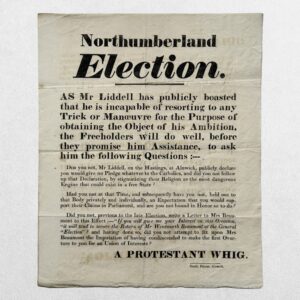
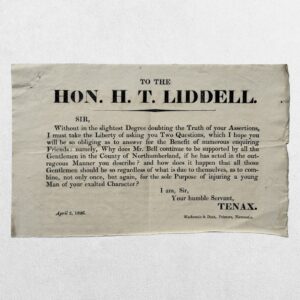
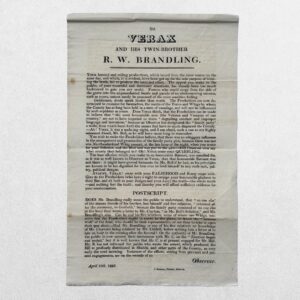
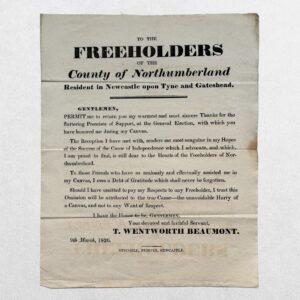
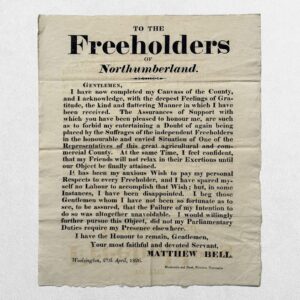
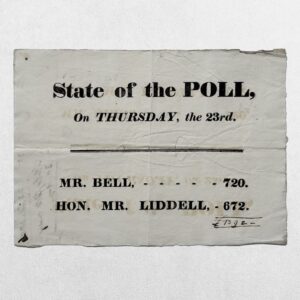
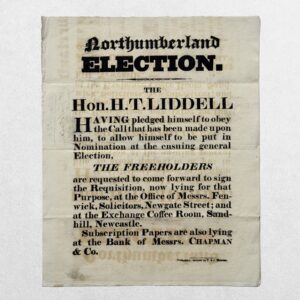
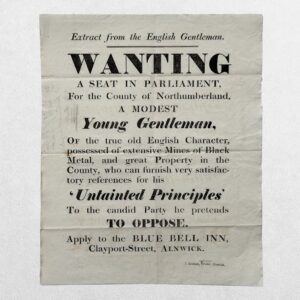
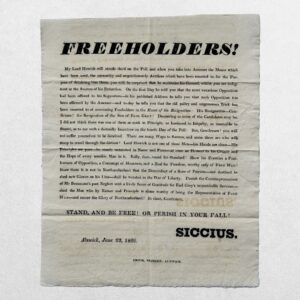
Printed by J. Graham of Alnwick, the sheet belongs to the remarkable body of ephemeral print generated by the Northumberland elections of 1826. The February–March by-election saw Matthew Bell defeat Henry Thomas Liddell; the later general election brought Bell and Liddell together against Viscount Howick and Thomas Wentworth Beaumont in one of the most celebrated and expensive county contests of the Georgian period. The present ballad appears to belong to the earlier phase of the year, when Bell and Liddell were still direct rivals.
No copy of this specific ballad has been traced in the British Library, Library Hub, WorldCat, Northumberland Archives’ online catalogue, the Bodleian broadside collections, parliamentary collections, or the principal institutional and commercial records consulted. Apparently unrecorded.
Condition: Single sheet. Old horizontal and vertical folds, light creasing, mild toning, a few small handling marks and minor marginal wear. Slight unevenness at head and edges, but complete, clean, legible and well preserved. Near fine condition overall.
A rare and highly engaging survival of Georgian Northumberland election ephemera, preserving in satirical verse the atmosphere of the Alnwick hustings and the factional politics of the Bell-Liddell contest before the Reform Act.
Why Buy from Hornseys?
Established in 1976, Hornseys specialises in rare books, signed editions, manuscripts, historical documents and works of enduring cultural importance. From our gallery in Ripon, on the edge of the Yorkshire Dales, we serve collectors, institutions and bibliophiles throughout the United Kingdom and internationally.
Our reputation is built upon careful scholarship, accurate cataloguing and a long-standing commitment to authenticity, provenance and condition. Every item we offer is selected not simply for rarity, but for its significance within the history of literature, art, politics, exploration and collecting.
Expertise and Authenticity
Each book, manuscript or historical item is thoroughly researched and professionally described. We carefully examine points of issue, bindings, dust jackets, inscriptions, provenance and bibliographical references to ensure accuracy and authenticity throughout our catalogue.
Curated Collections
Our stock is individually chosen for rarity, condition, historical importance and collector appeal. We specialise in literary first editions, children’s books, modern literature, signed and inscribed copies, Churchilliana, fine bindings, rare maps and unusual historical ephemera.
Provenance and Scholarship
We place particular importance on provenance and collecting history. Wherever possible, our cataloguing traces ownership, associations and historical context, allowing collectors to acquire objects with genuine bibliographical and historical significance.
Customer Service
We aim to provide a professional and straightforward buying experience, from detailed cataloguing and high-quality photography to secure packaging and prompt worldwide shipping. We are always happy to discuss condition, provenance or collecting advice directly with clients.
Returns Guarantee
All items are offered with an unconditional guarantee of authenticity. Purchases may be returned within fourteen days of receipt for any reason, provided items are returned in the same condition in which they were supplied. We simply request advance notice of any return.
Explore Our Collection
Discover exceptional rare books, manuscripts, signed editions and historical material at Hornseys. With nearly fifty years of experience in the trade, we continue to offer carefully curated material chosen for rarity, condition, provenance and lasting cultural importance.