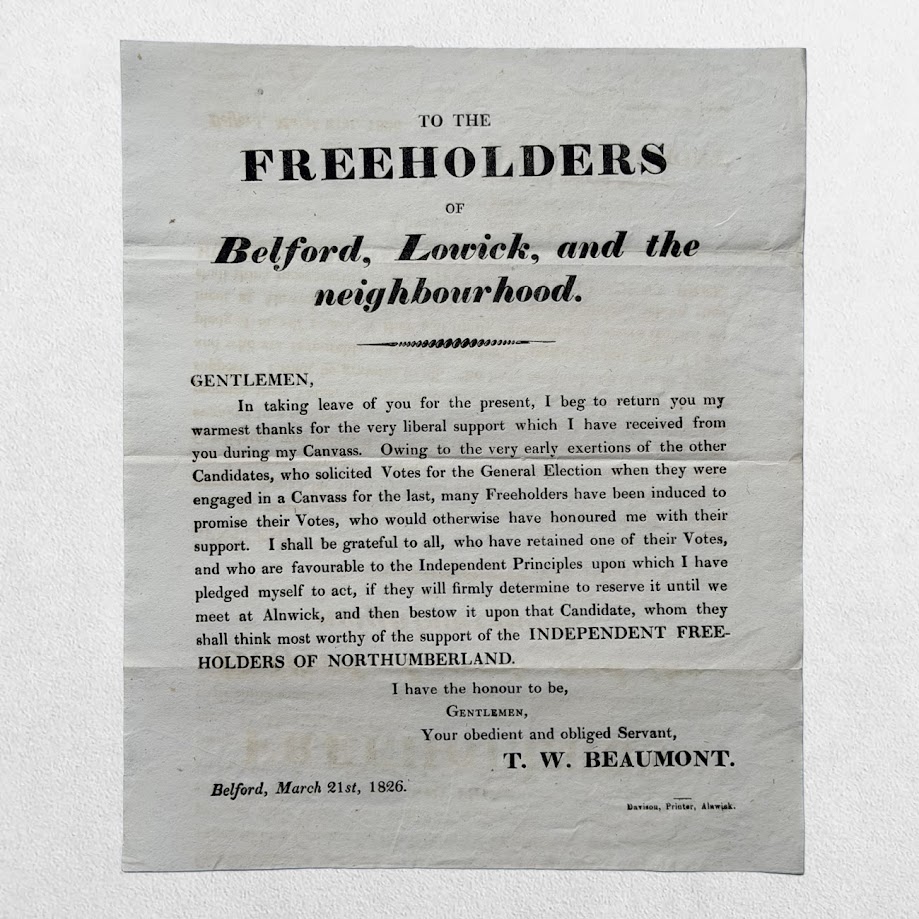
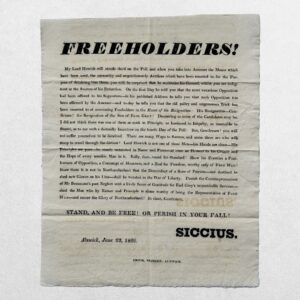
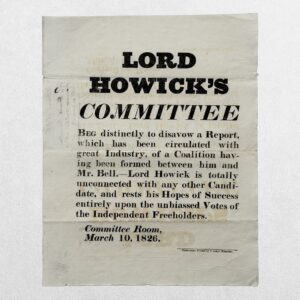
NORTHUMBERLAND ELECTION BROADSIDE – THOMAS WENTWORTH BEAUMONT’S ADDRESS TO THE FREEHOLDERS OF BELFORD, LOWICK, AND THE NEIGHBOURHOOD – A SCARCE ELECTION ADDRESS ISSUED DURING THE CELEBRATED NORTHUMBERLAND CONTEST OF 1826
Belford, Northumberland: W. Davison, Printer, Alnwick, 21 March 1826.
Single-sheet letterpress broadside.
Sheet size: 27.4 x 22.4 cm.
Condition: Near fine. Fold lines. Minor handling wear only. Clean, crisp example with strong impression and excellent legibility throughout.
Description
A scarce and historically important election broadside issued by Thomas Wentworth Beaumont (1792–1848) during the famous and fiercely contested Northumberland parliamentary election campaign of 1826, one of the most expensive and politically significant county elections of the late Georgian period.
Dated Belford, 21 March 1826, and printed at Alnwick by W. Davison, the broadside is addressed specifically:
“To the Freeholders of Belford, Lowick, and the neighbourhood.”
The address was circulated during a period of intense political manoeuvring following the death of Charles John Brandling, whose death in February 1826 precipitated a by-election and subsequently contributed to the wider electoral struggles that dominated Northumberland politics throughout the year.
In the present address Beaumont thanks local freeholders for their support while acknowledging that rival candidates had begun canvassing at an unusually early stage. He argues that many electors had already been induced to promise their votes elsewhere and urges supporters to reserve their commitments until they meet at Alnwick and can determine which candidate most deserves the support of the:
“Independent Freeholders of Northumberland.”
The language reflects Beaumont’s long-standing attempt to position himself as the candidate of independent county interests rather than of aristocratic influence or organised political factions.
Unlike many of the more aggressive Northumberland election broadsides of 1826, the present document adopts a measured and conciliatory tone. Nevertheless, it forms part of the same remarkable body of election literature that emerged from one of the most hard-fought county contests of the age.
Historical Context
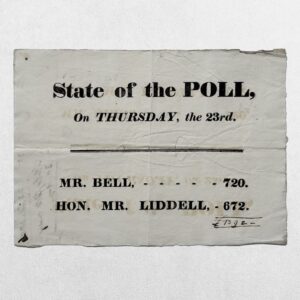
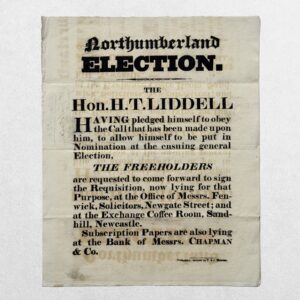
The Northumberland election of 1826 became one of the most celebrated electoral contests of the Georgian era. Four major candidates were involved:
- Thomas Wentworth Beaumont
- Matthew Bell
- Henry Thomas Liddell
- Lord Howick (Charles Grey, later Prime Minister Earl Grey)
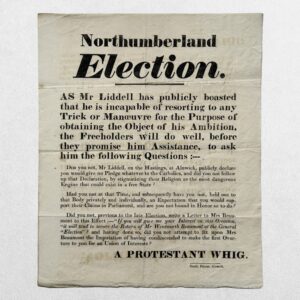
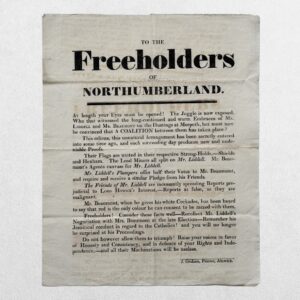
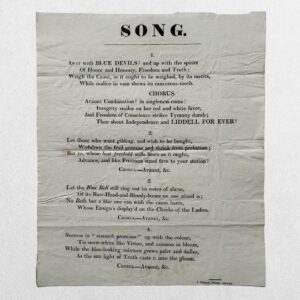
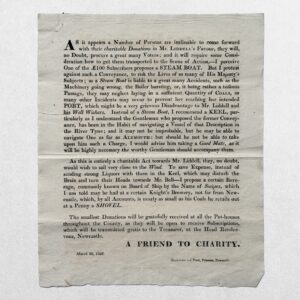
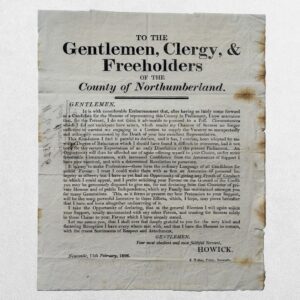
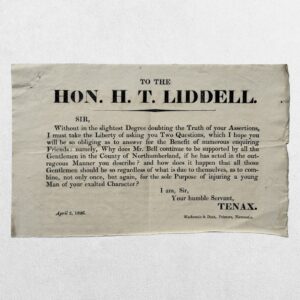
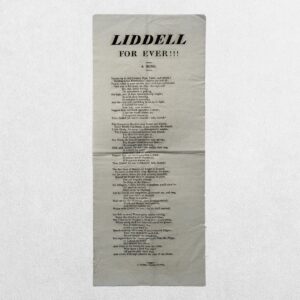
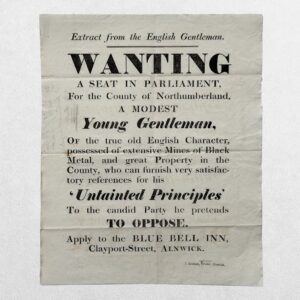
The campaign generated an enormous quantity of election addresses, broadsides, songs, committee notices and satirical attacks. Contemporary estimates placed the total expenditure at extraordinary levels, with the election becoming notorious throughout Britain for both its cost and intensity.
Beaumont was among the wealthiest landowners in Britain and represented an independent reforming interest within county politics. His campaign advocated positions including parliamentary reform and Catholic emancipation and frequently placed him at odds with both aristocratic and conservative interests in the county.
The election’s bitterness culminated in the famous duel fought on Bamburgh Sands between Beaumont and John Lambton, later Earl of Durham, a dramatic episode that has become one of the best-known incidents in Northumberland’s electoral history.
This broadside therefore survives from the opening phase of a campaign that would become one of the defining political contests of the period.
Thomas Wentworth Beaumont
Thomas Wentworth Beaumont of Bywell Hall and Bretton Hall was among the most influential political figures in northern England. A substantial landowner and former Member of Parliament for Northumberland, he was later returned again for the county and subsequently represented South Northumberland after parliamentary reform. His political career placed him at the centre of Northumberland’s electoral struggles for several decades.
Printing
Printed by W. Davison of Alnwick, one of the principal printers associated with Northumberland election literature during the 1820s. Davison’s press was responsible for a substantial body of election material produced during the celebrated 1826 contest.
Institutional Holdings
Election literature from the Northumberland contests of 1826 survives in a small number of major archival collections and poll-book compilations. Newcastle University’s Electoral Culture Project notes that hundreds of pages of addresses, broadsides, songs and election papers were generated during the campaign.
However, individual election broadsides survive unevenly and many were never systematically preserved. At the time of cataloguing, no separate institutional catalogue record has been identified for this specific Belford address dated 21 March 1826.
An attractive and uncommon survival from one of the most important county elections of the Georgian era, preserving Beaumont’s appeal to the independent freeholders of Northumberland at a critical moment in the celebrated contest of 1826.
Why Buy from Hornseys?
Established in 1976, Hornseys specialises in rare books, signed editions, manuscripts, historical documents and works of enduring cultural importance. From our gallery in Ripon, on the edge of the Yorkshire Dales, we serve collectors, institutions and bibliophiles throughout the United Kingdom and internationally.
Our reputation is built upon careful scholarship, accurate cataloguing and a long-standing commitment to authenticity, provenance and condition. Every item we offer is selected not simply for rarity, but for its significance within the history of literature, art, politics, exploration and collecting.
Expertise and Authenticity
Each book, manuscript or historical item is thoroughly researched and professionally described. We carefully examine points of issue, bindings, dust jackets, inscriptions, provenance and bibliographical references to ensure accuracy and authenticity throughout our catalogue.
Curated Collections
Our stock is individually chosen for rarity, condition, historical importance and collector appeal. We specialise in literary first editions, children’s books, modern literature, signed and inscribed copies, Churchilliana, fine bindings, rare maps and unusual historical ephemera.
Provenance and Scholarship
We place particular importance on provenance and collecting history. Wherever possible, our cataloguing traces ownership, associations and historical context, allowing collectors to acquire objects with genuine bibliographical and historical significance.
Customer Service
We aim to provide a professional and straightforward buying experience, from detailed cataloguing and high-quality photography to secure packaging and prompt worldwide shipping. We are always happy to discuss condition, provenance or collecting advice directly with clients.
Returns Guarantee
All items are offered with an unconditional guarantee of authenticity. Purchases may be returned within fourteen days of receipt for any reason, provided items are returned in the same condition in which they were supplied. We simply request advance notice of any return.
Explore Our Collection
Discover exceptional rare books, manuscripts, signed editions and historical material at Hornseys. With nearly fifty years of experience in the trade, we continue to offer carefully curated material chosen for rarity, condition, provenance and lasting cultural importance.