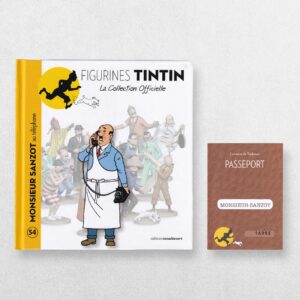
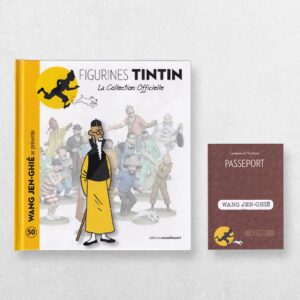
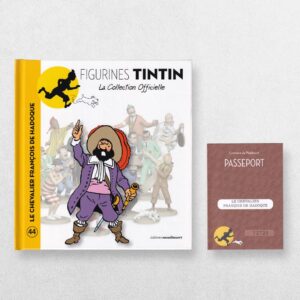
Professor Calculus On Skates – Figurines Tintin La Collection Officielle – 57 – Tournesol En Patins
Author: Hergé & Editions Moulinsart
Price: £50.00
Publisher: Editions Moulinsart
Publication date: 2013
Format: Original pictorial boards with passport and figurine
Condition: In near fine condition
Illustrations: Illustrated throughout
Description:
Original pictorial boards. Includes passport loosely inserted. Text in French. Includes the accompanying figurine. One from the collection of 111 books and figurines. Very slight wear. In very near fine, clean condition overall.
Professor Calculus On Skates: A Short Account
Among the many moments that define Professor Cuthbert Calculus (Professeur Tryphon Tournesol in French), few are as delightfully absurd and endearing as his escapades on roller skates. The scene encapsulates everything readers love about this eccentric genius — his absent-mindedness, his physical comedy, and his unshakable dignity amid chaos.
Appearing most notably in The Calculus Affair (L’Affaire Tournesol, 1956), this comic episode combines Hergé’s gift for visual humour with a sharp understanding of character.
The Scene
At Marlinspike Hall, the serene home of Captain Haddock, Tintin, and Professor Calculus, peace is often short-lived. In one particularly memorable interlude, Calculus decides to test a new invention — or, depending on the edition, simply to try a pair of roller skates for exercise.
What follows is a masterclass in silent comedy.
Completely oblivious to the potential danger, Calculus straps on the skates and begins gliding through the hallways and gardens of Marlinspike. Because of his severe deafness, he cannot hear the warnings or shouts of Tintin and Haddock, who look on in horror as he gathers speed, sways uncontrollably, and narrowly avoids disaster at every turn.
Hergé renders the sequence with exquisite timing: Calculus’s arms outstretched for balance, his expression one of serene concentration, and the chaos unfolding around him — tipped flowerpots, startled servants, and Captain Haddock leaping out of the way — all framed with the crisp precision of ligne claire artwork.
Eventually, Calculus barrels out of sight, leaving behind a trail of confusion and a very flustered Haddock.
Comic and Psychological Significance
Though purely humorous on the surface, the roller-skating episode reveals several deeper truths about Professor Calculus’s personality and Hergé’s artistic method.
- Absorbed in His Own World
Calculus’s deafness symbolises his isolation from the noise of everyday life. On roller skates, this detachment becomes literal: while the world panics, he glides serenely on, unaware of the chaos he causes. Hergé turns a physical gag into a metaphor for the scientist’s mental absorption — his capacity to exist entirely within his own thoughts. - Innocence and Dignity Amid Absurdity
Unlike many comic figures, Calculus is never cruelly mocked. His obliviousness is innocent, his intentions pure. Even when tumbling through corridors or skidding past Haddock, he maintains a peculiar grace — a man of intellect adrift in a physical world. - Harmony of Word and Image
The roller-skating sequence is a textbook example of Hergé’s mastery of visual rhythm. The panels alternate between stillness and motion, chaos and calm, creating a near-musical sense of timing. There is no need for dialogue — the humour is entirely visual, a silent-film moment rendered in pen and ink.
Relationship with Captain Haddock
The roller-skating scene also highlights the contrast between Calculus’s serenity and Haddock’s volatility. While Calculus glides blissfully through the hall, Haddock storms after him, bellowing warnings and curses.
Their dynamic mirrors a classic comic pairing — the calm eccentric and the exasperated realist. Yet beneath the laughter lies genuine affection: Haddock’s fury comes from concern, and Calculus’s unawareness makes him oddly endearing.
This interplay gives Marlinspike Hall its unique atmosphere — part laboratory, part madhouse, always full of warmth.
Thematic Resonance
The roller-skating episode may seem trivial, but it illustrates one of Hergé’s core artistic principles: that comedy can reveal character more deeply than dialogue.
- For Tintin, movement means purposeful action — a chase, a mission, a journey.
- For Calculus, movement is accidental and circular — the physical embodiment of absent-mindedness.
Yet both forms of motion express curiosity and vitality. Calculus on skates is the mirror image of Tintin on his adventures: one exploring the world’s mysteries, the other lost in his own.
Symbolism of Invention and Innocence
Calculus’s decision to use roller skates also reflects his identity as an inventor — endlessly curious, sometimes reckless, and completely unaware of practical limits. He embodies the spirit of pure scientific inquiry: experimenting for its own sake, untroubled by risk or ridicule.
His roller-skating experiment becomes a metaphor for intellectual freedom — the joy of thought unrestrained by convention.
Artistic Detail and Composition
In The Calculus Affair, Hergé’s art achieves remarkable precision. The sequence of Calculus on roller skates demonstrates:
- Economy of movement: each panel advances both action and character.
- Spatial logic: the hallways of Marlinspike are drawn with architectural exactness, so that Calculus’s movements feel physically real.
- Visual contrast: the professor’s calm face and elegant coat juxtaposed with wild motion heighten the comedy.
These touches reveal Hergé’s debt to silent cinema and physical comedians such as Buster Keaton, whose deadpan expressions inspired the same balance of dignity and disaster.
Legacy and Reception
The image of Professor Calculus on roller skates has become one of the most enduring in the Tintin canon. It captures his essence more completely than any line of dialogue: a brilliant man propelled by his own ideas, literally swept off his feet by curiosity.
Readers and critics alike regard this episode as a quintessential example of Hergé’s genius for “human comedy” — the ability to evoke laughter not through ridicule but through affection.
It also humanises science itself. In an age when scientific progress could appear intimidating or dehumanising, Calculus reminded readers that the scientist, too, is fallible, eccentric, and endearingly human.
Summary
- Character: Professor Cuthbert Calculus (Professeur Tryphon Tournesol)
- Episode: Roller-skating scene at Marlinspike Hall (The Calculus Affair, 1956)
- Traits revealed: Absent-mindedness, curiosity, innocence, intellectual absorption
- Symbolism: The harmony — and tension — between intellect and reality; invention and chaos
- Comedic style: Visual farce rooted in silent-film tradition, balanced with empathy
- Relationship highlight: Haddock’s exasperation and Calculus’s unshakable calm
Conclusion
The scene of Professor Calculus on roller skates distils the character’s essence: a mind in motion, detached from the world’s noise yet profoundly alive within it. Hergé transforms slapstick into subtle character study, turning a tumble into poetry.
In his skates, Calculus becomes both scientist and child — gliding through life with curiosity, confidence, and a complete lack of self-awareness. It is this blend of intellect and innocence that makes him not only one of Tintin’s most beloved companions, but also one of Hergé’s most enduring human creations.
Why Buy from Us?
At Hornseys, we are committed to offering items that meet the highest standards of quality and authenticity. Our collection of objects and rare books are carefully curated to ensure each edition is a valuable piece of bibliographical history. Here’s what sets us apart:
- Authenticity and Provenance: Each item is meticulously researched and verified for authenticity and collation.
- Expert Curation: Our selection process focuses on significance, condition, and rarity, resulting in a collection that is both diverse and distinguished.
- Customer Satisfaction: We aim to provide an exceptional customer experience, from detailed descriptions to secure and prompt delivery of your purchase.
- Returns Policy: We offer an unconditional guarantee on every item. If you wish to return an item, it may be sent back to us within fourteen days of receipt. Please notify us in advance if you wish to do so. The item must be returned in the same condition as it was sent for a full refund.
Cataloguer: Daniel Hornsey
Daniel Hornsey has specialised in fine and rare books, ephemera, and collectors’ editions for over thirty years. As a long-standing member of the antiquarian book trade, he has advised private collectors, curated catalogues, and sourced works for leading dealers, libraries and institutions across the world.
Hornseys’ exhibit regularly at book and map fairs in London and throughout the UK and are members of the Provincial Booksellers Fairs Association, the PBFA.
His fascination with Hergé’s work — especially ‘The Adventures of Tintin’ — began in childhood. Daniel recalls reading Tintin in original European editions and quickly recognising that these were not merely children’s books, but finely illustrated narratives crafted with artistic depth and wit.
As noted by the Musée Hergé in Louvain-la-Neuve, Hergé’s ‘ligne claire’ style has influenced generations of European comic artists and his original drawings and paintings command very high prices with his painting of ‘The Blue Lotus’ jar fetching £2.8m at auction in 2021.
By presenting these works through Hornseys’, he hopes to contribute to the continued appreciation of one of the 20th century’s most influential illustrators, helping new generations discover the artistry and legacy of Hergé.