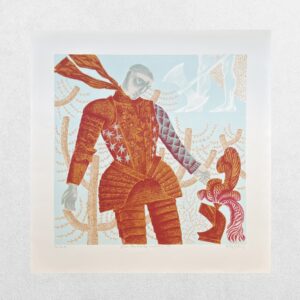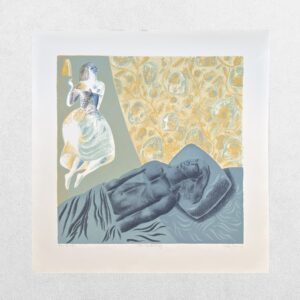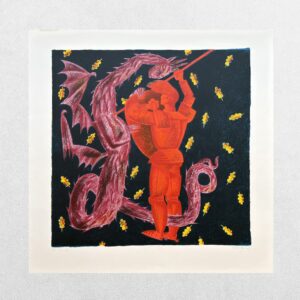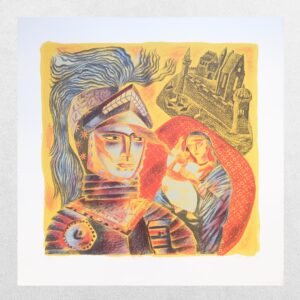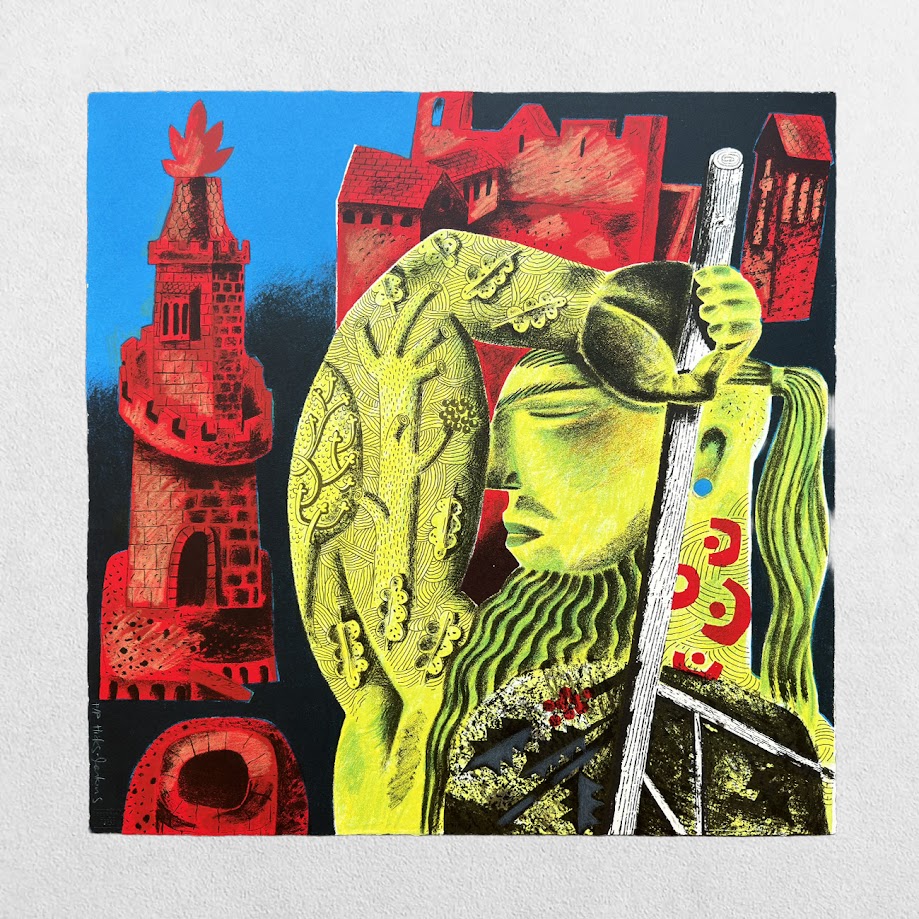
Sir Gawain And The Green Knight – 2 – The Green Knight Arrives – Original Screenprint – Variant Edition
Hicks-Jenkins, Clive & (Parvin, Sarah)
£495.00
Availability: In stock
Product Description
Sir Gawain And The Green Knight – 2 – The Green Knight Arrives – Original Screenprint – Variant Edition
Artist: Clive Hicks-Jenkins & (Parvin, Sarah)
Price: £495.00
Publisher: The Artist & The Penfold Press, UK
Format: Original screenprint
Condition: Fine condition, unframed
Size: 54.5cm x 54.5cm
Edition Number: Printer’s proof
Description
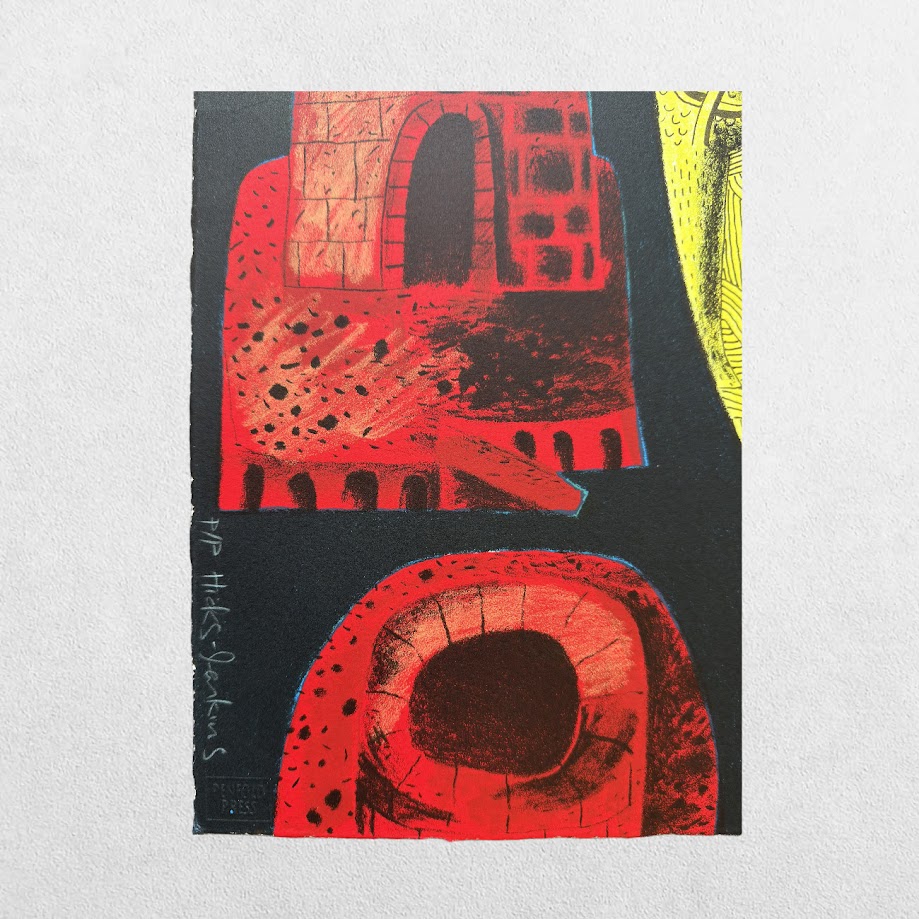
Date: 2016. Size: 54.5cm x 54.5cm without border. The second in the series that Clive Hicks-Jenkins based on Simon Armitage’s retelling of the anonymous 14th Century folk tale. Printer’s proof. Scarce format. Inscribed ‘P/P Hicks-Jenkins’. In fine condition. Sarah Parvin’s copy. ‘Sarah’ was the late Sarah Parvin and her copies of ‘The Sir Gawain And The Green Knight’ screenprints are arguably the most important copies extant for two reasons: Firstly, the contemporaneous record indicates that the ‘Sir Gawain and the Green Knight’ project was Sarah Parvin’s idea in the first place and secondly because there is compelling evidence that it was Sarah Parvin who made it happen. Please contact us for more information. PRICE INCLUDES FREE ROYAL MAIL SPECIAL DELIVERY POSTAGE IN THE UK.
Simon Armitage’s Sir Gawain and the Green Knight: A Short Overview
Simon Armitage’s Sir Gawain and the Green Knight is a modern verse translation of the late fourteenth-century Middle English romance, first published in 2007. Armitage, a contemporary British poet with a strong command of formal verse, sought to produce a version that is faithful to the original poem’s structure, energy, and moral complexity, while remaining readable and compelling for a modern audience.
The result is one of the most widely taught and read modern translations of the poem, valued both academically and creatively.
- The Original Poem: Context and Importance
Authorship and Date
Sir Gawain and the Green Knight was written in the late fourteenth century by an anonymous poet, often referred to as the Gawain Poet or Pearl Poet. The same manuscript contains Pearl, Patience, and Cleanness.
Literary Significance
The poem is a cornerstone of Middle English literature and Arthurian romance. It is notable for:
- Its sophisticated moral psychology
- Its fusion of chivalric romance with Christian ethics
- Its distinctive poetic form
The original poem is written in alliterative verse, punctuated by a recurring bob-and-wheel stanza form.
- Simon Armitage’s Aims as Translator
Armitage approaches the poem as both a scholar and a practising poet. His stated priorities include:
- Preserving the sound and momentum of the original
- Retaining the alliterative drive rather than producing a prose paraphrase
- Creating a poem that works as poetry in modern English
He avoids archaism for its own sake, but also resists flattening the poem into contemporary idiom. His translation occupies a deliberate middle ground: modern, but not casual.
- Form and Style in Armitage’s Translation
Alliteration
Armitage preserves alliteration throughout, which is central to the poem’s rhythm and identity. While the exact Middle English patterns are not always replicable, he recreates:
- Stress-based line structures
- Strong consonantal repetition
- Forward-driving musicality
This gives the translation a sense of oral performance, echoing the poem’s medieval roots.
Bob and Wheel
The bob-and-wheel — a short line followed by four rhymed lines — is retained. Armitage uses it to:
- Shift tone
- Underscore irony or moral judgement
- Provide narrative punctuation
His bob-and-wheel stanzas are often sharp, witty, or morally pointed.
Language Register
The language is:
- Clear and muscular
- Occasionally colloquial but never slang-heavy
- Capable of lyric beauty and blunt realism
This balance allows modern readers to engage with the poem’s emotional and ethical tensions without losing its medieval texture.
- Narrative Overview (as Rendered by Armitage)
The Beheading Game
The poem opens at King Arthur’s Christmas court, interrupted by the arrival of the Green Knight, an enormous, supernatural figure who challenges any knight to strike him once, on the condition that he may return the blow in a year and a day.
Gawain accepts the challenge and beheads the Green Knight, who calmly retrieves his head and reminds Gawain to meet him at the Green Chapel.
Gawain’s Journey
A year later, Gawain sets out alone. Armitage emphasises:
- The bleakness of the winter landscape
- The psychological isolation of the quest
- Gawain’s courage mixed with fear
The Castle of Bertilak
Gawain stays at a castle ruled by Bertilak, whose wife attempts to seduce him while Bertilak hunts each day. Gawain agrees to exchange whatever he gains during the day with his host.
Gawain accepts kisses from the lady (which he duly exchanges), but secretly keeps a green girdle she claims will protect him from death.
The Green Chapel
At the Green Chapel, the Green Knight spares Gawain’s life, nicking his neck only slightly. He reveals himself to be Bertilak, transformed by magic.
Gawain’s failure lies not in lust, but in concealment and self-preservation. His moral lapse is subtle, human, and deeply instructive.
- Key Themes in Armitage’s Translation
Honour and Human Frailty
Armitage highlights the poem’s central paradox: Gawain is virtuous, but not perfect. His fear of death leads him to compromise absolute honesty.
The translation foregrounds:
- Shame
- Self-knowledge
- Moral ambiguity
Gawain’s failure is not catastrophic, but formative.
Appearance vs Reality
The Green Knight embodies contradiction: terrifying yet playful, threatening yet forgiving. Armitage’s language sustains this tension, avoiding simplistic moral binaries.
The Limits of Chivalry
The poem questions the chivalric ideal by testing it under real pressure. Armitage’s version makes clear that:
- Chivalry is admirable but insufficient
- True virtue requires humility
Nature and the Supernatural
Armitage gives particular attention to:
- Seasonal cycles
- The wildness of the Green Knight
- The contrast between courtly order and natural chaos
Nature is not merely backdrop, but an active moral force.
- Tone and Interpretation
Armitage’s translation captures the poem’s tonal complexity:
- Comedy sits alongside menace
- Courtly elegance coexists with violence
- Moral seriousness is tempered by irony
The Green Knight’s final judgement is firm but compassionate, reinforcing the poem’s ethical maturity.
- Reception and Critical Standing
Armitage’s translation is widely regarded as:
- One of the most successful modern verse translations of the poem
- Especially effective for teaching and performance
- Faithful in spirit rather than literalism
Its authority comes from Armitage’s dual expertise as:
- A poet skilled in form and sound
- A careful reader of medieval literature
The translation is often compared favourably with versions by Tolkien, Marie Borroff, and Bernard O’Donoghue, distinguished by its balance of vigour and clarity.
- Significance for Modern Readers
Armitage’s Sir Gawain and the Green Knight speaks directly to contemporary concerns:
- Ethical compromise
- The pressure to appear flawless
- The tension between public reputation and private fear
By preserving the poem’s formal discipline while making it emotionally immediate, Armitage demonstrates why this medieval romance remains profoundly relevant.
Conclusion
Simon Armitage’s translation of Sir Gawain and the Green Knight is a major modern reimagining of a medieval masterpiece. It retains the original poem’s formal complexity, moral subtlety, and narrative power, while presenting it in language that is accessible without being reductive. Above all, it preserves the poem’s central insight: that true honour lies not in perfection, but in honest self-recognition.
Clive Hicks-Jenkins: A Short Biography
Introduction
Clive Hicks-Jenkins is widely regarded as one of the most distinctive visual artists working in Britain today. His oeuvre spans painting, drawing, printmaking, collage, artists’ books, and design for performance. What sets him apart is the cohesive imaginative world he has constructed over several decades: a visual language grounded in myth, folklore, biblical narrative, and the psychological landscapes of the human condition. His work is both contemporary and timeless, combining a modernist sensibility with the narrative clarity of medieval and early Renaissance art.
Hicks-Jenkins’ reputation has grown steadily, earning the respect of curators, critics, and fellow artists alike. His handling of form, staging, and character owes much to his first career in theatre and choreography, yet his mature visual art possesses a contemplative emotional resonance that is entirely his own.
Early Life and Background
Born in Newport, South Wales, in 1951, Clive Hicks-Jenkins grew up in a post-war environment marked by close-knit communities and a strong local culture of storytelling. Welsh landscape, language, and folklore would later become central to his work.
Although he showed artistic promise early on, his path into the arts did not begin with visual art. Instead, he gravitated towards theatre and dance—fields that would profoundly shape his later visual vocabulary. His sensitivity to gesture, staging, costume, and expressive movement all stem from this formative period.
Career in Theatre and Dance
Before devoting himself to visual art, Hicks-Jenkins had a distinguished career as a performer, choreographer, and director. He trained in dance and mime, later creating and directing productions for stage and television.
Key elements from his performance background that carried into his later artwork include:
- A choreographic understanding of bodies in space
- A theatre director’s grasp of narrative structure
- A designer’s sense of stylisation, colour, and mood
- The physicality of movement, gesture, and tableau
This grounding in performance gave his eventual paintings and drawings an unusual clarity of staging. Figures appear poised in theatrical tension, animals seem imbued with personality, and even his landscapes feel like constructed spaces in which stories unfold.
Transition to Visual Art
In the late 1980s and early 1990s, Hicks-Jenkins turned increasingly towards two-dimensional art, developing a practice that would become his life’s principal focus. He worked initially in drawing and painting, though collage and printmaking later became major components of his practice.
By the mid-1990s he had established himself as a significant presence within Welsh and British art, with major exhibitions and acquisitions confirming his growing prominence. What emerged was a signature style characterised by:
- flattened yet dynamic pictorial space
- layered pattern and bold colour
- stylised figures, animals, and architectural elements
- a sense of narrative tension and interior psychology
His work often feels like an illuminated manuscript reimagined for the present day.
Themes and Artistic Concerns
- Myth and Folklore
Hicks-Jenkins frequently draws on folklore, medieval romance, and storytelling traditions. His acclaimed “Green Knight” series, inspired by Sir Gawain and the Green Knight, is a notable example—combining medieval narrative with contemporary graphic invention.
- Biblical and Moral Narratives
Works such as his explorations of the story of Saint Kevin and other hagiographic subjects reveal his interest in moral complexity, temptation, sacrifice, and transformation.
- Animals and Anthropomorphic Creatures
Animals occupy a central place in his visual world. Horses, dogs, cats, birds, and hybrid beings appear frequently, often functioning as emotional or symbolic counterparts to human protagonists.
- The Landscapes of Wales
Welsh topography, architecture, and folk traditions permeate his imagery. Hills, chapels, farms, and woods become stage-sets for psychological drama.
- The Interior Self
While narrative is essential, Hicks-Jenkins’ work is deeply introspective. Many images operate as allegories for anxiety, compassion, courage, and vulnerability.
Techniques and Materials
Hicks-Jenkins is known for his versatility and technical mastery. His methods include:
Painting
Often using acrylics, gouache, and mixed media, he works in layers that give his compositions a luminous, graphic quality.
Collage
His collages—meticulously cut, assembled, and coloured—are among his most celebrated achievements. They have a sculptural presence, combining sharp edges with fluid storytelling.
Drawing
Drawing remains central to his practice, both preparatory and autonomous. His linework is expressive and economical.
Printmaking
He has collaborated with several notable printmakers and studios, producing linocuts, screenprints, and editions that extend the reach of his imagery.
Artists’ Books
Hicks-Jenkins has contributed to award-winning artists’ books, bringing together poetry, narrative, and visual composition. His collaborations with poets such as Derek Walcott, Marly Youmans, and Damian Walford Davies have been especially acclaimed.
Notable Collaborations and Publications
Hicks-Jenkins is highly regarded for his artistic collaborations. These include:
- The Penfold Press, which produced many of his print editions.
- Fine press publishers, with whom he has developed artists’ books rich in imagery and literary nuance.
- Poets and authors, whose texts often inspire or complement his visual cycles.
These collaborative projects are important to his practice: they reveal his commitment to interdisciplinary work and his belief in storytelling as a shared artistic endeavour.
Exhibitions and Recognition
Hicks-Jenkins has exhibited widely in the UK, and his work is represented in major public and private collections. Over the last two decades he has had several substantial solo exhibitions, including retrospectives that trace the evolution of his visual language from theatre to mixed-media masterworks.
Public recognition includes awards for both his visual art and book illustration projects. His influence extends across disciplines: painters, illustrators, printmakers, and set designers all cite him as a source of inspiration.
Personal Qualities and Working Practice
Colleagues and collaborators frequently remark on:
- his generosity of spirit
- his meticulous craftsmanship
- his deep respect for tradition alongside modern experimentation
- his ability to guide younger artists through mentorship and example
He maintains a strong connection to Wales, where he lives and works, drawing on its cultural and geographical richness.
Legacy and Continuing Contribution
Clive Hicks-Jenkins has established a body of work that is distinctive, emotionally resonant, and culturally rooted. His legacy rests on:
- a uniquely recognisable visual language
- the reinvigoration of narrative art in Britain
- significant contributions to artists’ books and contemporary printmaking
- a continued commitment to collaboration, mentorship, and cultural engagement
His work occupies a place at the intersection of folklore, fine art, theatre, and literature. Few contemporary artists have developed such a coherent personal mythology or approached storytelling with such depth, elegance, and humanity.
SHOP WITH CONFIDENCE AT HORNSEYS
At Hornseys, we are dedicated to offering items that uphold the highest standards of quality and authenticity. Our collection of artwork is carefully curated to ensure that each item we offer is authentic, collated, and complete.
Here’s what sets us apart:
- Authenticity and Provenance: Each print is researched and verified for authenticity, guaranteeing that you receive a genuine signature from the artist.
- Expert Curation: We wholly own all our artworks. We trust our taste and have invested heavily in it. We have confidence in all artwork that we offer for sale.
- Customer Satisfaction: We strive to provide an exceptional customer experience, from detailed descriptions and provenance to secure and prompt delivery of your purchase.
- Returns Policy: We offer an unconditional guarantee on every item. If, however, you wish to make a return, artworks may be sent back to us within fourteen days of receipt for whatever reason. We request that we are notified in advance if you wish to do so. They must be returned to us in the same condition as they were sent for a full refund.
OUR COMMITMENT TO QUALITY AND SERVICE
Understanding the value and rarity of these items, we ensure that every aspect of your purchase meets the highest standards of quality and service. This includes:
- Free Expedited, Tracked, and Insured Delivery within the UK: Ensuring that your artwork arrives safely and promptly.
- Fully-Insured Worldwide Delivery: Offering peace of mind for international collectors with reliable and secure shipping options.
EXPLORE OUR COLLECTION
Visit Hornseys today to explore our fine collection of original prints and other artworks. Whether you are an avid collector or looking for a special gift, our selection offers something truly unique. Located since 1976 in Ripon in the picturesque Yorkshire Dales, we are recognized as a destination gallery for tastefully curated artwork, design, and fine books.
Related products

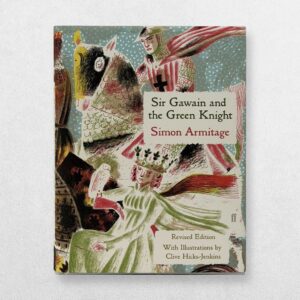
Sir Gawain And The Green Knight – Revised Edition With Illustrations By Clive Hicks-Jenkins – Signed By Clive Hicks-Jenkins
£95.00Armitage, Simon & Hicks-Jenkins, Clive
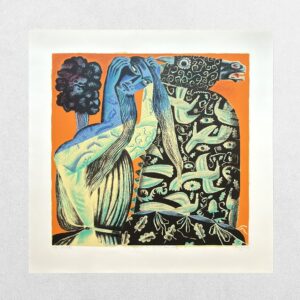
Sir Gawain And The Green Knight – 4 – The Green Knight’s Head Lives – Original Screenprint – Unique Copy Inscribed To Sarah Parvin
£1,495.00Hicks-Jenkins, Clive & (Parvin, Sarah)
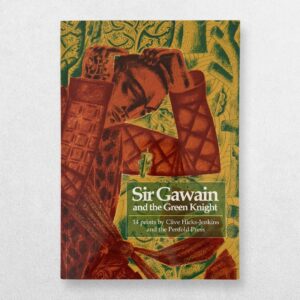
Sir Gawain And The Green Knight – 14 Prints By Clive Hicks-Jenkins And The Penfold Press – Signed Copy
£25.00Hicks-Jenkins, Clive, Russell, James, Wakelin, Peter & Wakelin, Andrew
Sir Gawain And The Green Knight – 14 Prints By Clive Hicks-Jenkins And The Penfold Press – First Edition
£10.00Hicks-Jenkins, Clive, Russell, James, Wakelin, Peter & Wakelin, Andrew

You may also like…
Sir Gawain And The Green Knight – 12 – Gawain Staunches The Wound To His Neck – Original Screenprint – Unique Copy Inscribed To Sarah Parvin
£1,495.00Hicks-Jenkins, Clive & (Parvin, Sarah)
Sir Gawain And The Green Knight – 9 – The Temptations – Original Screenprint – Unique Copy Inscribed To Sarah Parvin
£1,495.00Hicks-Jenkins, Clive & (Parvin, Sarah)
Sir Gawain And The Green Knight – 6 – The Travails – Original Screenprint – Unique Copy Inscribed To Sarah Parvin
£1,495.00Hicks-Jenkins, Clive & (Parvin, Sarah)
Sir Gawain And The Green Knight – 5 – The Armouring Of Gawain – Original Screenprint
£295.00Hicks-Jenkins, Clive
Sir Gawain And The Green Knight – 13 – Morgan Le Fay – Original Screenprint
£295.00Hicks-Jenkins, Clive
Sir Gawain And The Green Knight – 1 – Christmas At Camelot – Original Screenprint
£1,495.00Hicks-Jenkins, Clive