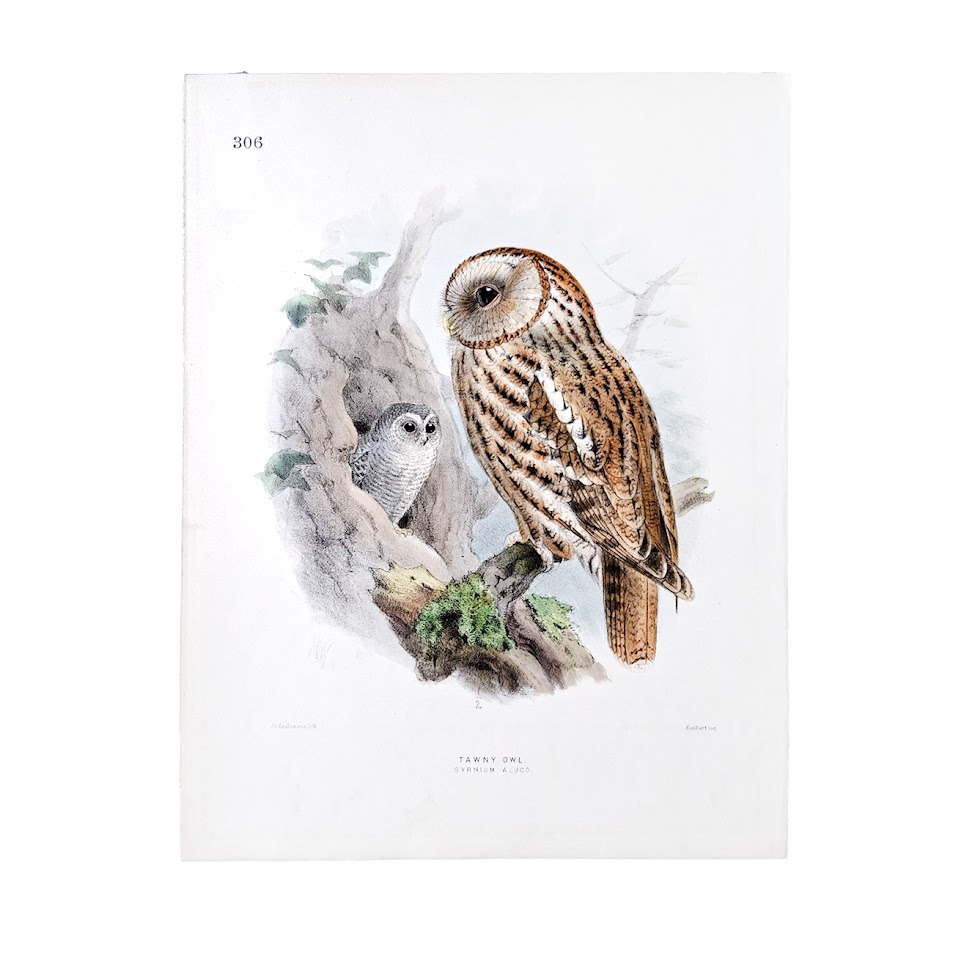
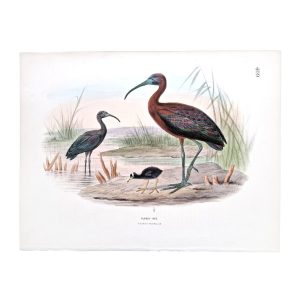
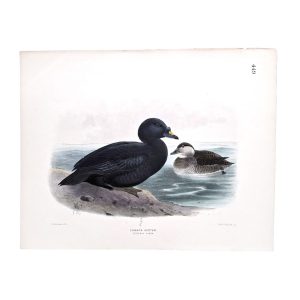
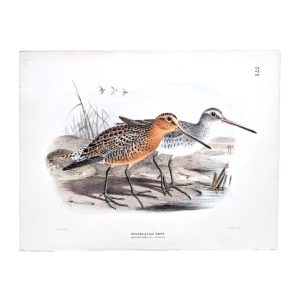
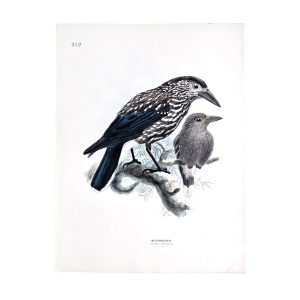
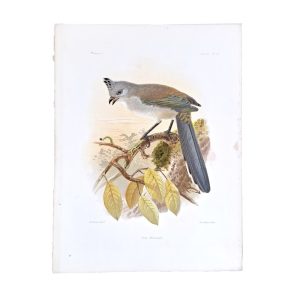
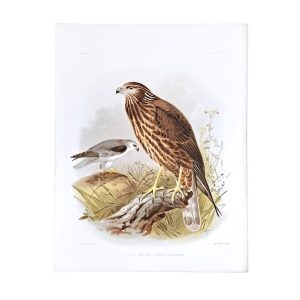
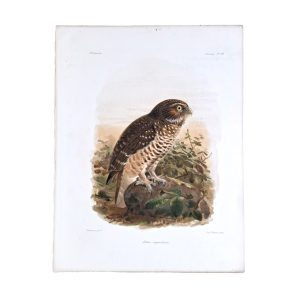
Syrnium Aluco – Tawny Owl – Original Hand-Coloured Lithograph
Engraver: John Gerrard Keulemans
Publisher: L’Imprimerie Nationale
Price: £95
Publication Date: Not dated but c.1876
Format: Original hand-coloured lithograph
Condition: In very good condition, unframed
Sheet Size: Sheet Size: 32.5cm x 25cm
Condition:
Original hand-coloured lithograph. Minor age-toning to the margins. In very good indeed, clean condition overall. A rare plate from this important work.
Location: Map Drawer B: FS: Folder JGK 001869
Tawny Owl: A Brief Description
The tawny owl (Strix aluco), also sometimes referred to by the older scientific name Syrnium aluco, is a medium-sized owl that is widespread throughout Europe and parts of Asia. It is known for its characteristic hooting call and nocturnal habits.
- Appearance: Tawny owls are stocky birds with rounded heads and no ear tufts. They have large, dark brown eyes and a relatively small, sharp beak. Their plumage is generally mottled brown or grey, helping them blend into their woodland habitats. The underparts are paler with streaks, and there is considerable variation in colour between individuals, with some appearing more reddish-brown and others more greyish.
- Size: Tawny owls are medium-sized, measuring about 37–43 cm in length, with a wingspan of 81–105 cm. They have broad wings and short tails, which make them agile fliers, particularly in wooded environments.
- Habitat: Tawny owls prefer dense, mature woodlands, but they are also commonly found in parks, gardens, and urban areas with sufficient tree cover. They are highly territorial and remain in the same area throughout the year. Unlike some owl species, tawny owls are non-migratory.
- Diet: Tawny owls are opportunistic hunters, feeding mainly on small mammals such as mice, voles, and shrews. They also eat birds, frogs, insects, and occasionally earthworms. They are nocturnal hunters, using their acute hearing and silent flight to locate and catch prey in the dark.
- Behaviour: Tawny owls are most active at night, especially at dusk and dawn. They are known for their haunting, far-reaching call, often described as a “hoot” or “twit-twoo.” This call is primarily used by males to mark their territory and attract mates. Tawny owls are monogamous and usually form long-term pair bonds.
- Breeding: Breeding typically occurs in late winter or early spring. Tawny owls nest in tree cavities, old nests of other large birds, or even in artificial nest boxes. The female lays 2–3 eggs, which she incubates for about 30 days. Once hatched, the young owls remain in the nest for around five weeks before fledging.
- Conservation Status: The tawny owl is currently listed as “Least Concern” by the IUCN, as it is widespread and relatively common in suitable habitats. However, like many woodland species, it faces pressures from habitat loss due to deforestation and urban development.
John Gerrard Keulemans: A Short Biography
John Gerrard Keulemans (1842–1912) was a prolific and influential Dutch bird illustrator whose work remains celebrated for its accuracy and artistic detail. He was born on June 8, 1842, in Rotterdam, Netherlands. From a young age, he showed an interest in natural history, particularly in birds, and this passion guided him toward a career in scientific illustration.
Early Life and Career
Keulemans studied under Hermann Schlegel at the Natural History Museum in Leiden, where he honed his skills as a naturalist and artist. This connection led to one of his early assignments: joining an expedition to West Africa in 1864 to collect specimens. His work during this period helped him establish his reputation as both a naturalist and an illustrator. He documented various species of birds, adding greatly to the knowledge of African avifauna.
Move to London and Prolific Period
In 1869, Keulemans moved to England, where he would spend the rest of his career. London at that time was a hub of scientific research and publishing, making it an ideal base for an artist like Keulemans. He quickly became a leading illustrator for many of the major ornithological works of the 19th century.
Major Works
Keulemans illustrated more than 100 books on natural history, with his most famous contributions to:
- “The Birds of Great Britain” (1862–1873) by John Gould – Keulemans contributed to many of Gould’s other works, but this publication remains one of the most significant.
- “A History of the Birds of New Zealand” (1873, 1888, 1906) by Sir Walter Buller – Keulemans’ illustrations were essential to the understanding of New Zealand’s birdlife.
- “The Ibis” and “Proceedings of the Zoological Society of London” – leading ornithological journals where Keulemans’ works regularly appeared.
- “The Avifauna of Laysan” and “The Birds of the Hawaiian Islands” by R. C. L. Perkins.
Keulemans’ distinctive style involved the meticulous depiction of birds in natural, life-like poses. His plates were highly detailed, showcasing the nuances of feathers and anatomy, and he often portrayed birds in natural habitats to highlight their behaviour and environment.
Style and Techniques
Keulemans mainly worked in lithography, a printmaking process that allowed for mass production of his artwork while maintaining high-quality detail. He was known for his ability to bring a bird’s plumage and colour to life on paper, despite the limitations of the printing techniques of the time. His method involved working with specimens, either from museums or from field collections, to create scientifically accurate and dynamic illustrations.
Personal Life
Keulemans lived in England for much of his life and married in 1871. He fathered 11 children, though only six survived into adulthood. Despite his immense output and contributions to science, Keulemans often struggled financially, a common challenge for many illustrators of his era.
Legacy
John Gerrard Keulemans passed away on March 29, 1912, in Ilford, Essex, England. His legacy is firmly cemented in the world of ornithological illustration. His works continue to be highly regarded for their scientific value and artistic beauty. Many of his original illustrations are held in museums and private collections, and his detailed depictions are still referenced by ornithologists and bird enthusiasts today.
Keulemans’ work represents an important bridge between the art of the natural world and scientific inquiry, providing invaluable insight into bird species from around the world during a period when photography was still in its infancy. His illustrations remain among the finest examples of ornithological art.
SHOP WITH CONFIDENCE AT HORNSEYS
At Hornseys, we are dedicated to offering items that uphold the highest standards of quality and authenticity. Our collection of artwork is carefully curated to ensure that each item we offer is authentic, collated, and complete.
Here’s what sets us apart:
- Authenticity and Provenance: Each lithograph is researched and verified for authenticity, guaranteeing that you receive a genuine item.
- Expert Curation: We wholly own all our artworks. We trust our taste and have invested heavily in it. We have confidence in all artwork that we offer for sale.
- Customer Satisfaction: We strive to provide an exceptional customer experience, from detailed descriptions and provenance to secure and prompt delivery of your purchase.
- Returns Policy: We offer an unconditional guarantee on every item. If, however, you wish to make a return, artworks may be sent back to us within fourteen days of receipt for whatever reason. We request that we are notified in advance if you wish to do so. They must be returned to us in the same condition as they were sent for a full refund.
OUR COMMITMENT TO QUALITY AND SERVICE
Understanding the value and rarity of these items, we ensure that every aspect of your purchase meets the highest standards of quality and service. This includes:
- Free Expedited, Tracked, and Insured Delivery within the UK: Ensuring that your artwork arrives safely and promptly.
- Fully-Insured Worldwide Delivery: Offering peace of mind for international collectors with reliable and secure shipping options.
EXPLORE OUR COLLECTION
Visit Hornseys today to explore our fine collection of maps and other artworks. Whether you are an avid collector or looking for a special gift, our selection offers something truly unique. Located sine 1976 in Ripon in the picturesque Yorkshire Dales, we are recognized as a destination gallery for tastefully curated artwork, rare maps, design, and fine books.