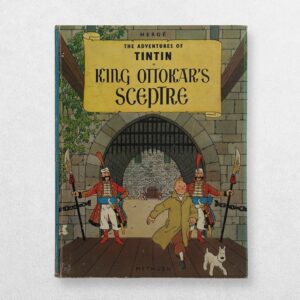
The Adventures Of Tintin – The Castafiore Emerald – First Edition – 1963
Author: Hergé
Price: £275.00
Publisher: Methuen, London, UK
Publication date: 1963
Format: Original cloth-backed boards with pictorial endpapers
Condition: Very good plus
Size: 23.2cm x 30.7cm
Pages: 62
Illustrations: Illustrated throughout in colour by the author
Description:
Published by Methuen, London, UK, 1963. 1st UK edition. Original cloth-backed boards. Pictorial endpapers. Size: 23.2cm x 30.7cm. Pp. 62. Illustrated throughout in colour by the author. Minor rubbing but with much less of the usual fading to the spine. Minor rubbing to the edges. Binding very nice and tight. A very good plus, tight, bright, clean copy.
‘The Castafiore Emerald’: A Brief Summary
The Castafiore Emerald, first published in 1963 in French, is the twenty-first volume of The Adventures of Tintin. Unlike most Tintin stories, it breaks from the formula of globe-trotting adventures and political intrigue. Instead, it unfolds entirely at Marlinspike Hall, focusing on domestic comedy, misunderstandings, and the apparent theft of a jewel. The story is celebrated for its innovative narrative, turning a seemingly small and ordinary setting into a stage for suspense and humour.
Castafiore Arrives
The adventure begins when Tintin and Captain Haddock learn that Bianca Castafiore, the flamboyant opera diva and recurring character, plans to visit Marlinspike Hall. Much to Haddock’s horror, Castafiore arrives with her entourage, including her maid Irma and pianist Igor Wagner. Her presence quickly throws life at Marlinspike into chaos.
Castafiore brings with her a priceless emerald, which immediately becomes the centre of attention. Haddock’s discomfort, her dramatic entrances, and her constant misnaming of his title (she repeatedly calls him “Captain Harrock” or “Captain Paddock”) provide much of the early humour.
Domestic Confusion
What follows is a series of comic misunderstandings. Journalists descend on Marlinspike, inventing stories about an impending marriage between Haddock and Castafiore, much to Haddock’s despair. Professor Calculus, oblivious as ever, provides comic interludes with his eccentric inventions and selective hearing.
Meanwhile, the household staff—including Nestor the butler—struggle to cope with the unexpected bustle. Even Snowy becomes embroiled in the confusion, alternately helping and hindering Tintin in his attempts to maintain order.
The Missing Emerald
The central drama occurs when Castafiore’s emerald suddenly disappears. Suspicion falls on various figures: her maid Irma, her pianist Wagner, the gypsy family camped nearby, and even the intrusive journalists. Each time, Tintin investigates diligently, following clues and analysing evidence, but the mystery deepens without resolution.
The gypsies, in particular, are subjected to prejudice from outsiders, but Tintin defends them, reinforcing his role as a champion of fairness and justice.
A Non-Traditional Resolution
In a striking departure from the usual Tintin formula, the mystery of the emerald is resolved not through dramatic adventure but through a simple, almost comical twist. The jewel was never stolen by villains at all: it had fallen into a crack in Castafiore’s armchair and reappears entirely by accident.
This anti-climax is deliberate, underscoring Hergé’s playful subversion of readers’ expectations. By denying the story a conventional villain or climactic chase, he creates a narrative that is both humorous and refreshing in its originality.
Themes and Style
The Castafiore Emerald is unique for its focus on character interaction rather than external action. It highlights themes of gossip, miscommunication, prejudice, and human folly. The press is lampooned for its sensationalism, while Haddock’s exasperation provides a running gag.
The story also reflects Hergé’s confidence as a storyteller, demonstrating that a Tintin adventure could succeed without exotic settings or political intrigue. Instead, humour, atmosphere, and characterisation carry the narrative.
Conclusion
The Castafiore Emerald stands as one of the most original entries in The Adventures of Tintin. By setting the entire story at Marlinspike Hall and focusing on everyday comedy and misunderstandings, Hergé created a narrative that is both subversive and charming. The non-traditional resolution of the jewel mystery highlights the playful nature of the work, while the character interactions showcase the richness of the Tintin universe. Far from being a digression, the book proves that even in the absence of global adventures, Tintin and his companions remain endlessly engaging.
Why Buy from Us?
At Hornseys, we are committed to offering items that meet the highest standards of quality and authenticity. Our collection of rare books is carefully curated to ensure each edition is a valuable piece of bibliographical history. Here’s what sets us apart:
- Authenticity and Provenance: Each book is meticulously researched and verified for authenticity and collation.
- Expert Curation: Our selection process focuses on significance, condition, and rarity, resulting in a collection that is both diverse and distinguished.
- Customer Satisfaction: We aim to provide an exceptional customer experience, from detailed descriptions to secure and prompt delivery of your purchase.
- Returns Policy: We offer an unconditional guarantee on every item. If you wish to return a book, it may be sent back to us within fourteen days of receipt. Please notify us in advance if you wish to do so. The book must be returned in the same condition as it was sent for a full refund.