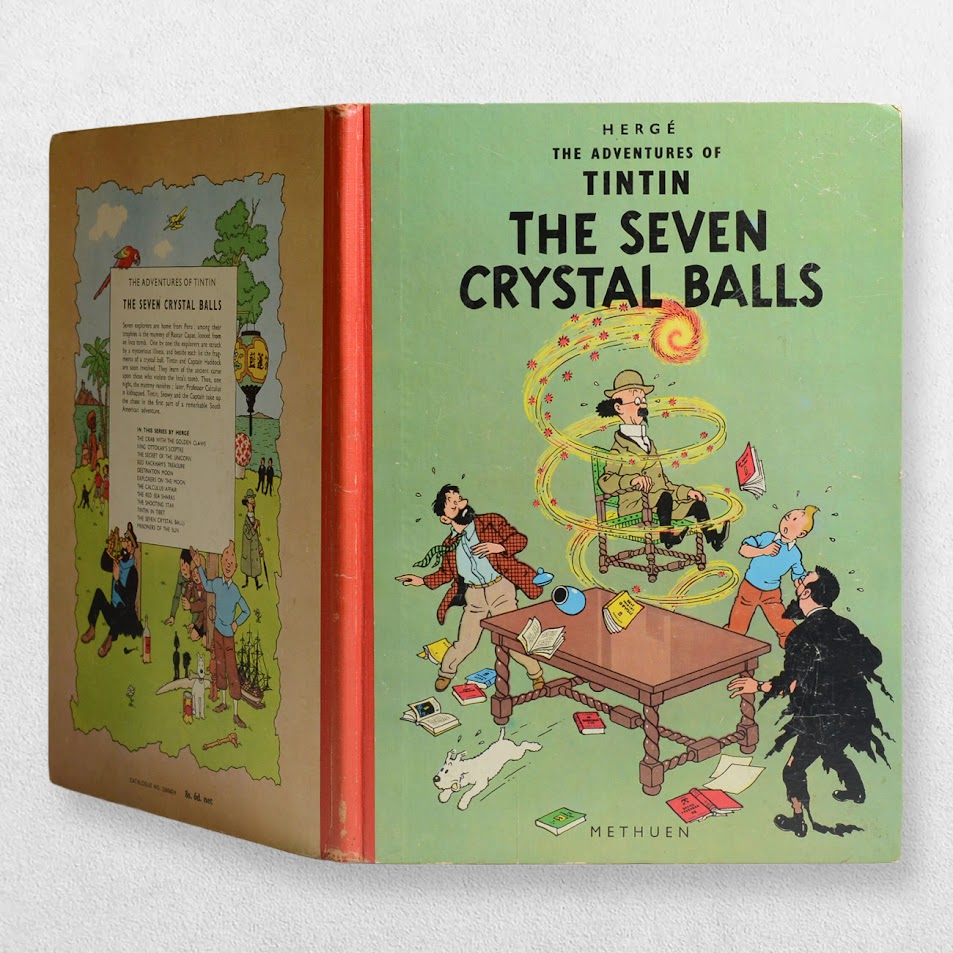
The Adventures Of Tintin – The Seven Crystal Balls – First Edition – 1962
Hergé
£295.00
Availability: In stock
Product Description
The Adventures Of Tintin – The Seven Crystal Balls – First Edition – 1962
Author: Hergé
Price: £295.00
Publisher: Methuen, London, UK
Publication date: 1962
Format: Original cloth-backed boards with pictorial endpapers
Condition: Very good
Size: 23.2cm x 30.7cm
Pages: 62
Illustrations: Illustrated throughout in colour by the author
Description:
Published by Methuen, London, UK, 1962. 1st UK edition. Original cloth-backed boards. Pictorial endpapers. Size: 23.2cm x 30.7cm. Pp. 62. Illustrated throughout in colour by the author. Binding nice and tight with only minor fading to the spine and slight spine lean. Very slight age toning to the pages. Slight rubbing to the spine and edges of the boards. A very good indeed, tight, clean copy. Scarce in this condition.
The Seven Crystal Balls: A Brief Summary
The Seven Crystal Balls (Les Sept Boules de Cristal, 1948) is the thirteenth volume in The Adventures of Tintin series by Hergé (Georges Remi). It stands as one of the most mature and haunting Tintin adventures, combining mystery, the supernatural, and psychological suspense with an undercurrent of cultural reflection.
It is the first part of a two-volume story that concludes with Prisoners of the Sun (1949). Together, they form Hergé’s great “Inca duology” — a saga that unites Western rationalism with Andean mysticism and explores the moral consequences of colonial curiosity.
Background and Context
Hergé began serialising The Seven Crystal Balls in 1943 in Le Soir Jeunesse, but production was interrupted by the liberation of Belgium in 1944 and by Hergé’s own post-war difficulties. Accused of collaboration for having worked during the Occupation, he suffered a nervous breakdown, halting Tintin for nearly two years.
When he resumed the story in 1946 in Tintin Magazine, the change in tone was unmistakable. The humour and exuberance of Red Rackham’s Treasure gave way to unease and shadow. Hergé was entering a more introspective creative phase, and The Seven Crystal Balls became a work of atmosphere, ambiguity, and conscience.
Plot Summary
The Return of the Sanders-Hardiman Expedition
The story opens in Brussels with the triumphant return of the Sanders-Hardiman Expedition, a group of European explorers who have brought back mummified remains and sacred artefacts from the tomb of an Inca king in Peru.
Soon afterwards, the members of the expedition begin to fall victim to a mysterious curse. Each is found in a death-like coma, their faces twisted in terror, with shattered crystal fragments beside them.
An Unnatural Affliction
Tintin, Captain Haddock, and Professor Calculus investigate the mystery, which deepens when Calculus shows fascination with a mummy named Rascar Capac (“the Scourge of the Sun”). When the mummy is stolen, a terrifying thunderstorm descends upon the city, suggesting supernatural forces at work.
The Curse Intensifies
The victims’ condition baffles scientists and doctors. They remain alive but unresponsive, seemingly trapped in a state between life and death.
Tintin suspects human agency behind the apparent curse and traces clues to the theft of the mummy. Calculus, meanwhile, begins to display strange behaviour, sleepwalking and uttering cryptic remarks about “the wrath of the Sun.”
The Abduction
The investigation takes a darker turn when Professor Calculus is kidnapped. Tintin and Haddock follow the trail to the port, where they discover evidence that Calculus is being transported to South America.
The story ends on a powerful cliff-hanger, with Tintin and Haddock boarding the ship Pachacamac to pursue the kidnappers — a transition that leads directly into Prisoners of the Sun.
Principal Characters
Tintin
As investigator and moral anchor, Tintin combines rational analysis with empathy. His refusal to dismiss indigenous beliefs as superstition marks a growth in cultural sensitivity. He stands as a mediator between the scientific and the spiritual.
Captain Haddock
Haddock provides both humour and humanity. His exasperation at Brussels’ drawing-room absurdities and his loyalty to Tintin reveal a character increasingly grounded in decency rather than bluster. His scepticism towards “mystical nonsense” gives the story much of its comic tension.
Professor Calculus
Calculus’s fascination with Rascar Capac’s mummy prefigures his tragic abduction. His absent-mindedness, once comic, becomes poignant — a reminder of how intellectual curiosity can lead to peril when detached from respect.
Rascar Capac
Though long dead, the mummy’s presence dominates the story. He is both a symbol of violated sacredness and a personification of cultural revenge — the past reclaiming justice from colonial arrogance.
The Sanders-Hardiman Expedition
The afflicted explorers represent Western scientific arrogance. By disturbing the tomb, they awaken not merely a curse, but a moral reckoning.
Themes and Analysis
- The Clash of Civilisations
At its heart, the story dramatises the confrontation between Western rationalism and indigenous spirituality. The “curse” of Rascar Capac may be seen as supernatural or as poetic justice — the moral backlash of exploitation masquerading as science.
Hergé’s portrayal of Andean culture is more respectful than his earlier depictions of non-European peoples. He treats indigenous spirituality as dignified, powerful, and mysterious, not primitive.
- Guilt and Retribution
The afflictions that strike the explorers are both literal and symbolic. They represent the haunting guilt of colonial plunder — the psychological cost of violating sacred boundaries.
Hergé’s Belgium, recovering from its own wartime moral crises, provides an implicit backdrop: the sins of the past returning to demand reckoning.
- Rationalism and the Supernatural
Tintin’s investigation oscillates between science and mysticism. The story never fully resolves whether the curse is real or engineered, leaving readers in a space of ambiguity.
This tension mirrors Hergé’s own intellectual struggle — a man of reason increasingly drawn to metaphysical questions.
- The Psychology of Fear
The album’s tone is one of dread and anxiety. Hergé uses storm imagery, night scenes, and silent panels to evoke psychological horror rather than action. The dream sequence in which Tintin envisions Rascar Capac invading his room remains one of the most chilling moments in the entire series.
- Compassion and Moral Inquiry
Unlike colonial adventurers of earlier decades, Tintin does not seek treasure or fame. His mission is restorative — to save lives, to understand, and to respect. His empathy for both victim and “villain” sets him apart as a morally modern hero.
Artistic and Narrative Achievement
The Seven Crystal Balls is widely regarded as one of Hergé’s most visually accomplished works.
- Cinematic Suspense: The pacing builds slowly, like a detective film or gothic mystery.
- Atmosphere and Lighting: Hergé’s use of shadow, storm, and empty space anticipates film noir techniques.
- Realistic Brussels: The domestic settings heighten the sense of intrusion when the supernatural breaks in.
- Dream Imagery: The surreal dream sequence is rendered with meticulous detail — an early example of Hergé’s psychological storytelling.
The ligne claire technique here achieves new emotional depth. Hergé’s lines are calm and controlled, yet the mood is eerie and disquieting — a masterclass in visual restraint.
Moral and Philosophical Dimensions
The story invites reflection on moral responsibility and respect for other cultures. The “curse” functions as allegory: those who exploit the sacred for curiosity or gain will face consequences beyond their comprehension.
Hergé’s wartime experiences and post-war guilt likely influenced this moral tone. The story’s quiet horror can be read as a meditation on accountability — individual and collective.
Psychological Interpretation
Hergé’s own psyche is visible in the story’s unease. The interrupted production, his depression, and his self-questioning are mirrored in the album’s atmosphere of fear, paralysis, and haunting.
Rascar Capac, breaking through Tintin’s dream, may symbolise the intrusion of repressed guilt — personal or historical — into waking life. The story becomes both external adventure and internal reckoning.
Relation to Prisoners of the Sun
The Seven Crystal Balls ends mid-journey, with Calculus abducted and Tintin’s pursuit unresolved. Prisoners of the Sun completes the narrative, shifting from European mystery to South American epic.
The two works together chart a transformation: from dread to redemption, from guilt to understanding. If The Seven Crystal Balls is about the awakening of conscience, Prisoners of the Sun is about the reconciliation of worlds.
Legacy and Reception
When completed in 1948, The Seven Crystal Balls was hailed as one of Hergé’s most mature and technically accomplished stories. It has since been regarded as a turning point in the Tintin series — where suspense, spirituality, and moral depth replace pure adventure.
Its influence can be seen in later graphic literature, where atmosphere and emotion play as important a role as plot. The story remains one of readers’ favourites for its haunting beauty and psychological nuance.
Summary
- Title: The Seven Crystal Balls (Les Sept Boules de Cristal)
- First Published: 1943–1948 (album 1948)
- Main Characters: Tintin, Captain Haddock, Professor Calculus, Rascar Capac, the Sanders-Hardiman Expedition
- Setting: Brussels and Europe, leading to South America
- Themes: Colonial guilt, mystery and superstition, rationalism versus faith, fear and conscience
- Artistic Style: Ligne claire with heightened atmosphere and psychological realism
- Significance: First part of the “Inca duology”; one of Hergé’s most introspective and haunting works
Conclusion
The Seven Crystal Balls is more than an adventure: it is a meditation on guilt, respect, and the thin line between knowledge and desecration. Its mystery, though set among explorers and museums, unfolds within the moral imagination.
In its quiet tension, its luminous art, and its unresolved dread, the story represents Hergé at his most artistically ambitious. It captures the moment when Tintin — and his creator — move beyond external heroism into the deeper realm of conscience and compassion.
Where Red Rackham’s Treasure found home and belonging, The Seven Crystal Balls finds the shadow — the haunting reminder that every civilisation must reckon with the ghosts it awakens.
Why Buy from Us?
At Hornseys, we are committed to offering items that meet the highest standards of quality and authenticity. Our collection of rare books is carefully curated to ensure each edition is a valuable piece of bibliographical history. Here’s what sets us apart:
- Authenticity and Provenance: Each book is meticulously researched and verified for authenticity and collation.
- Expert Curation: Our selection process focuses on significance, condition, and rarity, resulting in a collection that is both diverse and distinguished.
- Customer Satisfaction: We aim to provide an exceptional customer experience, from detailed descriptions to secure and prompt delivery of your purchase.
- Returns Policy: We offer an unconditional guarantee on every item. If you wish to return a book, it may be sent back to us within fourteen days of receipt. Please notify us in advance if you wish to do so. The book must be returned in the same condition as it was sent for a full refund.
Cataloguer: Daniel Hornsey
Daniel Hornsey has specialised in fine and rare books, ephemera, and collectors’ editions for over thirty years. As a long-standing member of the antiquarian book trade, he has advised private collectors, curated catalogues, and sourced works for leading dealers, libraries and institutions across the world.
Hornseys’ exhibit regularly at book and map fairs in London and throughout the UK and are members of the Provincial Booksellers Fairs Association, the PBFA.
His fascination with Hergé’s work — especially ‘The Adventures of Tintin’ — began in childhood. Daniel recalls reading Tintin in original European editions and quickly recognising that these were not merely children’s books, but finely illustrated narratives crafted with artistic depth and wit.
As noted by the Musée Hergé in Louvain-la-Neuve, Hergé’s ‘ligne claire’ style has influenced generations of European comic artists and his original drawings and paintings command very high prices with his painting of ‘The Blue Lotus’ jar fetching £2.8m at auction in 2021.
By presenting these works through Hornseys’, he hopes to contribute to the continued appreciation of one of the 20th century’s most influential illustrators, helping new generations discover the artistry and legacy of Hergé.
Related products

The Gruffalo & The Gruffalo’s Child: First Deluxe Miniature Editions Both Signed By Julia Donaldson & Axel Scheffler
£495.00Donaldson, Julia & Scheffler, Axel
The Fairies Or The Tales Of Mother Goose Corrected Typescript: Presentation Copy To John Arlott
£275.00Disher, M Willson
When We Were Very Young – Winnie The Pooh – Now We Are Six – The House At Pooh Corner – The Collectors’ Facsimile Edition – Four Volumes In Slipcase
£85.00Milne, A. A. & Shepard, Ernest H