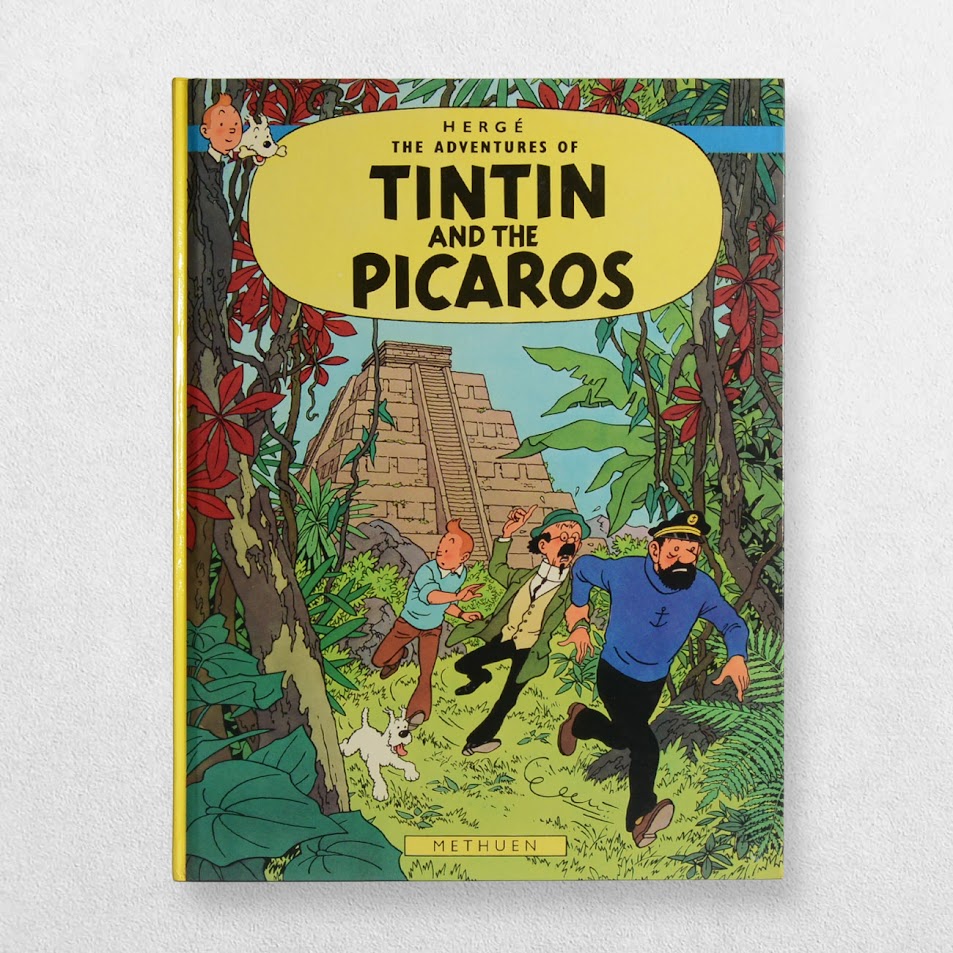
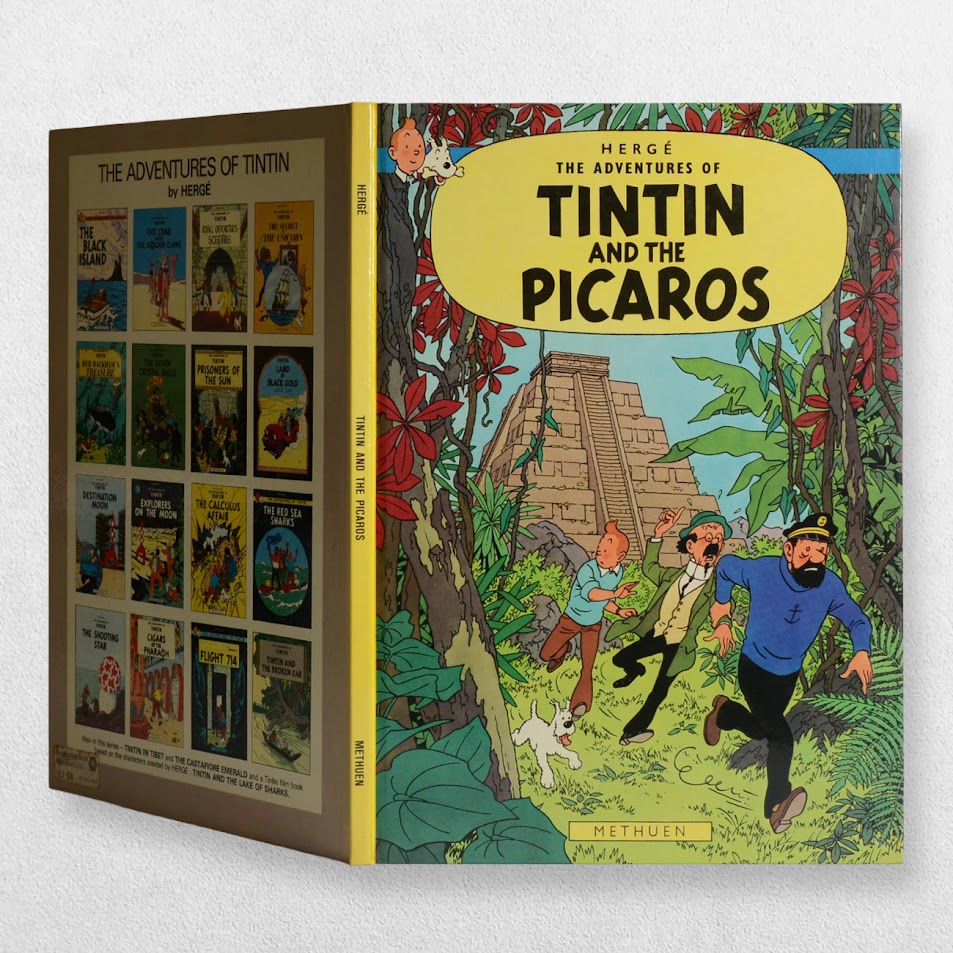
The Adventures Of Tintin – Tintin And The Picaros – First Edition
Hergé
£175.00
Out of stock
Product Description
The Adventures Of Tintin – Tintin And The Picaros – First Edition
Author: Hergé
Price: £175
Publisher: Methuen, London, UK
Publication Date: 1976
Format: Original pictorial boards.
Condition: Near fine
Edition: First edition
Size: 23.2cm x 30.7cm
Pages: 62
Illustrations: Illustrated throughout by the author
Condition:
Published by Methuen, London, UK, 1976. 1st UK edition. Original pictorial boards. Pictorial endpapers. Size: 23.2cm x 30.7cm. Pp. 62. Illustrated throughout in colour by the author. Slight foxing to the text block. A near fine, tight, clean, copy.
Tintin And The Picaros: A Brief Summary
Tintin and the Picaros (Tintin et les Picaros), first published in 1976, is the twenty-third and final completed volume in The Adventures of Tintin series by Hergé. It represents a culmination of the series’ long-running themes—political disillusionment, moral ambiguity, and the limits of heroism—set against the backdrop of revolution in Latin America.
The story opens in Belgium, where Captain Haddock, Professor Calculus, and Tintin learn through the press that their old friends Bianca Castafiore, her maid Irma, and pianist Igor Wagner have been arrested in the fictional South American republic of San Theodoros. They have been accused of plotting against General Tapioca, who now rules the country after overthrowing General Alcazar, last seen in The Broken Ear. Tintin is initially sceptical about becoming involved; his sense of adventure has been tempered, and he is seen wearing modern clothing, including a motorcycle helmet and jeans—a subtle symbol of the times changing and of Tintin’s maturing worldview.
Nevertheless, when an invitation arrives from General Tapioca offering to host the group in San Theodoros, Tintin reluctantly agrees to travel there, suspecting ulterior motives. Upon arrival, they are greeted with exaggerated hospitality that soon gives way to suspicion. The regime’s propaganda machinery parades Tintin and his friends before the press as honoured guests, but they quickly realise they are under surveillance and effectively imprisoned in a luxury compound.
Meanwhile, a rebel faction led by Tintin’s old ally General Alcazar—now heading the guerrilla group known as the Picaros—operates in the jungle. Alcazar’s forces are poorly organised, demoralised, and reliant on alcohol. Tintin arranges contact with Alcazar, escaping Tapioca’s control to join the rebels in their remote jungle base. There, he is dismayed to find Alcazar and his men heavily dependent on rum supplied by the political schemer Colonel Sponsz, who manipulates both sides to his advantage.
Determined to prevent further bloodshed, Tintin devises a plan to neutralise Tapioca’s troops without violence. Using a gas developed by Professor Calculus that induces dizziness and disorientation, Tintin ensures that the capital’s military guards are rendered harmless during Alcazar’s coup. The operation succeeds, and Alcazar returns to power—his revolution achieved without killing a single person.
However, Tintin’s victory is tinged with irony. Once Alcazar assumes control, the new regime looks identical to the old one: the same propaganda, the same parades, the same slogans, merely with names and uniforms changed. Even the supposedly liberated Castafiore remains uninterested in politics, and Tintin, rather than celebrating, observes the outcome with weary resignation. The album closes with a quiet, ambiguous scene: Tintin, Haddock, and Calculus flying home, while the endless cycle of revolution and repression continues in San Theodoros.
Analysis
Tintin and the Picaros is Hergé’s most mature and reflective work, imbued with a tone of disenchantment that stands in stark contrast to the youthful optimism of the early albums. Created after a decade-long hiatus, it reveals both the artist’s growing scepticism about political idealism and his awareness of the futility of revolutionary change when the underlying systems remain unaltered.
Political and Social Commentary
The story’s fictional setting, San Theodoros, had appeared decades earlier in The Broken Ear, but here it is transformed into a stage for satire on Cold War-era Latin American politics. The characters of General Alcazar and General Tapioca parody the endless cycle of coups and counter-coups that characterised many 20th-century regimes, often influenced by foreign powers. Neither represents progress or moral clarity; they are mirror images, sustained by propaganda and personal ambition.
Hergé’s portrayal of Tintin in this context is deliberately understated. No longer the impetuous boy reporter, Tintin has become a thoughtful, somewhat detached observer. His refusal to wear his traditional plus-fours and his adoption of a more modern wardrobe symbolise his evolution from heroic adventurer to pragmatic realist. His chief goal is no longer adventure for its own sake but the prevention of harm and needless suffering.
The narrative’s moral centre lies in Tintin’s insistence on a non-violent solution. The use of Calculus’s harmless gas to overthrow Tapioca symbolises a pacifist ideal that contrasts sharply with the chaos and bloodshed of real revolutions. Yet Hergé’s ending undercuts even this triumph: the unchanged reality of San Theodoros suggests that violence and corruption are not merely the result of individuals but of entrenched systems of power.
Themes of Disillusionment and Modernity
Throughout the story, Hergé subtly explores the passage of time and the waning of idealism. The album’s atmosphere is more subdued and introspective than its predecessors. The humour is gentler, the pacing slower, and the colour palette earthier. Many of Tintin’s iconic characteristics—his impulsive bravery, his boundless optimism, his faith in truth—are replaced by quiet rationality and restraint. This reflects not only Hergé’s personal evolution but also the changing world of the 1970s, where global politics had become morally complex and cynicism pervasive.
Hergé also revisits earlier motifs with a mature perspective. The exoticism that once defined Tintin’s travels is replaced by realism; the jungle scenes, though vividly drawn, lack the romantic adventure of The Broken Ear or The Seven Crystal Balls. Instead, they serve as a backdrop for political weariness. Even familiar characters such as Haddock and Calculus seem subdued, functioning less as comic relief and more as witnesses to a decaying ideal.
Artistic and Symbolic Depth
Visually, Tintin and the Picaros remains faithful to the ligne claire style but incorporates a more modern aesthetic. The compositions are balanced and restrained, with fewer slapstick sequences and more attention to atmosphere and realism. Hergé’s line work and use of colour reflect his lifelong pursuit of clarity and precision, while the visual symmetry between Alcazar’s and Tapioca’s regimes reinforces the story’s central irony.
The title itself carries symbolic resonance: the “Picaros” (from the Spanish pícaro, meaning rogue or trickster) evokes both the guerrillas in the jungle and the broader sense of human duplicity and self-interest. Tintin’s attempt to bring morality into a corrupt world feels increasingly quixotic—a theme Hergé explores with subtle melancholy.
Conclusion
Tintin and the Picaros serves as a fitting, if sombre, conclusion to The Adventures of Tintin. It replaces the triumph of justice and discovery found in earlier volumes with reflection and irony. Hergé presents a world where revolutions change names but not systems, where the hero’s victory is moral rather than material, and where wisdom lies in restraint rather than action.
Viewed through a contemporary lens, the album encapsulates Hergé’s final message: that heroism must evolve alongside understanding, and that the pursuit of justice—however noble—must confront the enduring flaws of human nature. In its quiet ambiguity and mature tone, Tintin and the Picaros stands as both an end and an elegy to one of the most enduring figures in twentieth-century literature.
Why buy from us?
At Hornseys, we are dedicated to offering items that uphold the highest standards of quality and authenticity. Our book collection is carefully curated to ensure that each edition is a valuable and authentic piece of bibliographical history. Here’s what sets us apart:
- Authenticity and Provenance: Every book is researched, collated and verified for authenticity.
- Expert Curation: Each book is selected using our keen eye for significance, condition, and rarity, ensuring a collection that is both diverse and distinguished.
- Customer Satisfaction: We strive to provide an exceptional customer experience, from detailed descriptions and provenance to secure and prompt delivery of your purchase.
- Returns Policy: We offer an unconditional guarantee on every item. If, however, you wish to make a return, books may be sent back to us within fourteen days of receipt for whatever reason. We request that we are notified in advance if you wish to do so. They must be returned to us in the same condition as they were sent for a full refund.
Related products

When We Were Very Young – Winnie The Pooh – Now We Are Six – The House At Pooh Corner – The Collectors’ Facsimile Edition – Four Volumes In Slipcase
£85.00Milne, A. A. & Shepard, Ernest H



You may also like…
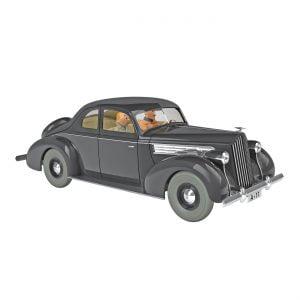
King Muskar’s Packard – Model Car – 29928 – La Packard De Muskar XII – 1/24 Scale
£95.00Tintin New Model Cars 1/24 Scale by Hergé & Editions Moulinsart
The Rally Citroen 2CV – Model Car – 29954 – La 2CV Du Rallye – 1/24 Scale
£125.00Tintin New Model Cars 1/24 Scale by Hergé & Editions Moulinsart
The Blue Jeep – Model Car – 29904 – La Jeep Bleue – 1/24 Scale – First Edition – 2019
£245.00Tintin New Model Cars 1/24 Scale by Hergé & Editions Moulinsart