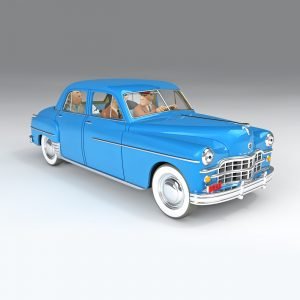
Tintin 1/24 Model Car 29928 – La Packard de Muskar XII – Le Sceptre d’Ottokar
Tintin New Model Cars 1/24 Scale by Hergé & Editions Moulinsart
£100.00
Availability: In stock
Product Description
Tintin 1/24 Model Car 29928 – La Packard de Muskar XII – Le Sceptre d’Ottokar
Author: Hergé & Editions Moulinsart
Manufacturer: Editions Moulinsart / Tintinimaginatio
Format: 1/24 scale model car on display plinth with illustrated diorama and clear acetate case
Condition: Brand new and unopened. The model, display case and explanatory booklet remain in their original presentation packaging.
Description:
From the official Les Voitures de Tintin collection, this substantial 1/24 scale model of La Packard de Muskar XII, reference 29928, recreates the imposing black Packard driven by King Muskar XII in Hergé’s Le Sceptre d’Ottokar (King Ottokar’s Sceptre).
The model depicts King Muskar XII at the wheel with Tintin and Snowy accompanying him, the long black coupé presented on its original display plinth beneath a clear acetate case. A monochrome Syldavian street scene derived from Hergé’s artwork provides the background, creating the effect of a three-dimensional recreation of the original comic-strip sequence.
Produced by Editions Moulinsart as number 28 in the 1/24 scale Tintin vehicle collection, reference 29928, the car is based upon a Packard Super Eight Coupé, one of the prestigious American automobiles associated with the marque during the late 1930s and 1940s.
The Packard has an important narrative role in Le Sceptre d’Ottokar. After Tintin reveals to King Muskar XII that a conspiracy is underway to steal the royal sceptre and overthrow him, the King takes direct action. With Tintin and Snowy aboard, he drives his powerful Packard at speed through the streets of Klow towards Kropow Castle, where the plot is unfolding.
The model captures the distinctive scale and dignity of the car particularly well. Its sweeping rear bodywork, substantial bonnet, enclosed passenger compartment, whitewall tyres and restrained black finish give it the imposing presence appropriate to a royal automobile.
This example is brand new and unopened. The model and accompanying explanatory booklet remain in their original presentation packaging, making this a particularly desirable example for the collector seeking an unused specimen.
Reference: 29928
Scale: 1/24
Model: La Packard de Muskar XII
Album: Le Sceptre d’Ottokar
Vehicle: Packard Super Eight Coupé
Colour: Black
Material: Resin, metal and plastic
Presentation: Display plinth with illustrated diorama and clear acetate case
Packaging: Original grey and white outer box
Documentation: Original illustrated explanatory booklet in French and English
Condition: Brand new and unopened
EAN: 2992800000008
La Packard de Muskar XII: A Brief Account
The black Packard appears at a crucial moment in Le Sceptre d’Ottokar, when Tintin finally succeeds in convincing King Muskar XII of Syldavia that the monarchy is threatened by a carefully organised conspiracy.
Tintin has uncovered a plot to steal the royal sceptre before the annual ceremony of Saint Wladimir. Under Syldavian tradition, the King must appear before his subjects holding the sceptre; failure to do so would require him to abdicate. The conspirators therefore intend to use the theft of this symbolic object as the mechanism for bringing down the monarchy.
Once Tintin explains the danger, Muskar XII abandons ceremony and takes matters into his own hands. The King drives the Packard himself, with Tintin and Snowy accompanying him as they race towards Kropow Castle.
The car consequently becomes part of one of the decisive sequences in the adventure. It carries the characters from the moment of revelation directly towards the confrontation with the conspiracy.
The Moulinsart model reproduces this scene particularly effectively. Muskar XII is shown concentrating at the wheel, while Tintin is visible inside the large passenger compartment. The restrained black finish reinforces the official and royal character of the automobile.
The Packard Super Eight
Packard was one of the great American luxury automobile manufacturers of the first half of the twentieth century.
Founded in the closing years of the nineteenth century, the company established a reputation for exceptionally well-engineered prestige cars. By the inter-war period, Packard had become strongly associated with wealthy private owners, government officials and institutional fleets.
The Super Eight designation was used for some of Packard’s larger and more prestigious eight-cylinder automobiles. These cars combined substantial dimensions with powerful engines, refined interiors and conservative but imposing styling.
Such a vehicle was an entirely appropriate choice for Muskar XII. Hergé required a car that would immediately communicate authority and status without distracting from the action. The Packard’s size and restrained elegance fulfil that function perfectly.
At 1/24 scale, the model gives the design considerable presence. The long bonnet, flowing wings, enclosed rear bodywork, whitewall tyres and chrome detailing can all be appreciated clearly.
Le Sceptre d’Ottokar: A Brief Account
Le Sceptre d’Ottokar is one of the most important Tintin adventures of the late 1930s.
The story introduces Syldavia, the fictional Balkan monarchy which would later play an important role in several Tintin adventures. Tintin becomes involved after discovering suspicious circumstances surrounding Professor Alembick, a sigillographer travelling to Syldavia to study the country’s royal archives.
What begins as a comparatively small mystery develops into a conspiracy against King Muskar XII. The plotters intend to steal the Sceptre of Ottokar, one of the principal symbols of Syldavian kingship, and thereby create a constitutional crisis that will enable neighbouring Borduria to intervene.
The story was conceived against the increasingly unstable political background of Europe in the late 1930s. Hergé constructed a fictional monarchy, language, history, heraldry and political system for Syldavia, giving the country an unusual degree of internal coherence.
The adventure also marks a significant stage in the development of Hergé’s visual storytelling. Architecture, uniforms, vehicles and landscapes are increasingly carefully researched and integrated into the clean narrative language that would become the mature ligne claire style.
King Muskar XII
Muskar XII is one of the most significant fictional rulers in the Tintin series.
He is presented as a constitutional monarch deeply connected with Syldavian national identity and tradition. Although surrounded by ceremony, guards and officials, Muskar XII is not portrayed as a remote figure.
When Tintin explains the conspiracy, the King responds decisively. His willingness to drive his own car at speed towards the castle is a particularly effective piece of characterisation: Hergé transforms him from a ceremonial monarch into an active participant in the adventure.
The Packard contributes substantially to this scene. Its dignity reflects Muskar’s position, while the speed with which he drives it emphasises the urgency of the situation.
Syldavia and Hergé’s Imaginary Europe
Syldavia is one of Hergé’s most fully realised fictional countries.
Rather than simply inventing a name, Hergé created a history, monarchy, language, national costume, heraldry and geography for the state. Its visual character combines influences drawn from various parts of Central and South-Eastern Europe.
The capital, Klow, is depicted as a city where traditional architecture coexists with contemporary automobiles, government institutions and modern communications.
The Packard therefore contributes subtly to Hergé’s construction of this imaginary world. It is a recognisable real-world luxury automobile operating within a fictional European capital, helping Syldavia feel plausible despite never having existed.
This combination of authentic objects and imaginary geography became one of the great strengths of the Tintin universe.
Hergé and the Motor Car
Automobiles occur throughout The Adventures of Tintin and often perform much more than a purely decorative role.
Hergé understood that cars could establish period, social status and geographical location while simultaneously providing movement and narrative momentum.
The Packard is particularly effective because it tells the reader something about its owner before any explanation is required. Its size, restrained finish and prestige identify it immediately as an important official automobile.
The Les Voitures de Tintin collection translates these carefully observed vehicles into three-dimensional form. Rather than presenting generic scale cars, the models recreate specific vehicles, occupants and moments from the albums.
The 1/24 Moulinsart Model
La Packard de Muskar XII was issued as number 28 in the large-format Les Voitures de Tintin collection.
The 1/24 scale is particularly effective for a car of this size and character. The Packard’s long body and substantial passenger compartment give the model considerable visual presence, while the figures of Muskar XII, Tintin and Snowy establish its precise narrative context.
The black bodywork contrasts particularly well with the monochrome Syldavian background, allowing the form of the automobile to remain dominant while retaining the connection with Hergé’s original artwork.
The model was originally supplied with its display plinth, clear presentation case, grey and white outer packaging and illustrated explanatory booklet in French and English.
Why Buy from Us?
At Hornseys, we are committed to offering collectible Tintin models, books and related objects that meet high standards of authenticity, condition and presentation. Every item is handled, inspected and authenticated in-house at our Ripon gallery.
Our Tintin collection is personally curated by Daniel Hornsey, whose interest in Hergé and The Adventures of Tintin extends back to childhood. Individual models are examined for condition, correct accessories, packaging and documentation before being offered for sale.
We wholly own all our stock. Postage is free within the UK, with tracked and insured worldwide shipping available. Every purchase is covered by our 14-day unconditional return guarantee.
Cataloguer: Daniel Hornsey
Daniel Hornsey has specialised in fine and rare books, maps, ephemera, artworks and collectors’ items for over thirty years. Hornseys was established in 1976 and, in its fiftieth year, continues to research and catalogue every item individually from its gallery and bookshop in Ripon, North Yorkshire.
Related products

Tintin 1/24 Model Car 29922 – La Voiture de Mitsuhirato – Le Lotus Bleu
£100.00Tintin New Model Cars 1/24 Scale
The Thompson’s 2CV – Model Car – 29908 – La 2CV Des Dupondt – 1/24 Scale – First Edition – 2019
£225.00Tintin New Model Cars 1/24 Scale by Hergé & Editions Moulinsart


You may also like…
The Sbrodj Dodge Coronet – Model Car – 29945 – La Coronet De Sbrodj – 1/24 Scale
£95.00Tintin New Model Cars 1/24 Scale by Hergé & Editions Moulinsart
The Opel Olimpia – Model Car – 29921 – L’Olympia Des Espions Sylvades – 1/24 Scale
£95.00Tintin New Model Cars 1/24 Scale by Hergé & Editions Moulinsart