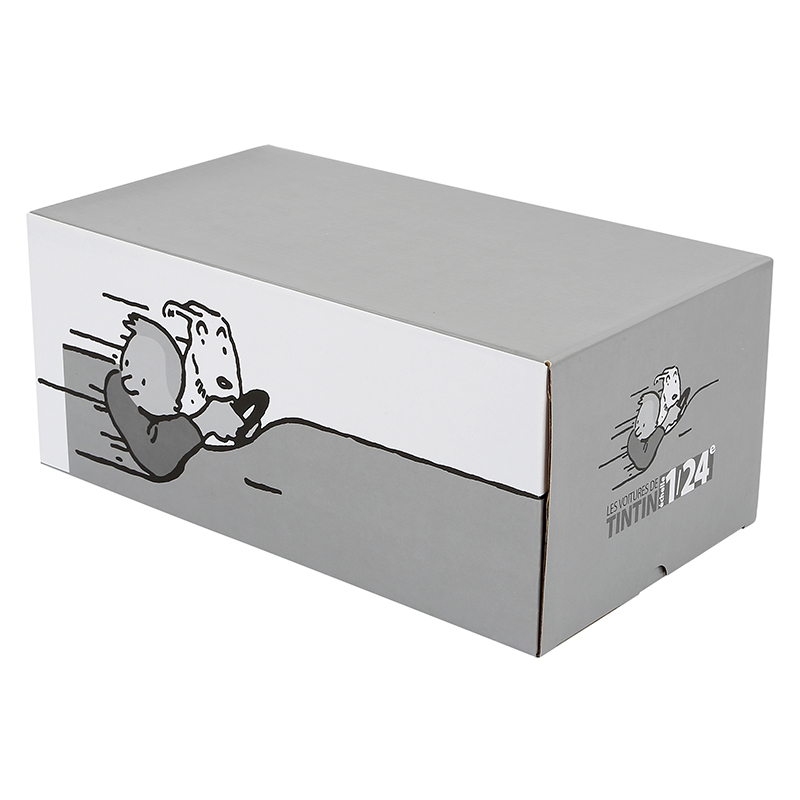
Mr Cutts The Butcher’s Van – Model Car – 29913 – La Camionette Sanzot – 1/24 Scale
Tintin New Model Cars 1/24 Scale by Hergé & Editions Moulinsart
£245.00
Availability: In stock
Product Description
Mr Cutts The Butcher’s Van – Model Car – 29913 – La Camionette Sanzot – 1/24 Scale
Author: Hergé & Editions Moulinsart
Price: £245.00
Manufacturer: Editions Moulinsart
Format: Original pictorial wrappers with car on plinth in perspex case
Condition: New. In excellent condition. Model car and book are both unopened
Description:
Size: 20.5cm x 7cm x 7cm. From ‘The Calculus Affair’. Material: Painted metal with resin and plastic. Comes in a perspex case in an outer box with accompanying brochure in French and English. Brand new. Mint condition. UPC: 29913
Mr Cutts The Butcher: A Brief Account
Mr Cutts the Butcher makes a brief but distinctive appearance in The Calculus Affair (L’Affaire Tournesol), one of the most acclaimed albums in Hergé’s The Adventures of Tintin series. First published in 1956, the story is often regarded as the point at which Hergé’s work reached full artistic and psychological maturity, blending Cold War intrigue with the familiar warmth of Tintin’s domestic world. Within this context, Mr Cutts serves as a minor yet vividly realised character whose presence anchors the early scenes in the comfortable, small-town life surrounding Marlinspike Hall.
Mr Cutts is the local butcher who operates from a well-kept shop and delivers meat to the residents of the area in his van, painted with the proud sign “Mr Cutts – Family Butcher.” His name and occupation, though simple, are emblematic of Hergé’s attention to the fabric of everyday life. The butcher’s van becomes a recognisable detail of the English countryside setting that frames the opening chapter, helping establish the calm, familiar atmosphere soon to be disrupted by the mysterious glass-shattering experiments connected to Professor Calculus.
Visually, Mr Cutts is depicted as a stocky, middle-aged man in a white apron, sleeves rolled up and cap slightly askew—an archetype of the respectable tradesman. His van, faithfully drawn with ligne claire precision, features hanging joints of meat and the meticulous lettering characteristic of mid-20th-century local businesses. In Hergé’s hands, this modest figure becomes part of a subtly observed social landscape: the post-war European village where modernity and tradition coexist, and where the extraordinary can intrude at any moment.
Narratively, Mr Cutts’s role is small but functional. When a window shatters at Marlinspike due to the mysterious sonic vibrations produced by Calculus’s experiments, it is Mr Cutts who experiences a similar phenomenon as he drives past in his van—the glass in his vehicle suddenly shatters. This event, comically but dramatically rendered, marks one of the first public signs that something highly unusual is occurring. Mr Cutts’s alarmed reaction—an ordinary man confronted with inexplicable science—perfectly captures the tension between everyday realism and technological mystery that defines The Calculus Affair.
From a thematic perspective, Mr Cutts embodies the grounded normality of Hergé’s world. His brief appearance contrasts sharply with the espionage, secret police, and scientific weaponry that soon dominate the plot. By including a character like Mr Cutts, Hergé reinforces the story’s moral and emotional balance: the human scale of ordinary life set against the dehumanising machinery of modern power.
The Calculus Affair: A Brief Account
The Calculus Affair (L’Affaire Tournesol), first published in 1956, is widely regarded as one of the finest and most mature instalments in The Adventures of Tintin, written and illustrated by Hergé (Georges Remi). Combining elements of Cold War espionage, scientific ethics, and moral courage, the album reflects a post-war Europe defined by political tension and technological competition. It is both a gripping adventure story and a subtle reflection on humanity’s relationship with power and invention.
The narrative begins in tranquil Marlinspike Hall, where Tintin, Captain Haddock, and Professor Calculus are living peacefully. Their calm is soon shattered by a series of mysterious incidents: glass objects shatter spontaneously, windows explode without cause, and odd vibrations disturb the household. These events prove to be the result of an experimental ultrasonic weapon devised by the unassuming Professor Calculus. When foreign powers learn of his discovery, he becomes the target of a ruthless struggle between rival intelligence agencies—one from Borduria and the other from Syldavia, the two fictional Eastern European nations that had previously appeared in King Ottokar’s Sceptre.
The story unfolds as a taut thriller. Calculus is kidnapped and taken to Borduria, whose authoritarian regime under Marshal Kûrvi-Tasch bears clear satirical resemblance to the totalitarian states of mid-20th-century Europe. Tintin and Haddock, joined intermittently by the ever-bumbling detectives Thomson and Thompson, embark on a dangerous mission to rescue him. Their journey leads through Switzerland and across Eastern Europe, blending espionage intrigue with moments of comic absurdity and intense human drama.
From a narrative standpoint, The Calculus Affair demonstrates Hergé’s mastery of pacing and realism. Every clue, chase, and setback contributes organically to the unfolding plot. The tone is sharper and more adult than earlier adventures; the villains are no longer comic criminals but agents of state power, operating within a recognisably modern political framework. Tintin’s world, though still stylised, feels anchored in real-world geopolitics—reflecting the anxieties of the Cold War era.
Visually, the album exemplifies the ligne claire style at its peak. Hergé’s draughtsmanship is clear and economical, yet rich in architectural and mechanical detail. The depictions of Geneva, Nyon, and Bordurian cities are based on careful research and photographs, while vehicles such as the Citroën Traction Avant and the SNCF trains are drawn with technical precision. Every frame is composed with cinematic clarity, contributing to the sense of realism that defines the work.
Characterisation also reaches new depth. Tintin is no longer simply the intrepid boy reporter; he emerges as a morally grounded young man, brave, rational, and deeply loyal. Captain Haddock provides warmth and humanity, his bluster masking real courage and compassion. Calculus, meanwhile, is portrayed with poignant complexity—his genius both a gift and a burden. His deafness, often used for comic effect, takes on new meaning in this story, symbolising both his innocence and his isolation from the consequences of his invention.
Thematically, The Calculus Affair explores the moral responsibility of science. Calculus’s weapon, capable of mass destruction, mirrors the nuclear anxieties of the 1950s. Yet Hergé handles the theme without didacticism, allowing the story to function equally as a thrilling adventure and a moral fable. The Bordurian regime’s obsession with technological supremacy serves as a warning about the dangers of political exploitation of scientific discovery.
Moments of humour—such as the recurring destruction of glass, the antics of Thomson and Thompson, and Haddock’s explosive temper—temper the story’s intensity without diminishing its seriousness. The balance of tension and levity is masterful, sustaining engagement while deepening emotional resonance.
By its conclusion, with Calculus safely returned and his plans for the weapon destroyed, The Calculus Affair reaffirms the values that define Tintin’s universe: integrity, friendship, and the triumph of reason over tyranny.
Critics and readers alike continue to regard The Calculus Affair as one of Hergé’s most accomplished works. Its blend of realism, moral depth, and visual precision captures the essence of modern Tintin—no longer a simple adventurer, but a witness to the complexities of a divided world. The album stands today as both an enduring classic of European storytelling and a subtle meditation on the responsibilities that come with knowledge and power.
Why Buy from Us?
At Hornseys, we are committed to offering items that meet the highest standards of quality and authenticity. Our collection of objects and rare books are carefully curated to ensure each edition is a valuable piece of bibliographical history. Here’s what sets us apart:
- Authenticity and Provenance: Each item is meticulously researched and verified for authenticity and collation.
- Expert Curation: Our selection process focuses on significance, condition, and rarity, resulting in a collection that is both diverse and distinguished.
- Customer Satisfaction: We aim to provide an exceptional customer experience, from detailed descriptions to secure and prompt delivery of your purchase.
- Returns Policy: We offer an unconditional guarantee on every item. If you wish to return an item, it may be sent back to us within fourteen days of receipt. Please notify us in advance if you wish to do so. The item must be returned in the same condition as it was sent for a full refund.
Cataloguer: Daniel Hornsey
Daniel Hornsey has specialised in fine and rare books, ephemera, and collectors’ editions for over thirty years. As a long-standing member of the antiquarian book trade, he has advised private collectors, curated catalogues, and sourced works for leading dealers, libraries and institutions across the world.
Hornseys’ exhibit regularly at book and map fairs in London and throughout the UK and are members of the Provincial Booksellers Fairs Association, the PBFA.
His fascination with Hergé’s work — especially ‘The Adventures of Tintin’ — began in childhood. Daniel recalls reading Tintin in original European editions and quickly recognising that these were not merely children’s books, but finely illustrated narratives crafted with artistic depth and wit.
As noted by the Musée Hergé in Louvain-la-Neuve, Hergé’s ‘ligne claire’ style has influenced generations of European comic artists and his original drawings and paintings command very high prices with his painting of ‘The Blue Lotus’ jar fetching £2.8m at auction in 2021.
By presenting these works through Hornseys’, he hopes to contribute to the continued appreciation of one of the 20th century’s most influential illustrators, helping new generations discover the artistry and legacy of Hergé.
Related products

The Ford Model T – Model Car – 29905 – La Ford T – 1/24 Scale – Second Edition
£95.00Tintin New Model Cars 1/24 Scale by Hergé & Editions Moulinsart
The Blue Jeep – Model Car – 29904 – La Jeep Bleue – 1/24 Scale – First Edition – 2019
£245.00Tintin New Model Cars 1/24 Scale by Hergé & Editions Moulinsart


You may also like…
King Muskar’s Packard – Model Car – 29928 – La Packard De Muskar XII – 1/24 Scale
£100.00Tintin New Model Cars 1/24 Scale by Hergé & Editions Moulinsart