
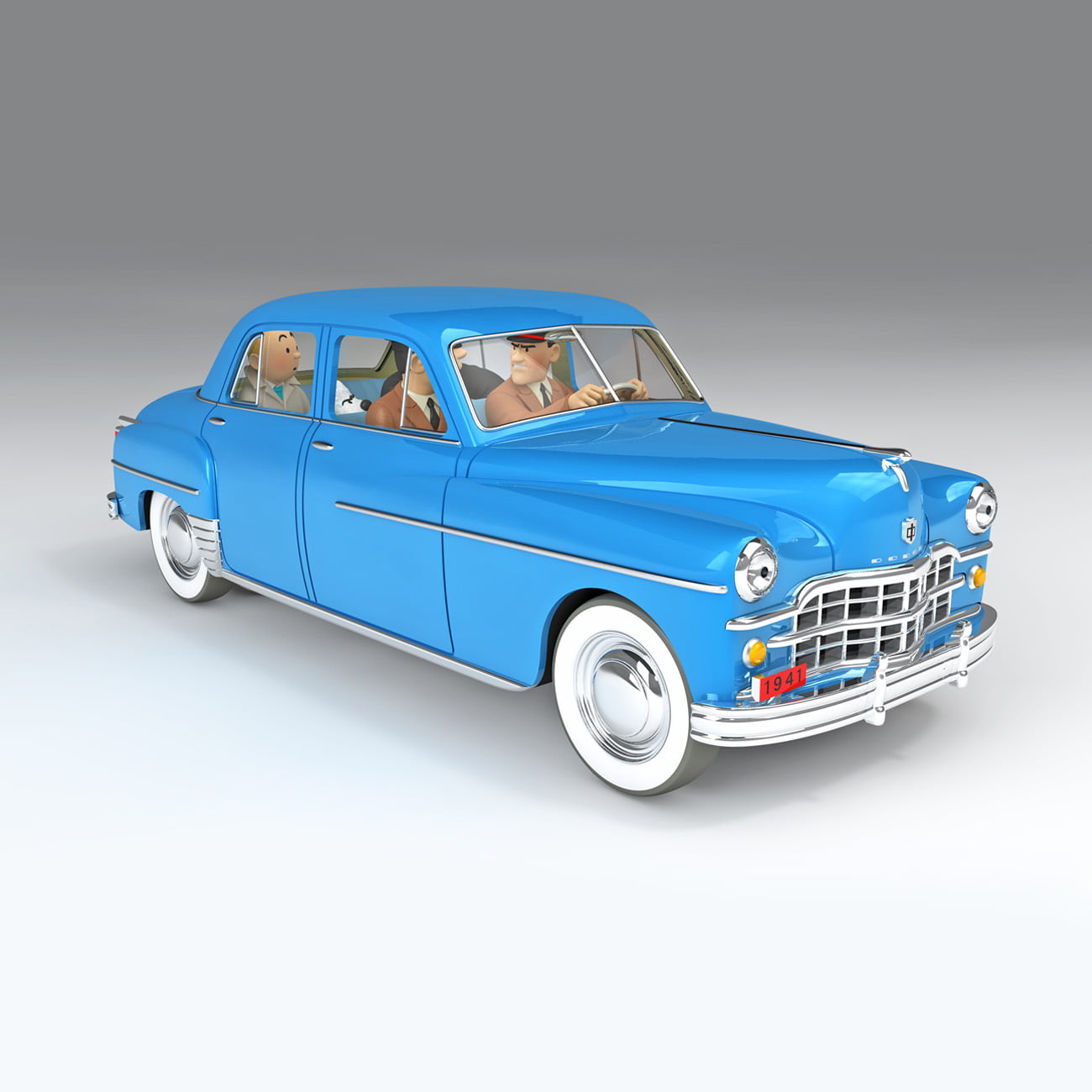

The Sbrodj Dodge Coronet – Model Car – 29945 – La Coronet De Sbrodj – 1/24 Scale
Tintin New Model Cars 1/24 Scale by Hergé & Editions Moulinsart
£95.00
Availability: In stock
Product Description
The Sbrodj Dodge Coronet – Model Car – 29945 – La Coronet De Sbrodj – 1/24 Scale
Author: Hergé & Editions Moulinsart
Price: £95.00
Manufacturer: Editions Moulinsart
Format: Original pictorial wrappers with car on plinth in perspex case
Condition: New. In excellent condition. Model car and book are both unopened
Description:
Size: 20.5cm x 7cm x 7cm. From ‘The Calculus Affair’. Material: Painted metal with resin and plastic. Comes in a perspex case in an outer box with accompanying brochure in French and English. Brand new. Mint condition. UPC: 29945
The Dodge Coronet: A Brief Account
The Dodge Coronet is a classic American automobile that encapsulates the spirit of post-war motoring—powerful, confident, and stylistically bold. Produced by the Dodge division of Chrysler Corporation, the Coronet nameplate was first introduced in 1949 and continued intermittently until 1976, spanning several distinct eras of American automotive design. Over that period, it evolved from a modest full-size sedan into one of the defining mid-sized muscle cars of the 1960s.
The first-generation Dodge Coronet (1949–1952) emerged at a pivotal time in American industry. It was the company’s first all-new post-war design, replacing pre-war models and introducing smoother, more modern styling. The car featured a solid steel body with flowing fenders integrated into the main bodywork—a departure from the separate-wing design of the 1940s. Under the bonnet sat a 230-cubic-inch flathead straight-six engine, producing around 103 horsepower, mated to a three-speed manual gearbox with optional Fluid Drive semi-automatic transmission. It was durable, unpretentious, and aimed squarely at the growing middle-class market.
By the mid-1950s, the Coronet had become one of Dodge’s key full-size offerings. The 1955 redesign, influenced by the so-called “Forward Look” styling of Chrysler’s chief designer Virgil Exner, introduced tailfins, wraparound windscreens, and a lower, sleeker stance. Engine options expanded to include the powerful 241-cubic-inch Red Ram Hemi V8, marking the Coronet’s transition from a practical family car to a performance-oriented saloon. The combination of futuristic styling and V8 power captured the optimism of 1950s America—an era of economic expansion and technological ambition.
The 1960s brought a complete reimagining of the Coronet. Reintroduced in 1965 as a mid-size car, it quickly became a favourite platform for Dodge’s high-performance models. The 1966–1970 Coronet series included some of the most iconic muscle cars of the era, equipped with formidable engines such as the 426 Hemi V8 and 440 Magnum. These cars could produce upwards of 425 horsepower, with quarter-mile times that rivalled many dedicated sports cars. Distinctive design cues—aggressive front grilles, sculpted flanks, and bold use of chrome—combined with their muscular stance to make the Coronet synonymous with American power and self-assurance.
The Coronet’s versatility was part of its success. While high-performance variants like the Coronet R/T (Road/Track) and Super Bee catered to enthusiasts, more restrained versions—such as the Coronet 440 and Coronet Deluxe—remained popular family cars, offering comfort, reliability, and understated style. Interiors were typically finished in durable vinyl with full instrumentation, large steering wheels, and generous seating for five or six passengers.
Mechanically, the Coronet reflected Chrysler’s engineering strength. Features such as torsion-bar front suspension, rear leaf springs, and power-assisted brakes and steering gave it both comfort and stability. The drivetrain options included robust TorqueFlite automatic transmissions, ensuring the effortless, high-torque driving experience characteristic of American cars of the period.
By the 1970s, however, tightening emissions regulations and changing consumer tastes began to erode the muscle car market. The Coronet line gradually shifted towards practicality, eventually being phased out in favour of the Dodge Aspen and other compact models. Its final iterations, produced through 1976, were primarily full-size family sedans and station wagons, far removed from the high-performance image of a decade earlier.
Culturally, the Dodge Coronet holds a special place in American motoring heritage. It embodies the evolution of the car as both a tool and a symbol—from dependable post-war transport to high-performance expression of individual freedom. Its presence in films, advertising, and popular culture reinforces its status as a quintessential American automobile.
Today, the Coronet—particularly the late-1960s muscle variants—is highly prized by collectors and restorers. Its blend of muscular styling, mechanical robustness, and historical significance ensures its continued admiration. Whether viewed as a symbol of mid-century optimism or as an artefact of automotive engineering excellence, the Dodge Coronet remains a compelling representation of America’s golden age of motoring: bold, confident, and unmistakably powerful.
Destination Moon: A Brief Account
Destination Moon (Objectif Lune), first published in 1953, marks a decisive moment in The Adventures of Tintin series and in the history of European comics. Written and illustrated by Hergé (Georges Remi), it represents the point at which Tintin’s adventures entered the realm of science fiction—yet with a level of technical realism, research, and narrative sophistication that set new standards for the genre. The album, and its sequel Explorers on the Moon (On a marché sur la Lune, 1954), together form a meticulously imagined account of humankind’s journey to the Moon—produced more than fifteen years before the Apollo missions.
The story begins at Marlinspike Hall, where Professor Calculus reveals his latest and most ambitious project: the construction of a nuclear-powered rocket capable of reaching the Moon. To carry out this enterprise, he has been invited to the fictional European state of Syldavia, whose remote mountainous landscape provides the ideal location for a high-security research facility. Tintin, Captain Haddock, and Snowy accompany Calculus to Syldavia, where they soon find themselves drawn into a complex mixture of scientific endeavour, espionage, and moral questioning.
From a scientific standpoint, Destination Moon is remarkable for its technical authenticity. Hergé worked closely with experts in physics and aeronautics, most notably the Swiss engineer Alexis L. de Pommereul, to ensure that the rocket’s design and the associated infrastructure were credible. The resulting imagery—launch pads, control rooms, laboratories, and astronaut training equipment—anticipates real-world developments in space technology. The rocket itself, instantly recognisable by its red-and-white chequered livery, has since become an icon of 20th-century popular culture, symbolising optimism, precision, and the human drive for exploration.
Thematically, the story explores the intersection of science, ethics, and human ambition. Professor Calculus embodies the visionary scientist—brilliant yet innocent, devoted to knowledge rather than power. His invention of a nuclear propulsion system raises questions about technology’s moral responsibilities, a theme consistent with the anxieties of the early atomic age. Tintin, as ever, serves as the voice of conscience and reason, while Captain Haddock provides humour, humanity, and a counterweight to scientific abstraction.
Narratively, Destination Moon departs from the globe-trotting adventures of earlier Tintin albums. Much of the story unfolds in the confines of the Syldavian research centre, focusing on preparation, construction, and testing rather than action or travel. Yet Hergé sustains tension through espionage subplots—foreign agents attempt to infiltrate the project—and through the psychological strain of human endeavour at the limits of knowledge. The realism of the environment, combined with moments of slapstick and friendship, gives the story both intellectual weight and emotional warmth.
Artistically, the album demonstrates Hergé’s ligne claire style at its most refined. Every line is purposeful; every panel contributes to the sense of order and precision that mirrors the scientific subject matter. The visual language of modern technology—control panels, steel gantries, laboratory glassware, and mechanical apparatus—is rendered with architectural accuracy and almost cinematic clarity. Hergé’s use of perspective and scale, particularly in the scenes depicting the rocket’s assembly and testing, conveys the awe-inspiring magnitude of the enterprise.
Historically, Destination Moon must be understood within the post-war context of scientific optimism. The 1950s were an era in which nuclear energy and space exploration represented both hope and fear: the promise of progress alongside the shadow of destruction. Hergé captures this ambivalence with remarkable subtlety. His vision of space travel is not triumphalist but thoughtful—a celebration of human curiosity tempered by awareness of its potential consequences.
In cultural terms, the album’s influence has been profound. It introduced generations of readers to the idea of space travel as a serious scientific pursuit rather than mere fantasy. When the first astronauts landed on the Moon in 1969, many observers noted the uncanny similarities between NASA’s technology and Hergé’s earlier depictions—from spacesuits and airlocks to the modular layout of the lunar rocket.
Destination Moon also serves as a moral and philosophical turning point in Tintin’s world. It affirms Hergé’s belief in rational inquiry, international cooperation, and ethical responsibility—values that transcend politics and ideology. The story’s focus on teamwork, intelligence, and integrity makes it as relevant today as it was in the early years of the space race.
In sum, Destination Moon stands as one of Hergé’s great masterpieces: a synthesis of art, science, and storytelling that anticipated real history with visionary clarity. It is both a thrilling adventure and a meditation on human progress—a work that continues to inspire admiration for its imagination, precision, and profound faith in humanity’s pursuit of knowledge.
Why Buy from Us?
At Hornseys, we are committed to offering items that meet the highest standards of quality and authenticity. Our collection of objects and rare books are carefully curated to ensure each edition is a valuable piece of bibliographical history. Here’s what sets us apart:
- Authenticity and Provenance: Each item is meticulously researched and verified for authenticity and collation.
- Expert Curation: Our selection process focuses on significance, condition, and rarity, resulting in a collection that is both diverse and distinguished.
- Customer Satisfaction: We aim to provide an exceptional customer experience, from detailed descriptions to secure and prompt delivery of your purchase.
- Returns Policy: We offer an unconditional guarantee on every item. If you wish to return an item, it may be sent back to us within fourteen days of receipt. Please notify us in advance if you wish to do so. The item must be returned in the same condition as it was sent for a full refund.
Cataloguer: Daniel Hornsey
Daniel Hornsey has specialised in fine and rare books, ephemera, and collectors’ editions for over thirty years. As a long-standing member of the antiquarian book trade, he has advised private collectors, curated catalogues, and sourced works for leading dealers, libraries and institutions across the world.
Hornseys’ exhibit regularly at book and map fairs in London and throughout the UK and are members of the Provincial Booksellers Fairs Association, the PBFA.
His fascination with Hergé’s work — especially ‘The Adventures of Tintin’ — began in childhood. Daniel recalls reading Tintin in original European editions and quickly recognising that these were not merely children’s books, but finely illustrated narratives crafted with artistic depth and wit.
As noted by the Musée Hergé in Louvain-la-Neuve, Hergé’s ‘ligne claire’ style has influenced generations of European comic artists and his original drawings and paintings command very high prices with his painting of ‘The Blue Lotus’ jar fetching £2.8m at auction in 2021.
By presenting these works through Hornseys’, he hopes to contribute to the continued appreciation of one of the 20th century’s most influential illustrators, helping new generations discover the artistry and legacy of Hergé.
Related products

The Land Rover Of Trenxcoatl – The Off-Road Vehicle For Trenxcoatl – Model Car – 29957 – Le Tout-Terrain Pour Trenxcoatl – 1/24 Scale – First Edition
£195.00Tintin New Model Cars 1/24 Scale by Hergé & Editions Moulinsart


