


The Adventures Of Tintin – Tintin In America – First Edition
Hergé
£145.00
Availability: In stock
Product Description
The Adventures Of Tintin – Tintin In America – First Edition
Author: Hergé
Price: £145
Publisher: Methuen, London, UK
Publication Date: 1978
Format: Original pictorial boards.
Condition: Very good
Edition: First edition
Size: 23.2cm x 30.7cm
Pages: 62
Illustrations: Illustrated throughout by the author
Condition:
Published by Methuen, London, UK, 1978. 1st UK edition. Original pictorial boards. Pictorial endpapers. Size: 23.2cm x 30.7cm. Pp. 62. Illustrated throughout in colour by the author. Slight foxing to the text block and occasional foxing to the text. Spine very slightly faded. A very good copy.
Tintin In America: A Brief Summary
Tintin in America, first published in 1932, is the third volume in The Adventures of Tintin series by the Belgian cartoonist Hergé. It follows the intrepid young reporter Tintin and his faithful fox terrier, Snowy, as they travel to the United States to uncover crime and corruption in Chicago during the height of the gangster era.
Upon arriving in the city, Tintin quickly becomes embroiled in a confrontation with Al Capone—based on the real-life mobster—who is attempting to expand his criminal empire. After being captured by Capone’s henchmen, Tintin narrowly escapes and exposes the gangster’s operations. However, his success makes him a target for rival mobsters.
Tintin’s investigation leads him deep into Chicago’s underworld, where he faces ambushes, assassination attempts, and a host of traps set by gang leaders such as Bobby Smiles. Smiles, one of Capone’s competitors, becomes Tintin’s principal adversary. In pursuit of him, Tintin ventures beyond the city into the American Midwest.
Outside Chicago, Tintin encounters Native Americans, a sequence that reflects the colonial attitudes and stereotypes of the early 20th century. Hergé’s portrayal—typical of European perspectives of the time—depicts Tintin being captured by a tribe misled by Smiles into believing that the young reporter is their enemy. Tintin eventually clears his name and continues his pursuit of the gangster.
His adventures take a series of increasingly absurd turns: he rescues Snowy from kidnappers, survives numerous murder attempts, and inadvertently becomes a national hero after capturing a criminal gang. The story concludes with Tintin returning to Chicago, where he ensures that the city’s criminal networks are dismantled. The final panels show him being celebrated as a hero, his mission of bringing justice to America complete.
Analysis
Hergé’s Tintin in America represents a formative stage in his artistic and narrative development. While it retains the fast-paced humour and energetic adventure typical of the early Tintin albums, it also reveals the limitations of Hergé’s knowledge of the world beyond Europe at the time of writing. His America is a caricature—a collage of popular images drawn from Hollywood films, pulp magazines, and newspaper headlines.
The story’s chief theme is the clash between innocence and corruption. Tintin embodies moral clarity and courage; his European rationality contrasts sharply with the greed and lawlessness of Prohibition-era America. Through Tintin’s encounters with Chicago’s gangsters, Hergé creates a satirical portrait of a society consumed by capitalism, crime, and spectacle. The depiction of Chicago as a city in thrall to organised crime mirrors contemporary European anxieties about American modernity and moral decay.
Another layer of analysis lies in the colonial undertone of Tintin’s interactions with Native Americans. These scenes, though problematic by today’s standards, are historically important for understanding the evolution of Hergé’s worldview. Later in his career, after extensive research and personal growth, Hergé would adopt a more empathetic and nuanced approach to cultural representation, as seen in The Blue Lotus (1936).
From an artistic standpoint, Tintin in America marks a clear step forward in Hergé’s mastery of the ligne claire (“clear line”) style that would become synonymous with his work. The compositions are crisp, the pacing brisk, and the humour visual rather than verbal. The American setting allowed Hergé to experiment with scale—skyscrapers, cars, oil fields—and to refine his visual storytelling through dynamic action sequences.
Despite its dated racial and cultural stereotypes, Tintin in America remains a key work for understanding Hergé’s early ambition and the global expansion of The Adventures of Tintin. It reflects both the allure and the critique of modern America as perceived from interwar Europe: a land of opportunity, excess, and contradiction.
Conclusion
Tintin in America endures as a vivid example of early 20th-century European adventure fiction. Its combination of satire, action, and moral clarity established many of the narrative and visual conventions that would define Hergé’s later, more sophisticated works. When read today, it offers insight not only into Tintin’s evolution as a character but also into Hergé’s developing artistry and the cultural context from which his stories emerged.
Why buy from us?
At Hornseys, we are dedicated to offering items that uphold the highest standards of quality and authenticity. Our book collection is carefully curated to ensure that each edition is a valuable and authentic piece of bibliographical history. Here’s what sets us apart:
- Authenticity and Provenance: Every book is researched, collated and verified for authenticity.
- Expert Curation: Each book is selected using our keen eye for significance, condition, and rarity, ensuring a collection that is both diverse and distinguished.
- Customer Satisfaction: We strive to provide an exceptional customer experience, from detailed descriptions and provenance to secure and prompt delivery of your purchase.
- Returns Policy: We offer an unconditional guarantee on every item. If, however, you wish to make a return, books may be sent back to us within fourteen days of receipt for whatever reason. We request that we are notified in advance if you wish to do so. They must be returned to us in the same condition as they were sent for a full refund.
Related products

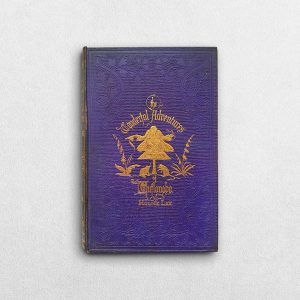
The Wonderful Adventures Of Tuflongbo And His Elfin Company: John Leighton Binding
£175.00Lee, Holme pseudonym of Parr, Harriet
The Gruffalo & The Gruffalo’s Child: First Deluxe Miniature Editions Both Signed By Julia Donaldson & Axel Scheffler
£495.00Donaldson, Julia & Scheffler, Axel
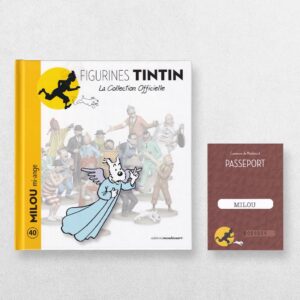
Snowy The Half-Angel – Figurines Tintin La Collection Officielle – 40 – Milou Mi-Ange
£65.00Hergé & Editions Moulinsart


You may also like…
Calculus The Gardener – Figurines Tintin La Collection Officielle – 28 – Tournesol En Jardinier
£35.00Hergé & Editions Moulinsart
Baxter The Director of The Base – Figurines Tintin La Collection Officielle – 26 – Baxter Le Directeur De La Base
£35.00Hergé & Editions Moulinsart
Calculus With The Ear Trumpet – Figurines Tintin La Collection Officielle – 17 – Tournesol Au Cornet
£40.00Hergé & Editions Moulinsart


