

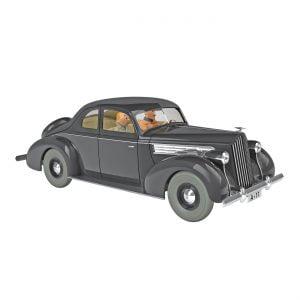
The Chicago Taxi – 7 – Le Taxi De Chicago
Tintin New Model Cars 1/24 Scale
£125.00
Availability: In stock
Product Description
The Chicago Taxi – 7 – Le Taxi De Chicago
Author: Hergé & Editions Moulinsart
Price: £125.00
Publisher: Editions Moulinsart
Publication date: 2019
Format: Original pictorial wrappers with car on plinth
Condition: In excellent condition. Model car is unopened
Illustrations: Illustrated throughout
Description:
Original pictorial wrappers. Text in French. Includes the accompanying car. One from the collection of 71 books and models. In excellent condition. Model car is unopened.
Tintin And The Chicago Taxi: A Brief Account
Introduction
The Chicago taxi makes a memorable appearance in Tintin in America (1932), one of the earliest Tintin adventures and the first to place Hergé’s young reporter squarely within the United States. Although Hergé had never visited America at the time, his depiction of Chicago was ambitious, merging journalistic curiosity with cinematic imagination. The taxi is one of the key visual anchors in this urban setting, introducing Tintin — and European readers — to a modern, bustling, automobile-dominated metropolis.
Context and Significance
During the early 1930s, the taxi symbolised mobility, opportunity and modernity, particularly in cities such as New York and Chicago. American taxi cabs, frequently seen in newspapers and Hollywood films, had already become cultural icons. Hergé adopted this imagery, not only to lend authenticity to his depiction of the United States, but also to emphasise Tintin’s immersion in a fast-paced, industrial society shaped by capitalism and crime.
The Chicago taxi embodies that duality: a symbol of civic modernity and yet a tool frequently commandeered by the criminal underworld that Tintin confronts.
The Taxi in the Narrative
Upon arrival in Chicago, Tintin steps into a taxi believing it will take him to a hotel. Instead, he enters a trap set by mobsters linked to Al Capone’s empire — a recurring threat throughout the story. The taxi becomes a narrative device illustrating the perilous nature of the city, where infrastructure appears orderly but danger lurks within ordinary institutions.
Hergé cleverly subverts audience expectations: what should be a mundane, everyday moment becomes the beginning of a kidnapping attempt, signalling the lawlessness and corruption the hero will face.
Artistic Depiction
Hergé’s illustration of the taxi reflects contemporary American automotive design:
- A boxy yet streamlined body
- Prominent grille and headlights
- A checker-pattern motif — widely associated with urban taxis of the period
- A robust, industrial-era look, consistent with photographic references of late-1920s Chicago cabs
Although simplified by the constraints of early ligne claire style, the vehicle’s form captures the essence of American city transport during the Prohibition era.
Themes and Interpretation
Modernity and Mechanisation
The taxi symbolises the machine age — the dominance of automobiles, the metropolis as a technological marvel, and a society built on speed and service.
Urban Danger
Hergé uses the taxi to show how modern conveniences may be exploited by criminal elements. In Tintin in America, organised crime penetrates everyday life, reflecting contemporary European anxieties about American gangsterism.
Culture and Imagination
The scene is a testament to Hergé’s ability to transform journalistic research and popular culture into compelling storytelling. His Chicago is not merely drawn; it is imagined through European eyes, blending factual detail with cinematic atmosphere.
Place in Tintin’s Development
The Chicago taxi moment marks a decisive step in Tintin’s evolution as a character. From this point onward, he operates not only in exotic lands but also within the complexity of the modern industrial world. The scene also foreshadows Hergé’s lifelong commitment to realistic vehicles, which would later include carefully rendered Citroëns, Jeeps, Lockheed aircraft and other recognisable machines.
Legacy
While brief, the appearance of the Chicago taxi is iconic among Tintin enthusiasts. It highlights Hergé’s early instinct for:
- Cultural observation
- Visual authenticity
- Urban atmosphere
- Storytelling driven by everyday objects carrying symbolic weight
The taxi represents Tintin’s entry into a dangerous, mechanised America — a land of opportunity and threat, glamour and corruption, modern marvels and moral uncertainty.
Why Buy from Us?
At Hornseys, we are committed to offering items that meet the highest standards of quality and authenticity. Our collection of objects and rare books are carefully curated to ensure each edition is a valuable piece of bibliographical history. Here’s what sets us apart:
- Authenticity and Provenance: Each item is meticulously researched and verified for authenticity and collation.
- Expert Curation: Our selection process focuses on significance, condition, and rarity, resulting in a collection that is both diverse and distinguished.
- Customer Satisfaction: We aim to provide an exceptional customer experience, from detailed descriptions to secure and prompt delivery of your purchase.
- Returns Policy: We offer an unconditional guarantee on every item. If you wish to return an item, it may be sent back to us within fourteen days of receipt. Please notify us in advance if you wish to do so. The item must be returned in the same condition as it was sent for a full refund.
Cataloguer: Daniel Hornsey
Daniel Hornsey has specialised in fine and rare books, ephemera, and collectors’ editions for over thirty years. As a long-standing member of the antiquarian book trade, he has advised private collectors, curated catalogues, and sourced works for leading dealers, libraries and institutions across the world.
Hornseys’ exhibit regularly at book and map fairs in London and throughout the UK and are members of the Provincial Booksellers Fairs Association, the PBFA.
His fascination with Hergé’s work — especially ‘The Adventures of Tintin’ — began in childhood. Daniel recalls reading Tintin in original European editions and quickly recognising that these were not merely children’s books, but finely illustrated narratives crafted with artistic depth and wit.
As noted by the Musée Hergé in Louvain-la-Neuve, Hergé’s ‘ligne claire’ style has influenced generations of European comic artists and his original drawings and paintings command very high prices with his painting of ‘The Blue Lotus’ jar fetching £2.8m at auction in 2021.
By presenting these works through Hornseys’, he hopes to contribute to the continued appreciation of one of the 20th century’s most influential illustrators, helping new generations discover the artistry and legacy of Hergé.
Related products

King Muskar’s Packard – Model Car – 29928 – La Packard De Muskar XII – 1/24 Scale
£95.00Tintin New Model Cars 1/24 Scale by Hergé & Editions Moulinsart


You may also like…
The Lincoln Zephyr Model Car – 2 – Le Décapotable De Haddock
£125.00Tintin New Model Cars 1/24 Scale


