

Sir Edmund Hillary and Tenzing Norgay After the First Ascent of Mount Everest, 1953 – Rare Original Reuters Press Photograph – Thyangboche Monastery – Shields Gazette Archive
Hillary, Sir Edmund & Norgay, Tenzing
£2,500.00
Availability: In stock
Product Description
Sir Edmund Hillary and Tenzing Norgay After the First Ascent of Mount Everest, 1953 – Rare Original Reuters Press Photograph – Thyangboche Monastery – Shields Gazette Archive
THE CONQUEST OF MOUNT EVEREST, 1953: SIR EDMUND HILLARY AND TENZING NORGAY – THE FIRST CONFIRMED CLIMBERS TO REACH THE SUMMIT – ORIGINAL GELATIN SILVER PRESS PHOTOGRAPH, DATED 20 JUNE 1953.
Publisher: P. A. Reuter Ltd., London, England.
Date: 20 June 1953 (press photograph date).
Photograph Size: 13 × 20.5 cm.
Process: Original black-and-white gelatin silver press photograph.
Edition: Original contemporary press photograph, not a modern reproduction.
Provenance: Shields Gazette photographic archive, South Shields, County Durham, England.
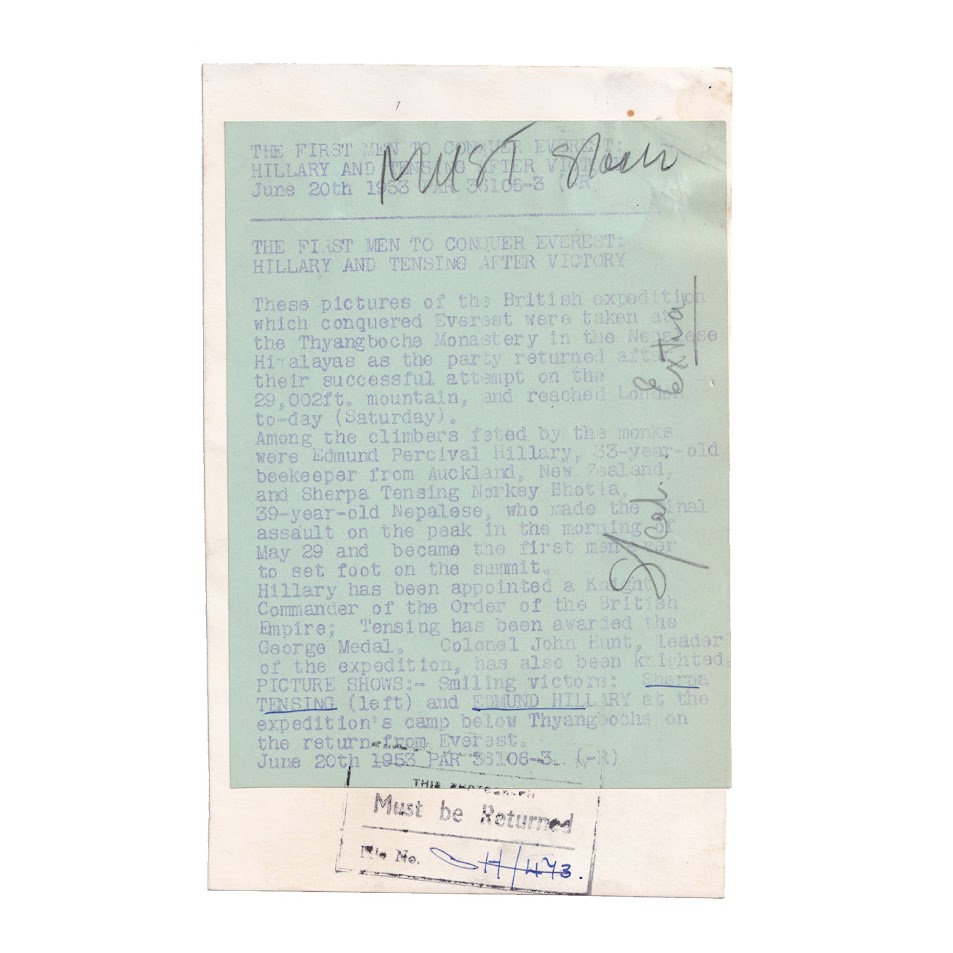
Special Features: Original press photograph bearing contemporary copyright and editorial information on the reverse, including a description identifying the two mountaineers as the ‘Smiling victors’. Associated with the victorious 1953 British Mount Everest Expedition and photographed at Thyangboche Monastery in the Nepalese Himalayas.
Stock Reference: 002303.
Description
An exceptionally desirable original press photograph depicting Sir Edmund Hillary (1919–2008) and Tenzing Norgay (c.1914–1986) together following their historic first confirmed ascent of Mount Everest on 29 May 1953. The photograph was issued by P. A. Reuter Ltd., London, and bears the date 20 June 1953. It depicts the two celebrated mountaineers at Thyangboche Monastery, also known as Tengboche Monastery, in the Khumbu region of Nepal, following their successful return from the mountain.
The original accompanying press description refers to the men as the ‘Smiling victors’, a wonderfully evocative phrase capturing the international excitement surrounding their achievement. This is an original photographic artefact from the immediate aftermath of one of the defining events in twentieth-century exploration, rather than a later reproduction of a famous image.
The photograph derives from the photographic archive of the Shields Gazette, the historic newspaper published in South Shields in north-east England. Its surviving agency copyright and editorial markings provide valuable evidence of its original function within the contemporary newspaper industry.
Original contemporary photographs of Hillary and Tenzing are particularly desirable to collectors of mountaineering history, Himalayan exploration, twentieth-century photography and historically important press imagery.
Historical Significance: The First Ascent of Mount Everest, 29 May 1953
On 29 May 1953, Edmund Hillary of New Zealand and Tenzing Norgay, the celebrated Sherpa mountaineer, became the first climbers confirmed to have reached the summit of Mount Everest. Their achievement represented the culmination of decades of extraordinary effort by British, Swiss and international expeditions attempting to reach the world’s highest point.
Mount Everest, known as Sagarmatha in Nepal and Chomolungma in Tibetan and Sherpa traditions, rises to approximately 8,849 metres above sea level, according to the modern measurement agreed by Nepal and China in 2020. The successful expedition was led by Colonel John Hunt and depended upon an extensive organisation of climbers, Sherpas, porters and support personnel. Its success was not simply the achievement of two individuals but the result of considerable planning, technical expertise, endurance and cooperation. Tenzing Norgay had already acquired outstanding experience at extreme altitude. During the Swiss expedition of 1952, he and Raymond Lambert had reached approximately 8,600 metres, establishing themselves among the most accomplished high-altitude climbers of their generation.
The British expedition of 1953 made its final assault upon Everest by way of the South Col and south-east ridge. An initial summit attempt by Tom Bourdillon and Charles Evans on 26 May reached the South Summit before problems with their oxygen equipment obliged them to turn back.
Three days later, Hillary and Tenzing made their successful attempt. The final ascent included the formidable rock obstacle subsequently known as the Hillary Step. Working together, the two climbers overcame the remaining difficulties and reached the summit at approximately 11.30 a.m. They remained at the summit for around fifteen minutes, taking photographs and leaving small offerings before beginning their descent.
Their extraordinary achievement was announced publicly on 2 June 1953, the day of Queen Elizabeth II’s coronation, creating a remarkable conjunction of events in British public life. News of the ascent spread around the world, making Hillary and Tenzing international celebrities. The present photograph belongs to the remarkable period immediately following their triumph, when the two men became enduring symbols of exploration, perseverance and cooperation.
Thyangboche Monastery: The Location of the Photograph
The photograph was taken at Thyangboche Monastery, more commonly rendered today as Tengboche Monastery, in the Khumbu region of north-eastern Nepal.
Situated at an altitude of approximately 3,867 metres, Tengboche is one of the most important Buddhist monasteries in the Everest region. The monastery occupies a prominent position amid the mountains of the Khumbu, with views towards Everest, Lhotse and Ama Dablam.
Its religious and cultural significance makes it an especially appropriate setting for a photograph of Tenzing Norgay, whose relationship with the Himalayas was deeply influenced by the spiritual traditions of the region. The location adds another dimension to the photograph. Rather than portraying the summit itself, it documents the mountaineers’ return to the inhabited Himalayan world following their extraordinary achievement.
An Original 1953 Reuters Press Photograph
The photograph was issued by P. A. Reuter Ltd., the London-based news agency associated with Reuters, one of the most important international news organisations of the twentieth century.
During the 1950s, news photography was distributed to newspapers and picture editors through agencies that supplied photographic prints accompanied by captions, copyright markings, dates and other information required for editorial use. These photographs were working objects within the newspaper industry. Unlike later commercial reproductions, contemporary press photographs were produced for the immediate dissemination of news, often passing through several stages of handling, captioning and editorial processing.
The reverse of the present photograph retains its original copyright and descriptive information, including the date 20 June 1953. Such surviving documentation is an important feature of original press photography because it helps establish the photograph’s historical context, agency attribution and relationship to contemporary newspaper production.
Provenance: The Shields Gazette Photographic Archive
This photograph comes from the photographic archive of the Shields Gazette, one of the longest-established regional newspapers in England.
Founded in 1849, the Shields Gazette has served South Shields and the surrounding area of north-east England for more than 175 years. Like many regional newspapers, the Gazette maintained an extensive photographic archive containing images of local events, national affairs, international news and historically significant personalities. Such archives represent an important part of the history of British journalism, recording not only the events covered by newspapers but also the methods through which news photographs were distributed, stored and published.
The presence of original Reuters copyright and editorial information on the reverse is consistent with the photograph’s function as a contemporary agency-supplied press print.Its provenance from an established newspaper archive is a particularly desirable attribute, establishing a documented historical context for the surviving photograph.
A Comparable Photograph: The Fairfax Media Archive Auction, New Zealand, 2020
An interesting market comparison is provided by the celebrated sale of photographs from the Fairfax Media photographic archive in New Zealand in 2020.
A copy of this photograph depicting Edmund Hillary and Tenzing Norgay following their Everest triumph was sold for NZ$14,340, becoming one of the notable results of the sale. That photograph carried the caption ‘Everest behind them, Hillary and Tenzing return from conquest’ and was dated 29 June 1953.
The present photograph bears the earlier press date of 20 June 1953, nine days before the date associated with the Fairfax example.
The Fairfax sale highlighted the considerable historical importance of original newspaper photographic archives, particularly when they contain images documenting major events in twentieth-century history.
Sir Edmund Hillary (1919–2008): Mountaineer, Explorer and Humanitarian
Sir Edmund Percival Hillary was born in Auckland, New Zealand, on 20 July 1919. He developed his passion for mountaineering in New Zealand’s Southern Alps, where he acquired the technical and physical skills that would eventually take him to the Himalayas. Before the Everest expedition, Hillary had established himself as an accomplished climber and participated in important Himalayan reconnaissance and climbing expeditions. His partnership with Tenzing Norgay during the 1953 British Everest Expedition became one of the most celebrated collaborations in mountaineering history.
Hillary was knighted following the successful ascent and subsequently participated in further expeditions, including the Commonwealth Trans-Antarctic Expedition of 1955–58. In January 1958, he reached the South Pole as leader of the New Zealand party using modified Ferguson tractors, becoming part of the first overland expedition to reach the Pole since the expeditions of Amundsen and Scott. However, Hillary’s legacy extends far beyond his achievements as an explorer. He developed a lifelong relationship with the people of Nepal, particularly the Sherpa communities of the Khumbu region. Through the Himalayan Trust, established in 1960, he supported the construction of schools, hospitals, bridges and other essential infrastructure.
His humanitarian work became one of the defining achievements of his later life. Hillary died in Auckland on 11 January 2008, aged 88. He remains one of New Zealand’s most internationally recognised historical figures and one of the greatest mountaineers of the twentieth century.
Tenzing Norgay (c.1914–1986): One of the Greatest Mountaineers of the Twentieth Century
Tenzing Norgay was one of the most accomplished Himalayan mountaineers of his generation and a central figure in the history of the first ascent of Mount Everest.
His early life has been the subject of differing accounts, particularly concerning his precise birthplace. Born around 1914, he spent his formative years in the Himalayan region and subsequently established himself in Darjeeling, India, which was then an important centre for mountaineering expeditions. Originally known as Namgyal Wangdi, he adopted the name Tenzing Norgay during his childhood. Tenzing developed an intimate knowledge of the Himalayas and became one of the most experienced high-altitude mountaineers working on Everest expeditions. His climbing career included participation in several expeditions before 1953, notably the Swiss attempts of 1952.
During one of these expeditions, Tenzing and Raymond Lambert climbed to an extraordinary altitude on Everest’s south-east ridge, bringing them within striking distance of the summit. By the time of the British expedition in 1953, Tenzing was already an internationally respected mountaineer. His appointment as sirdar, or leader of the expedition’s Sherpa climbers, reflected his substantial experience and standing. His partnership with Edmund Hillary was founded upon mutual trust, determination and considerable technical ability.
Their successful ascent on 29 May 1953 was a shared achievement, and both men have an equal place in the history of the first confirmed ascent of Mount Everest.
Recognition and Honours
Following the successful expedition, Tenzing became an international celebrity. He was awarded the George Medal by the British government in recognition of his achievement and received the Padma Bhushan, one of India’s highest civilian honours, in 1959. Although the contemporary international press frequently gave greater prominence to Hillary, Tenzing’s contribution has increasingly been recognised as fundamental to the expedition’s success. He was not simply an assistant to a Western mountaineer, but an exceptionally experienced and accomplished climber whose judgement, knowledge and physical ability were crucial to reaching the summit.
The Himalayan Mountaineering Institute
In 1954, the Himalayan Mountaineering Institute was established in Darjeeling, India, following the enormous public enthusiasm generated by the successful ascent of Everest.
Tenzing became the Institute’s first Director of Field Training. Through his work there, he helped train succeeding generations of mountaineers and contributed to the development of organised mountaineering in India. He continued to be celebrated internationally until his death in Darjeeling on 9 May 1986. His achievements remain particularly significant to the Sherpa people and to the wider history of Himalayan mountaineering.
Tenzing Norgay and the Renewed Interest in the First Ascent of Everest: The 2026 Film
More than seventy years after the first successful ascent of Mount Everest, Tenzing Norgay’s remarkable life has become the subject of renewed international attention.
The 2026 biographical feature film Tenzing, directed by Australian filmmaker Jennifer Peedom, presents the celebrated mountaineer’s achievement from a perspective that places Tenzing himself at the centre of the narrative. The film stars Genden Phuntsok as Tenzing Norgay, Tom Hiddleston as Edmund Hillary and Willem Dafoe as John Hunt, the leader of the 1953 British Everest Expedition.
Following its theatrical release in October 2026, the film premiered internationally on Apple TV on 16 October 2026. Rather than presenting the Everest expedition exclusively as a triumph of British exploration, the production explores Tenzing’s exceptional climbing ability, his cultural background, his relationship with the mountain and his partnership with Hillary. The film has encouraged renewed discussion of the essential contributions made by Sherpa mountaineers to the history of Himalayan exploration.
This changing historical perspective makes original contemporary photographs depicting Tenzing and Hillary together especially relevant. The present photograph offers collectors an opportunity to acquire an authentic photographic document from the expedition’s immediate aftermath, produced during the very period now being revisited by filmmakers, historians and audiences worldwide. While the film represents a modern interpretation of events, this original Reuters photograph is a surviving artefact from 1953 itself. It records the two mountaineers together at a moment when their extraordinary achievement was still fresh and when the international press was beginning to establish the visual narrative through which the conquest of Everest would be remembered.
Collecting Original Everest Expedition Photographs
Original press photographs associated with the first ascent of Mount Everest occupy an important position within the collecting fields of exploration, mountaineering, photography and twentieth-century history.
Particular significance attaches to photographs that can be securely associated with the original expedition and its immediate aftermath. A contemporary press photograph differs fundamentally from later reproduction prints, commemorative photographic editions and modern photographic enlargements. Original agency photographs may retain period captions, copyright markings, publication dates, newspaper annotations and other material that documents their historical use. These features are important both as evidence of authenticity and as part of the photograph’s broader historical interest.
The collecting significance of the present example rests upon several distinctive qualities:
- Historical subject: Edmund Hillary and Tenzing Norgay, the first climbers confirmed to have reached the summit of Mount Everest.
- Early date: The photograph bears the original press date of 20 June 1953, only twenty-two days after the successful ascent.
- Original photographic process: A contemporary gelatin silver press photograph rather than a later reproduction.
- Agency provenance: Issued by P. A. Reuter Ltd., London, an important international news agency.
- Newspaper archive provenance: From the historic Shields Gazette photographic archive.
- Identifiable location: Thyangboche Monastery in the Khumbu region of Nepal.
- Contemporary documentation: Retains original copyright and descriptive information on the reverse.
- Historical and cultural appeal: A photograph associated with one of the defining mountaineering achievements of the twentieth century.
Together, these attributes make it a highly desirable example of original Everest expedition photography.
Condition
Very near fine.
The original gelatin silver photograph is exceptionally well preserved, presenting cleanly and retaining its strong historical and visual appeal. The reverse retains the original press agency copyright and descriptive information, including the date of 20 June 1953. These contemporary markings form an integral part of the photograph’s provenance and historical significance.A particularly attractive, well-preserved original press photograph dating from the immediate aftermath of the first ascent of Mount Everest.
Bibliographical and Photographic Details
Title: Sir Edmund Hillary and Tenzing Norgay After the First Ascent of Mount Everest, 1953.
Subject: Sir Edmund Hillary and Tenzing Norgay.
Event: First confirmed ascent of Mount Everest, 29 May 1953.
Location Depicted: Thyangboche (Tengboche) Monastery, Khumbu, Nepal.
Photographic Agency: P. A. Reuter Ltd., London.
Date: 20 June 1953, as recorded in the contemporary press documentation.
Original Format: Black-and-white gelatin silver press photograph.
Dimensions: 13 × 20.5 cm.
Provenance: Shields Gazette photographic archive, South Shields, England.
Reverse: Original copyright, date and press description.
Condition: Very near fine.
Stock Number: 002303.
Location: Map Drawer C, Folder 3003.
Why Buy From Hornseys?
Established in 1976, Hornseys is an independent, family-run gallery and antiquarian bookselling business based in the historic cathedral city of Ripon, North Yorkshire. For fifty years, we have specialised in carefully selected books, original photographs, maps, prints, works of art and historically significant ephemera. Our approach is founded upon detailed research, accurate cataloguing, careful condition assessment and a commitment to the authenticity of the material we offer. We recognise that collectors of historical photography require more than a description of the subject. The photographic process, date, contemporary annotations, condition and provenance are all essential considerations when assessing the significance of an original print.
Authenticity and Provenance
Every original photograph offered by Hornseys is individually examined and assessed. Where present, original agency markings, captions, editorial labels, stamps and provenance information are carefully considered and described. We distinguish original period photographs from later photographic prints and modern reproductions. Our catalogue entries aim to explain both the historical importance of the image and the significance of the surviving physical photograph.
Specialist Research and Cataloguing
We undertake detailed historical and bibliographical research to provide collectors with substantial and informative descriptions. Our cataloguing considers the photographic subject, historical circumstances, date, photographer or agency attribution where established, and the broader collecting significance of the object.
Condition Reporting
We endeavour to describe the condition of every item accurately and transparently. Original press photographs are historical artefacts, and any surviving agency stamps, captions, labels or editorial annotations may form an important part of their identity and provenance.
Established Since 1976
Hornseys has been serving collectors for fifty years. Our business is built upon specialist knowledge, careful stock selection and long-standing relationships with customers in the United Kingdom and internationally.
Free UK Tracked Delivery
We offer free tracked delivery within the United Kingdom, with careful and appropriate packaging to protect your purchase in transit.
Fourteen-Day Unconditional Returns
We offer a fourteen-day unconditional returns policy. If you wish to return an item for any reason, please notify us within fourteen days of receipt. Items should be returned in the same condition in which they were supplied.
Visit Our Gallery
Our photographs, maps, prints and books can be viewed by arrangement at our premises in Ripon, North Yorkshire. Whether you are an established collector of original historical photography or are acquiring your first important photographic artefact, we aim to provide the research, confidence and personal service expected of a specialist independent dealer.
Hornseys – Established 1976. Fifty Years of Books, Art, Maps and Original Photography.
Related products

SIR EDMUND HILLARY: HONEYMOONING EVEREST CONQUEROR HERE FOR ROYAL LECTURE, SEPT 12TH 1953: ORIGINAL PRESS PHOTOGRAPH
£150.00Hillary, Sir Edmund & Hillary, Lady Louise
BRITAIN’S EVEREST CLIMBERS LEAVE: 1953: ORIGINAL PRESS PHOTOGRAPH
£250.00Ward, Dr. M, Westmacott, M, Wylie, Major C. G, Band, G. C. & Stobart, T
EVEREST CLIMBER CHARLES G WYLIE TAKES LEAVE OF WIFE AND DAUGHTER: 1953: TELEPHOTO
£50.00Wylie, Major Charles G


You may also like…
SIR EDMUND HILLARY WATCHES LADY LOUISE HILLARY PLAY A VIOLIN MADE BY GEORGE ROBEY: 1953: ORIGINAL PRESS PHOTOGRAPH
£150.00Hillary, Sir Edmund & Hillary, Lady Louise
EXPLORERS PREPARE FOR EVEREST LECTURES: 1953: ORIGINAL PRESS PHOTOGRAPH
£100.00Hunt, Sir John, Hillary, Sir Edmund & Lowe, W.G


