


The House at Pooh Corner – A. A. Milne – First Edition, 1928 – First-Issue Dustwrapper – E. H. Shepard
Milne, A. A & Shepard, Ernest H
£1,250.00
Availability: In stock
Product Description
The House at Pooh Corner – A. A. Milne – First Edition, 1928 – First-Issue Dustwrapper – E. H. Shepard
Author: A. A. Milne (Alan Alexander Milne)
Title: The House at Pooh Corner
Illustrator: Ernest H. Shepard
Publisher: Methuen & Co. Ltd., London
Date: 1928
Edition: First Edition, First Impression
Format: Octavo
Pagination: xi, [1], 178pp
Binding: Original Publisher’s Salmon-Pink Cloth, Decorated and Lettered in Gilt
Page Edges: Top Edge Gilt
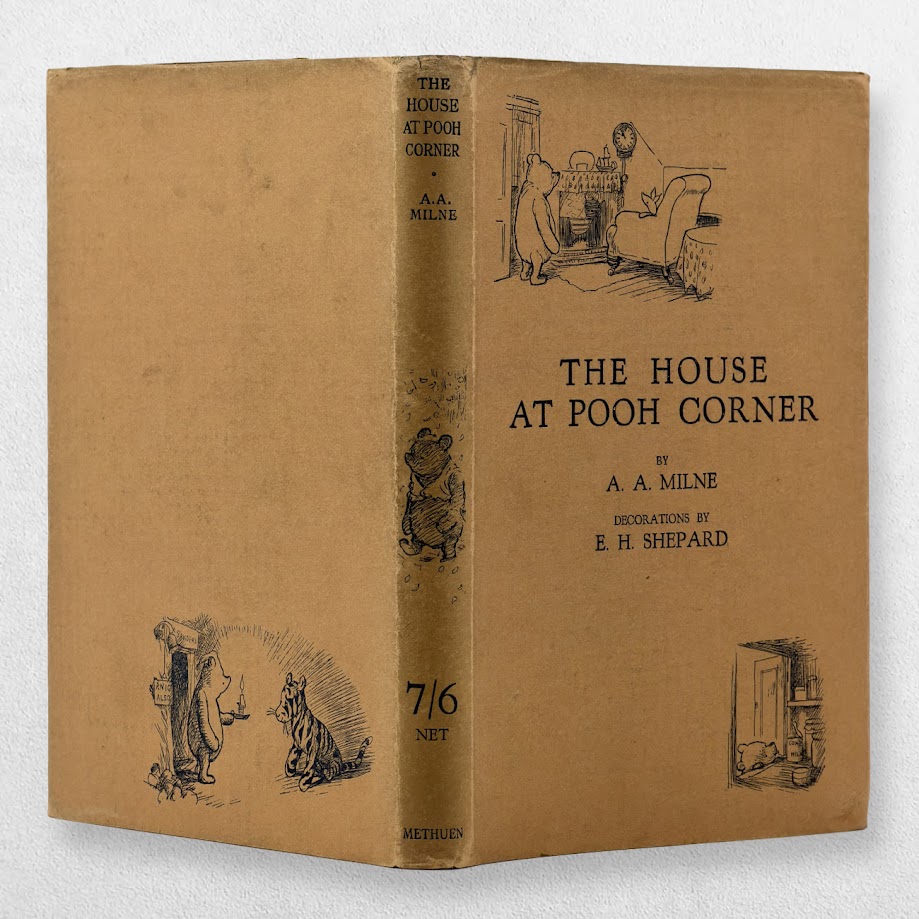
Dustwrapper: Original First-Issue Dustwrapper, Priced 7/6 Net
Condition: Near Fine in Very Good Plus Dustwrapper
Stock Number: 004211
Location: Bookroom
Description
A particularly attractive first edition, first impression of The House at Pooh Corner, A. A. Milne’s final prose volume devoted to Winnie-the-Pooh and the inhabitants of the Hundred Acre Wood, published by Methuen in 1928, with the original illustrations by Ernest H. Shepard.
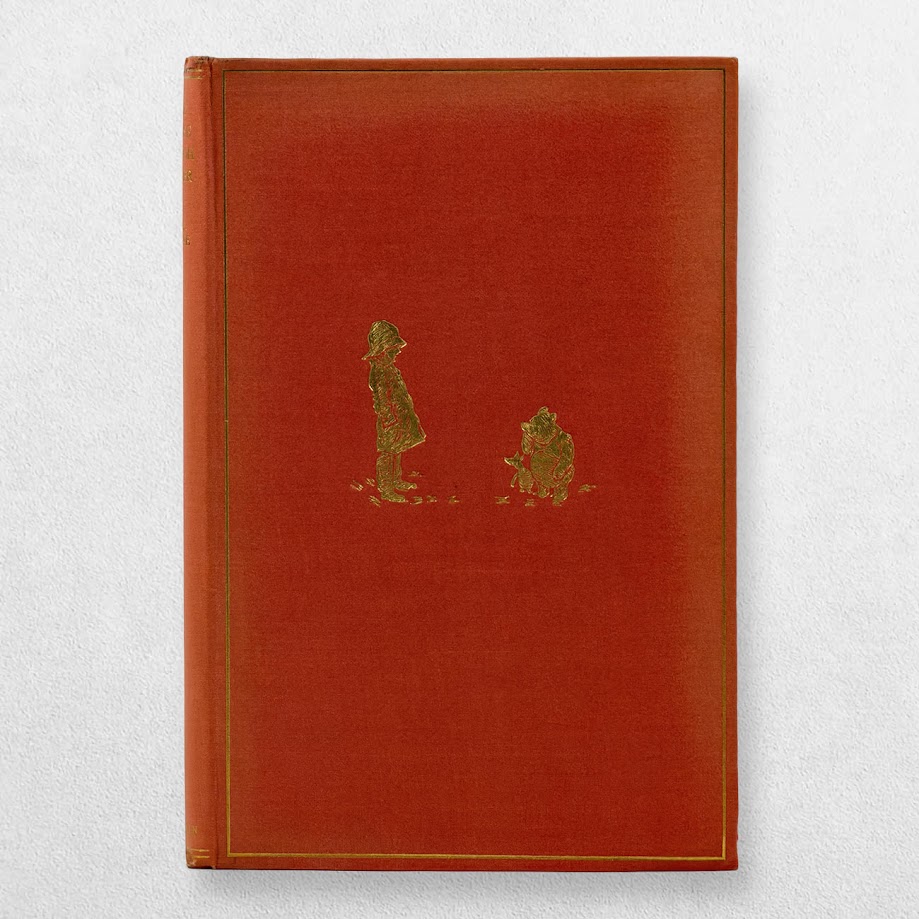
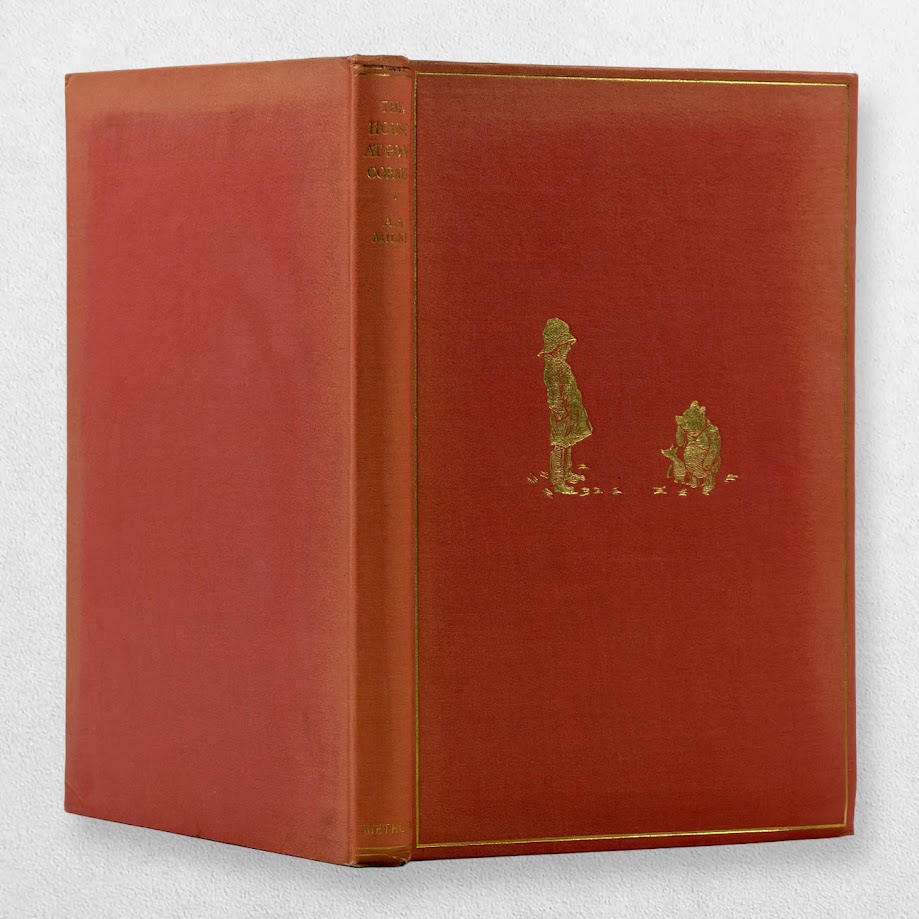
This is a notably well-preserved copy in the original publisher’s salmon-pink cloth, with gilt lettering to the spine and a charming gilt illustration of Christopher Robin and Winnie-the-Pooh to the upper board, enclosed within a gilt border. The top edge is gilt. The binding remains clean, bright and firm, while the pages and illustrations are very fresh.
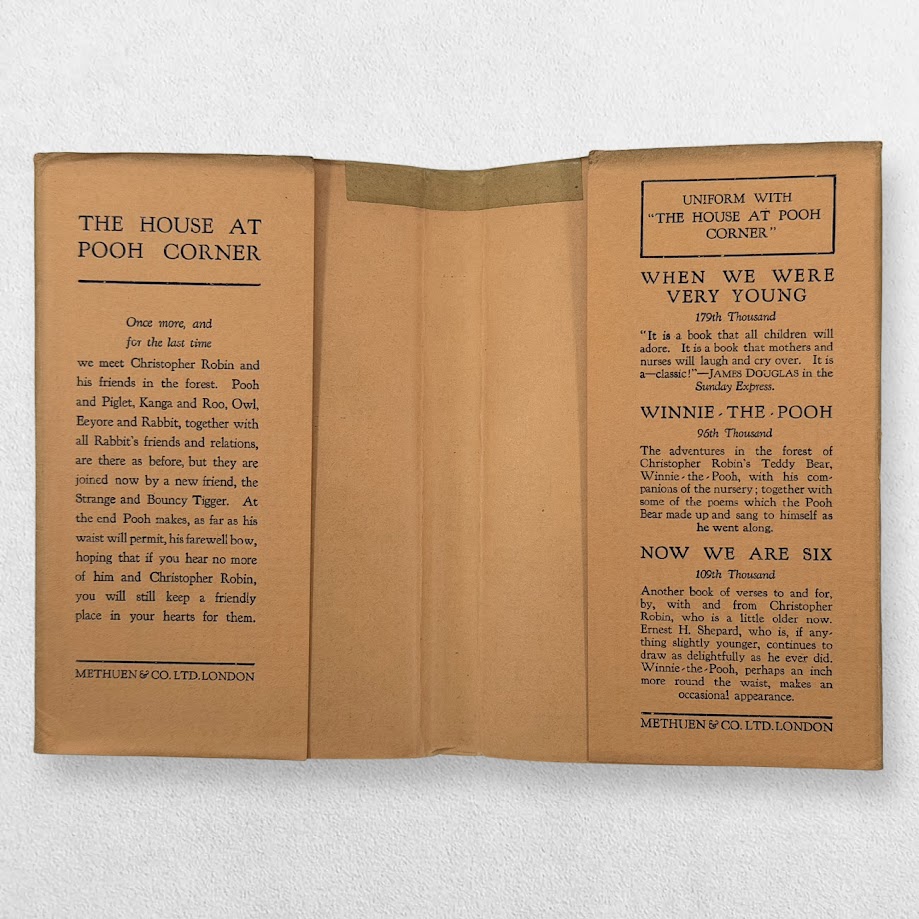
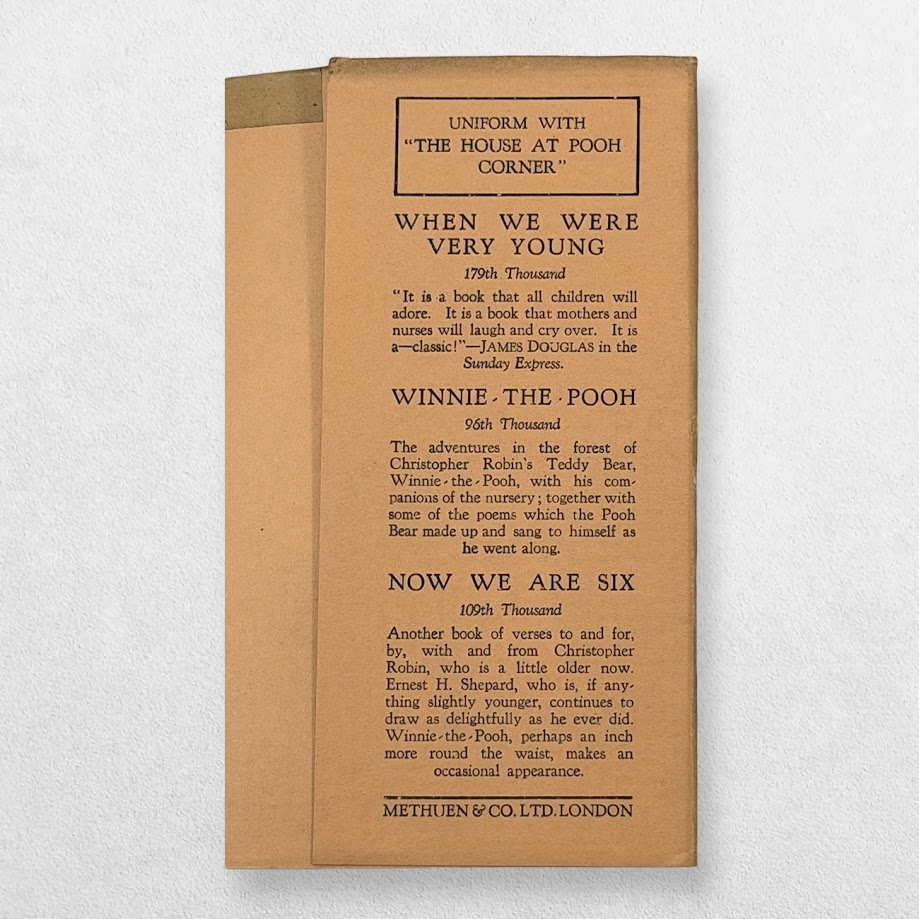
The book retains its original first-issue pictorial dustwrapper, priced 7/6 net to the spine. The rear flap advertises When We Were Very Young as the 179th Thousand, Winnie-the-Pooh as the 96th Thousand, and Now We Are Six as the 109th Thousand. These advertisement figures distinguish the earliest wrapper state; later wrappers alter the figures to 189th Thousand and 105th Thousand respectively. Published on 11 October 1928, The House at Pooh Corner completed the sequence of four books created by Milne and Shepard between 1924 and 1928 and introduced Tigger for the first time. A very handsome copy of one of the defining books of twentieth-century children’s literature, retaining the correct first-issue dustwrapper.
A. Milne and the Creation of the Pooh Books
Alan Alexander Milne (1882–1956) was already a successful playwright, novelist, essayist and contributor to Punch before the extraordinary success of his books for children transformed his literary reputation.
Milne’s collaboration with Ernest H. Shepard began with When We Were Very Young in 1924, followed by Winnie-the-Pooh in 1926, Now We Are Six in 1927 and finally The House at Pooh Corner in 1928. Together, these four books established one of the most distinctive imaginative worlds in modern children’s literature. The inspiration for the Pooh stories came from the childhood toys of Milne’s son, Christopher Robin Milne, and from the landscape surrounding the Milne family’s country home at Cotchford Farm near Ashdown Forest in Sussex. Christopher Robin’s teddy bear, originally called Edward Bear, became Winnie-the-Pooh, while other toys provided the models for Piglet, Eeyore, Kanga and Tigger. Milne transformed these familiar objects into a fictional community whose personalities are drawn with unusual subtlety. The apparently simple adventures of Pooh and his friends combine humour with observations about friendship, anxiety, vanity, loyalty, courage and the gradual passing of childhood.
The Final Winnie-the-Pooh Book
The House at Pooh Corner is the second and final prose Pooh book and the concluding volume in Milne’s original sequence.
Published on 11 October 1928, it contains ten chapters and returns to the familiar world of Pooh, Piglet, Rabbit, Eeyore, Owl, Kanga, Roo and Christopher Robin. The book begins with the construction of a house for Eeyore at Pooh Corner and proceeds through a series of adventures which include the arrival of Tigger, Rabbit’s attempts to manage him, Piglet’s acts of courage, and the game of Poohsticks. The tone is subtly different from that of Winnie-the-Pooh. Although the humour remains, there is a growing awareness that Christopher Robin is becoming older and that the world of childhood cannot remain unchanged indefinitely. This culminates in the final chapter, “In which Christopher Robin and Pooh come to an Enchanted Place, and We Leave Them There”, one of the most moving endings in children’s literature. The conclusion gives the book much of its emotional depth and distinguishes it from the earlier adventures.
The First Appearance of Tigger
One of the most important features of The House at Pooh Corner is the first appearance of Tigger.
Tigger arrives in the second chapter, “In which Tigger comes to the Forest and has breakfast”, introducing a new and exuberant personality into the established group of characters. His boundless confidence, physical energy and tendency to bounce create an immediate contrast with Pooh’s reflective nature, Piglet’s nervousness, Rabbit’s self-importance and Eeyore’s melancholy. Tigger quickly became one of the most recognisable and popular characters in the entire Pooh canon, and his first appearance is an important point for collectors. The book is also notable for its association with Poohsticks, the game played by dropping sticks from one side of a bridge and watching to see which emerges first on the other side. The game has become one of the most enduring elements of the Pooh stories.
Ernest H. Shepard and the Original Illustrations
An essential part of the book’s significance is the contribution of Ernest Howard Shepard (1879–1976), whose pen-and-ink drawings established the definitive appearance of Winnie-the-Pooh and his companions for generations of readers.
Shepard had trained at the Royal Academy Schools and was already well known for his work for Punch. His collaboration with Milne developed into one of the most celebrated partnerships between author and illustrator in British publishing. His drawings for The House at Pooh Corner retain the delicacy and economy of line that distinguish the earlier Pooh books, but the volume also required him to create a new visual personality for Tigger. Shepard’s illustrations are not merely decorative additions to Milne’s text. Gesture, posture and expression contribute directly to characterisation, often adding a layer of humour or tenderness not explicitly stated in the prose.
The partnership between A. A. Milne and E. H. Shepard remains one of the defining achievements of twentieth-century British illustrated children’s literature.
First Edition and the First-Issue Dustwrapper
The present copy is the first edition, first impression of The House at Pooh Corner, published by Methuen in 1928.
It retains the original publisher’s salmon-pink cloth binding, gilt lettering and decoration, pictorial endpapers, top edge gilt and numerous illustrations throughout by Shepard.
The wrapper retains the published price of 7/6 net to the spine and carries the following advertisement figures on the rear flap:
- When We Were Very Young: 179th Thousand
- Winnie-the-Pooh: 96th Thousand
- Now We Are Six: 109th Thousand
These figures identify the first issue of the dustwrapper.
Condition
First Edition, First Impression, 1928. Octavo. Original publisher’s salmon-pink cloth, lettered and pictorially decorated in gilt. Top edge gilt. Original first-issue dustwrapper, priced 7/6 net.
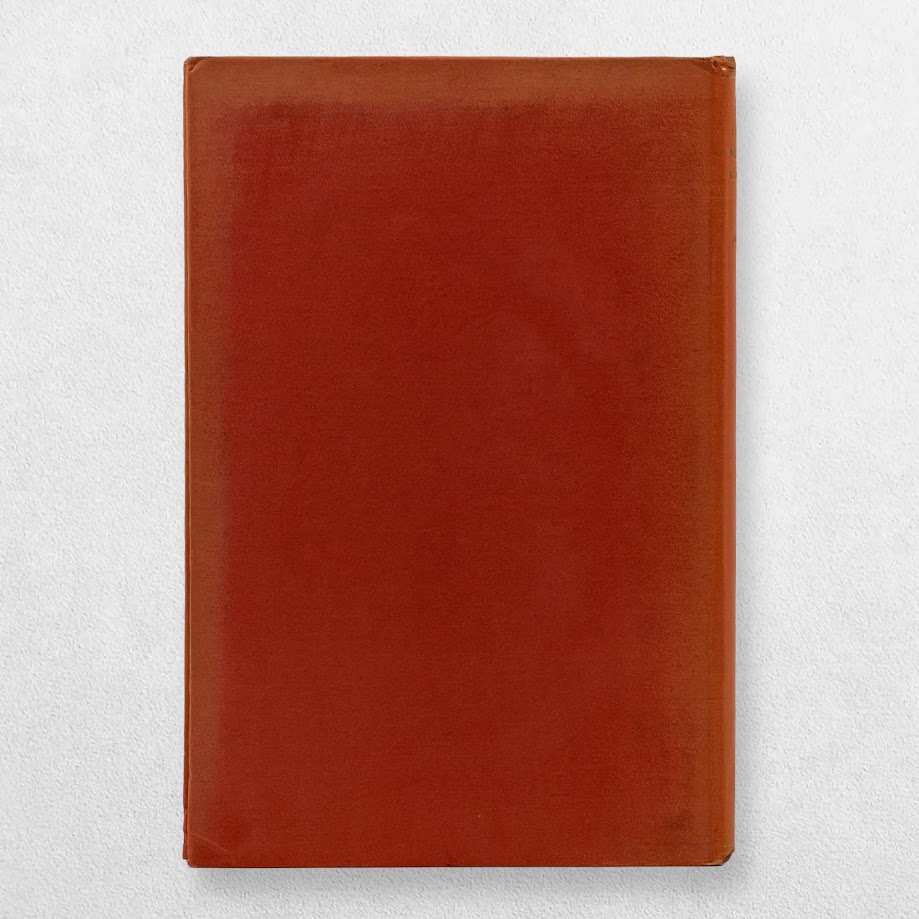
The binding is nice and tight and very clean and bright, with only very minor fading. The gilt decoration and lettering remain clear and attractive. The pages and Ernest H. Shepard illustrations are very nice and clean throughout, with minor offsetting, as usual, to the front free endpaper.
The book is in near fine condition overall.
The original dustwrapper is slightly dusty and rubbed, with minor nicks and light creasing. There are a couple of very short closed tears to the head of the spine which were strengthened to the reverse some time ago. This strengthening could be professionally removed if desired, but it is unobtrusive and certainly does not detract materially from the appearance of the dustwrapper. The original 7/6 net price remains present to the spine, and the rear-flap advertisements identify the wrapper as the first issue.
The dustwrapper is in very good plus condition overall.
The book is now housed in an easily removable clear acetate cover.
A very nice copy indeed of the 1928 first edition of The House at Pooh Corner, retaining the desirable original first-issue dustwrapper. An especially attractive example of the final Pooh book and the first appearance of Tigger.
Stock Number: 004211
Location: Bookroom
Why Buy from Hornseys?
At Hornseys, we specialise in carefully selected children’s books, illustrated books and books for readers of all ages, ranging from much-loved classics and collectable first editions to signed copies, finely illustrated works and unusual titles that are increasingly difficult to find. Every book is individually examined, researched and described before being offered for sale.
Our aim is to provide collectors, readers and gift buyers with clear, accurate information about each book’s edition, condition and bibliographical significance.
- Authenticity and Bibliographical Accuracy: Every book is carefully checked for edition, issue, completeness and relevant points of identification. Where appropriate, signatures, inscriptions, dustwrappers, illustrations and other distinguishing features are researched and described in detail.
- Carefully Selected Stock: Our collection includes classic children’s literature, picture books, illustrated books, juvenile fiction, first and early editions, signed books and other collectable works suitable for children, adults and lifelong collectors. We select books for their quality, interest, condition, scarcity and enduring appeal.
- Detailed Condition Reports: Condition is assessed individually and described as accurately as possible. We record significant faults as well as important features such as original dustwrappers, illustrations, inscriptions and provenance, helping buyers make informed purchasing decisions.
- Established Experience: Hornseys has been dealing in books, art and collectables since 1976. Our Ripon gallery in North Yorkshire reflects nearly fifty years of experience in handling and researching unusual, decorative and collectable material.
- Customer Service and Secure Delivery: We take care over every stage of a purchase, from answering questions and providing further information to careful packing and prompt, secure dispatch.
- Unconditional Returns: Every item is offered with our unconditional guarantee. Books may be returned within fourteen days of receipt for any reason, provided that we are notified in advance and the book is returned in the same condition in which it was supplied. A full refund will then be issued.
Books for Children, Collectors and the Young at Heart
Our stock ranges from traditional children’s classics and beautifully illustrated books to modern favourites, scarce editions and books whose appeal extends well beyond childhood. Whether you are building a collection, replacing a treasured childhood book, searching for a first edition or choosing a distinctive gift, we aim to offer books with lasting interest and character.
Hornseys has welcomed book lovers, collectors and visitors to Ripon since 1976.
Thank you for looking at our collection.
Related products

Paul Blake Or The Story Of A Boy’s Perils In The Islands Of Corsica And Monte Cristo
£145.00Elwes, Alfred (Leighton Binding)
The Gruffalo & The Gruffalo’s Child: First Deluxe Miniature Editions Both Signed By Julia Donaldson & Axel Scheffler
£495.00Donaldson, Julia & Scheffler, Axel


You may also like…
Jan Pieńkowski — Haunted House — First UK Edition, 1979, Inscribed by the Artist
£150.00Pieńkowski, Jan
René Goscinny & Albert Uderzo — Asterix in Corsica — First UK Edition, 1979
£95.00Goscinny, René & Uderzo, Albert
Kay Thompson’s Eloise — First Reprint of the First UK Edition, 1957
£30.00Thompson, Kay & Knight, Hilary